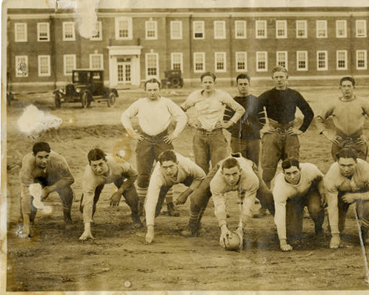
From the Archives: Football at High Point College (1925-1950)
-by Bryan Nicholls, ILL Assistant; Images provided by Laura Silva, Archives Assistant
With the popularity of modern day college football, do you ever wonder why High Point University does not have a football team? Has HPU ever taken to the gridiron? High Point University has not seen or felt the exhilaration that comes with the Friday night lights since 1950 when the school was still High Point College. The football team was disbanded at the end of the 1950 season and, since then, intramural football has been the staple of college students interested in football (Locke, 1975). Despite a 70-year absence from intercollegiate football, today HPC is still known for some of the most historic moments in North Carolina college football. A specific example of this is the 1931 match-up between HPC and NC State; this match was the first night game ever played in NC (Campbell, 1931.)
Beginnings of Football at High Point College: Jack P. Boylin
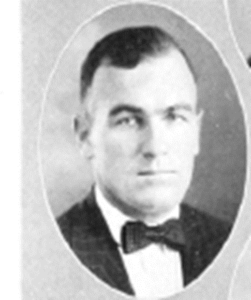
Athletics became prominent at HPC because of the hard work of Jack P. Boylin; his efforts led to the creation of the athletics program at HPC in 1925 (Locke, 1975). While J. P. Boylin receives a lot of credit for the creation of HPC’s first athletics program, it was not a solitary effort. A council of two HPC faculty members and students was created to guide Boylin during this process (McCaslin, 1995). The “Purple Panthers” were finally born in the fall of 1925, and Boylin, who came to HPC from High Point High School in 1924, went on to become one of the most influential coaches in the history of HPC athletics (Mathews, 1930). Boylin was well-known for his tenacity as a coach, boasting that he would “present three sports and win in two,” football being one of the three (McCaslin, 1995). Boylin accomplished his goal in just five short years. Despite being a rather poor driver, Boylin is also known for driving a newly-purchased Dodge (later referred to as “Shenandoah”) from High Point to Duluth to bring recruited players to High Point as cost-effectively as possible. Since there were no conferences or eligibility rules during this time, players were recruited from all over the US. Compared to the original football team at HPC, who were inexperienced and had only a part-time coach, Boylin’s team was a force to be reckoned with (Locke, 1975). Under Boylin’s leadership, HPC would go on to defeat Guilford twice and claim the honor and glory of winning the first North Carolina Conference title (McCaslin, 1995). Boylin also lead HPC to five championship victories during his five years as coach (Mathews, 1930).
Football Coaches at High Point College, 1930-1950
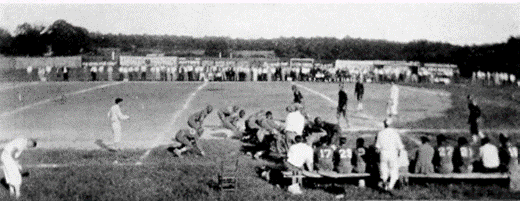
The Purple Panthers changed leadership several times in the 25 years that intercollegiate football was played at HPC. Coach Boylin left HPC in 1930 and was replaced by Julian F. Beall (McCaslin, 1995). Even after Boylin left HPC, the football team would continue to perform admirably (Locke, 1975); despite losing every “little-six” game the year after Boylin’s departure, HPC defeated the American University team 12-0 in the opening game of a new stadium at American University in Washington D.C. in 1931 (Locke, 1975). Coach Virgil Yow became the Panthers’ new coach in 1937 (McCaslin, 1995); Yow, however, was more skilled as a basketball coach and would lead the football team to multiple losing seasons until 1943 (McCaslin, 1995).
Ralph E. James took command of the Panthers in 1945 and coached them to a tie in the first ever Burley Bowl on Thanksgiving Day, 1945. The Panthers would also go on to win the 1945 North Carolina Conference (McCaslin, 1995). It is worth noting that most of the team members coached by James had very little experience on the football field. One of the most notable records that HPC ever set occurred during the final five years of football at HPC. The record was a 107-0 victory against the Pope Field Air Base team in the 1949 season (Locke, 1975.) This victory was somewhat controversial, as several commentators attributed the loss to improperly balanced teams (Locke, 1975).
The Decline of Football at HPC
From 1925-1950, football has been eliminated from the athletics program on three separate instances, which range from financial difficulties to all-out war. In 1933, despite an admirable performance record, football would ultimately be dropped by HPC due to low interest and difficulties with finances (McCaslin, 1995). HPC would not be without a football team for long, though. In 1937, HPC welcomed back their football team after being gone for only four short years (Locke, 1975). A contributing factor that led to the return of football at HPC was the newly constructed Albion-Millis Stadium (Locke, 1975); the stadium was named after Henry Albion-Millis, a former president of the HPC Board of Trustees (McCaslin, 1995).
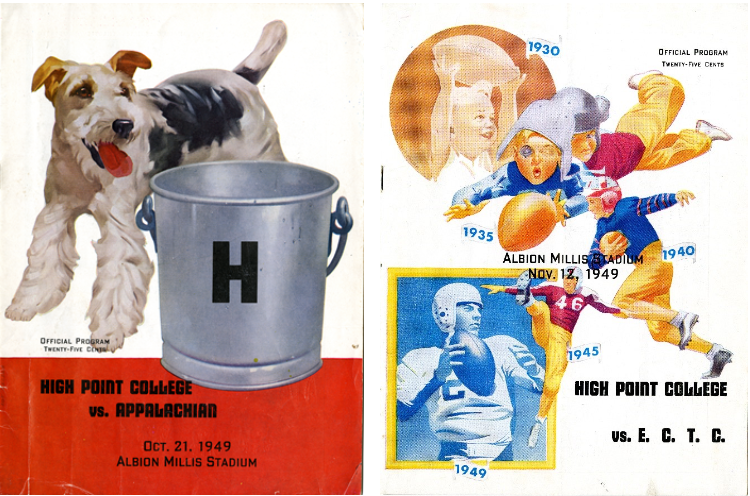
Despite having a brand new stadium, HPC Football’s return was short-lived. 1940 saw the beginning of selective service and the declaration of war in 1941, which dramatically decreased enrollment levels at HPC (Locke, 1975); enrollment fell to a staggeringly low count of 280 in 1943 (High Point University, 2018). As one might expect, wartime also had an effect on the athletic program at HPC. Football would be dropped for the second time in 1943 due to the war. Despite the 1945 revival of the HPC Panthers, ultimately, football would be eliminated for the third and final time in the Fall of 1950 due to a lack of funding. HPC is known to have spent $80,000 in its effort to keep the football program going in the years after WWII (Locke, 1975). While football was only offered at HPC for a very short time, its history is both exhilarating and formative; the work of J. P. Boylin set the stage not only for the football team but also for all sports played at HPU today. For more information, check out the books No easy task: The first fifty years of High Point College and Remembered be thy blessings: High Point University – the college years, 1924-1991
(Note: All images are courtesy of HPU Libraries Archives)
References
Campbell, Hart (1931.) The 1931 Zenith. High Point College.
High Point University. (2018.) World War II Roll of Honor. Retrieved January 18, 2020 from http://www.highpoint.edu/library/wwii-roll-of-honor/
Locke, W. (1975). No easy task: The first fifty years of High Point College. High Point College.
Mathews, T. Olin (1930.) The 1930 Zenith. High Point College
McCaslin, R. (1995). Remembered be thy blessings: High Point University – the college years, 1924-1991. High Point University.