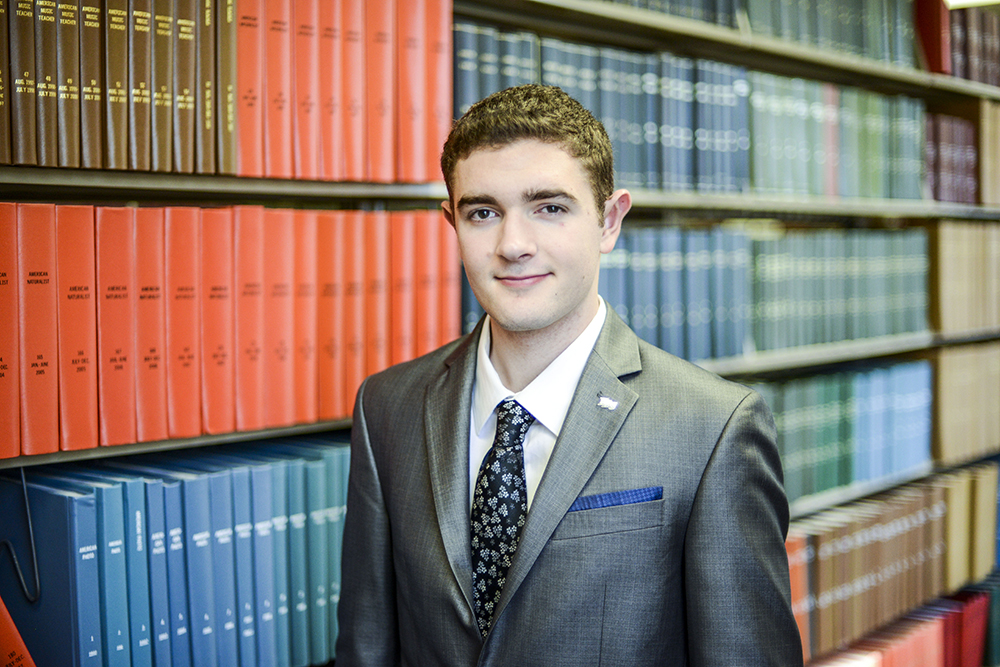
HIGH POINT, N.C., Dec. 10, 2015 – As technology plays a bigger role in the medical field, greater emphasis will need to be placed on a patient’s need for personal interaction and human empathy. High Point University sophomore Noah Coates will be exploring ways to improve this thanks to a research grant he received at the State of North Carolina Research and Creativity Symposium on Nov. 14.
The George T. Barthalmus Undergraduate Research Grant, awarded to 10 students from universities in North Carolina, is supporting his project, “Psychological Benefits of Narrative Medicine on Older Adults.” Coates, a biology major and English minor from Douglassville, Pennsylvania, is pursing this interdisciplinary research to see how writing can provide psychological, emotional and physical health benefits for adults and children.
“Physicians spend a limited amount of time with patients, and when they are with them, a computer is usually in front of them for taking notes or looking at charts,” Coates says. “Providing holistic, quality health care is about more than just physical health. Sometimes all we want as humans is to know that someone cares.”
With plans to pursue a medical education and become a doctor, Coates first learned about narrative medicine when he took a service learning course with English instructor Allison Walker. The class hosts the HPU LifeLines group poetry and creative writing workshops for Alzheimer’s and dementia patients at Pennybyrn at Maryfield retirement community. Coates will conduct his research through those sessions as well as the HPU Community Writing Center’s work with elementary students.
“My research could improve the health care system by showing that a comfortable and supportive environment for patients improves the overall quality of care,” Coates says. “Improved emotional and mental health has been shown to improve the immune system in patients, so indirectly, physical symptoms improve as well.”
Walker, who is serving as a mentor on this project, says Coates’ love for writing and future career in medicine embody the true spirit of narrative medicine – an interdisciplinary approach that combines the arts and sciences.
“Noah has already given nearly 50 hours of service to our workshops at Pennybyrn. Now he’s taking our narrative medicine work beyond the classroom with his own unique research,” Walker says. “Noah is enthusiastic about the potential health benefits of this project. The impact of this grant will be felt not only among the fellow student scholars his work will inspire, but also among a community in desperate need of the kind of empathic health care his research will provide.”
Coates will present the results of his research project at next year’s State of North Carolina Research and Creative Works Symposium in fall 2016.