HIGH POINT, N.C., April 16, 2018 – The gaming experience can be for everyone, including people with visual impairments.
That’s the hope a High Point University student group had when they set out to create an elevator-murder-mystery video game that’s accessible to visually impaired players through a process called audio description (AD).
Students from HPU’s Interactive Media and Design Program have been invited to present their game, “Levy,” to industry experts on April 19 at the East Coast Game Conference (ECGC) in Raleigh. The conference is the largest gathering of video game professionals on the East Coast.
The invitation is an important milestone in the group’s yearlong journey, which isn’t over yet, according to Dan St. Germain, a senior at HPU and one of the team’s presenters.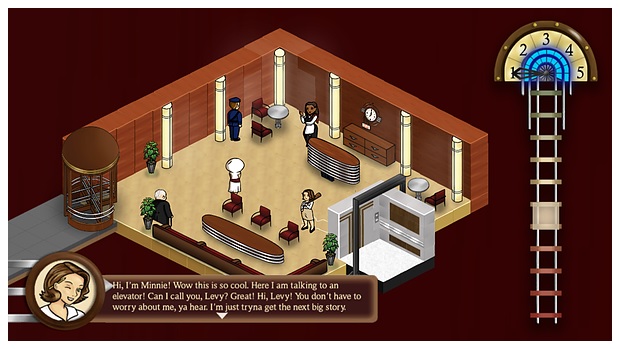
“We attended ECGC last year, so it’s very different and a big honor to be invited back to deliver a presentation about our game,” says St. Germain, originally from Southborough, Massachusetts. “We have previously spoken at three other conferences, including one in England, so it’s very jarring how far this project has taken us. We were a group of students who got together and decided to make a game, and now it’s turned into something impactful.”
The students began making the game a year ago during the spring 2017 semester. Contributors include St. Germain and senior Alex Lambright, as well as 2017 graduates Taylor Anderson-Barkley, Kira Foglesong and Will Bennett.
The 2017 graduates have gone on to impressive careers and graduate schools – Foglesong is pursuing a master’s degree in digital production arts at Clemson University; Anderson-Barkley works in quality assurance for Adult Swim Games; and Bennett is a verification engineer at Cree Inc. But they will return to Raleigh to represent the group along with St. Germain.
The video game is publicly available in a beta state, but the group continues to tweak it based on feedback from users. They now understand the importance of game creation for people with disabilities.




“Designing a game to be accessible to the visually impaired was challenging and required planning and pre-planning from the ground up,” St. Germain says. “It’s significantly more difficult for video games to be made accessible rather than things like film, which already has subtitles and other features. Games face unique issues with regards to accessibility, but it by no means is impossible. And it’s very important for us to think about an entire market that doesn’t get to experience a certain form of art.”
Another unique aspect of the game is its non-linear storyline. Players can make a variety of choices throughout the game that will lead to different outcomes.
Brian Heagney, the group’s faculty advisor and instructor in the Nido R. Qubein School of Communication, says that’s one of the game’s most unique aspects.
“What these HPU students did that was innovative was to apply audio description techniques that were designed for linear media, such as television and movies, to a non-linear video game,” says Heagney. “As a research project into how video games can be audio described for visually impaired players, it presents a lot of great ideas and is noteworthy.”
Heagney, who will accompany the team to the conference, says the multiple invitations they’ve received to present reflect the importance of their work.
“I’ve been going to this conference for five years, and I don’t think I have ever noticed a student speaker or presenter in their own timeslot,” Heagney says. “It’s a professional conference where industry experts present relevant skills and concepts, so the fact that our students have been invited to present is actually quite extraordinary.”