High Point University hosted a two-day open house event inside the new BEACON Lab. The lab is housed inside HPU’s Nido R. Qubein School of Communication and is a space for students to use biosensors to measure emotions while a participant is looking at a computer screen.
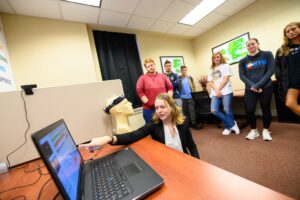
HIGH POINT, N.C., Nov. 19, 2019 – Over the past two days, High Point University students were introduced to new technology that gives them a cutting edge advantage in conducting undergraduate research.
HPU’s new BEACON Lab is a space in the Nido R. Qubein School of Communication which stands for biometric evaluation, analytics, cognitive observation and neuromarketing. While it’s a collaborative effort between HPU’s Earl N. Phillips School of Business and School of Communication, any and all schools and majors can utilize the lab.
“We can benefit from this lab so much because we can see the behavior behind how people react to certain images,” said Ally Patterson, a junior broadcast journalism major. “When we’re creating advertisements, commercials and other projects, we will be able to see real-time reactions.”
Students use biosensors that measure a participant’s brain activity, heart rate, eye tracking patterns and more while reading or looking at something on the computer screen. The information collected tells students if someone is engaged or not and the type of emotions they are feeling.
iMotions, the company that provides the software in the BEACON Lab, was on hand to introduce the technology to faculty and students.
“Our software combines a lot of data collected into one area,” explained Nam Nguyen, a neuroscience product specialist with iMotions. “If you want to get into this research to better understand not just how people are reporting how they reacted to your content, but actually on a moment-by-moment biometric basis, this can help. We are happy that High Point University invested in this technology, and we think this is where the future of research is going.”
According to iMotions, HPU is among very few North Carolina colleges and universities to have access to publishing biometric research.
“It opens a lot of doors in marketing and social media marketing,” said Sabrina Schrader, a junior strategic communication major. “It’s interesting to see the data live. They were showing us what is happening when someone is asking a question.”