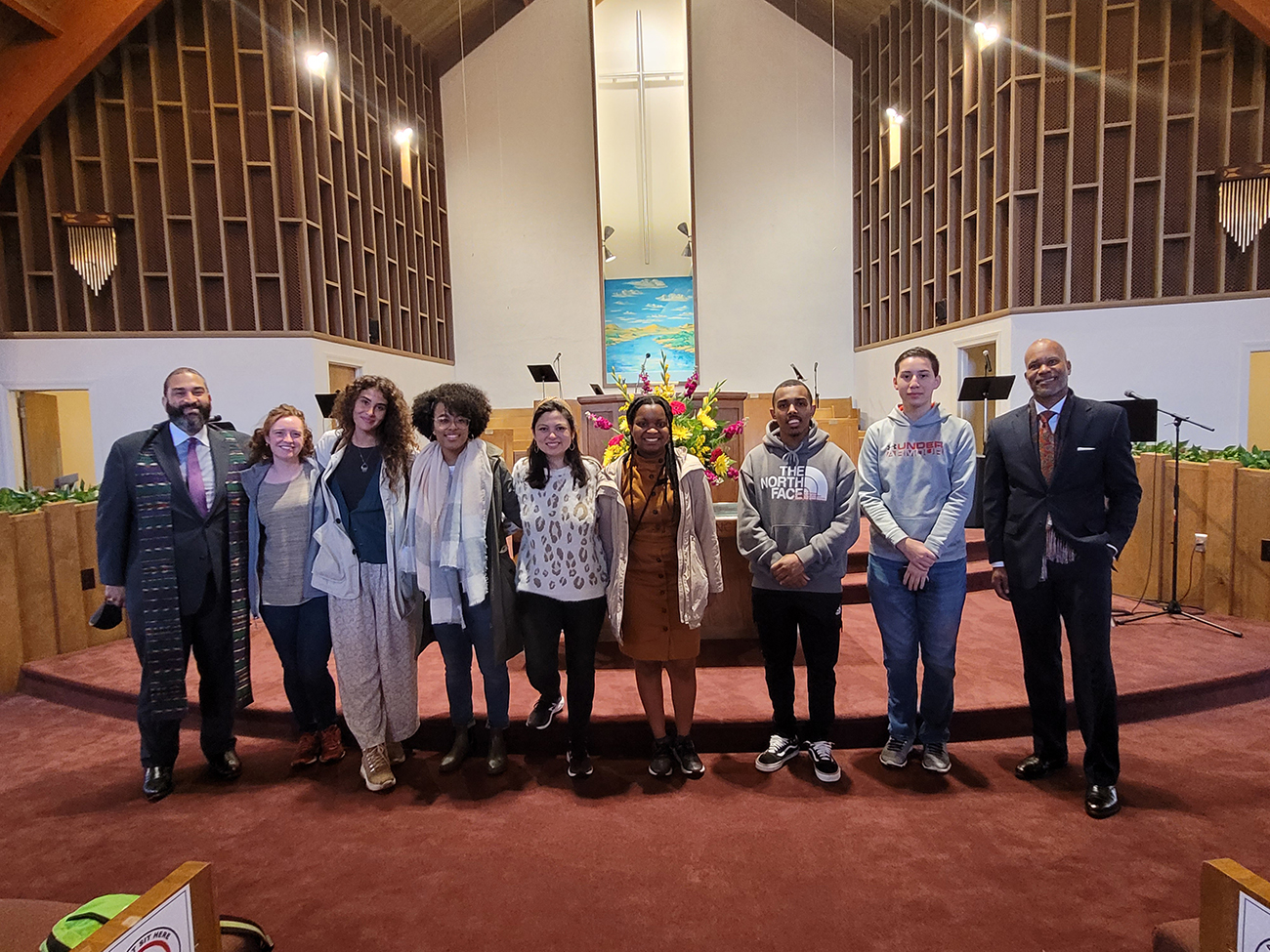
During HPU Pilgrimages, students discovered the importance of faith in the lives of others, as well as their own. When they do, they see firsthand why HPU describes itself as a “God, family, country school.” Students experience God like the oxygen they breathe. He is everywhere they look.
Since 2014, during every fall and spring break, HPU has taken students on pilgrimages to Haiti, New York City, Spain, Houston and Charleston, South Carolina. These trips have helped students grow deeper in their faith, expand their understanding of leadership and become more aware of how faith communities can make an impact wherever they are.
Rev. Dr. Preston Davis sees it happen every Fall or Spring Pilgrimage.
He’ll accompany students from High Point University, and he’ll watch them open up to one another and the world around them. They see how they can make a difference, and they begin to understand how their leadership and their faith can make it happen.
Davis, minister to the university, saw it again a few weeks ago.
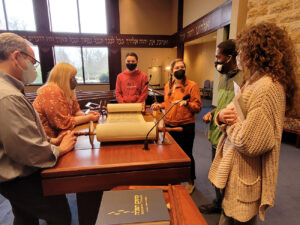
Two groups of High Point University students visited people in Asheville, Greensboro and Winston-Salem, North Carolina, and everywhere they went, they saw how people live out their faith every day. They saw how different communities worship, and they talked with people who help adults with developmental disabilities, address injustice, use art as a spiritual tool and feed the hungry.
“The pilgrimages we take every year deepen the faith of our students,” said Davis, who helped lead the Asheville pilgrimage along with Dr. Chris Franks, chair of the Religion and Philosophy Department. “They see for themselves the importance of what Jesus said: ‘Whatever you do for the least of these, you do for me.’ They get to see the face of Jesus right here and now.”
In Asheville, North Carolina, students met Woodchuck, a man without a home who carries his life in his backpack.
Seeing The Face of Jesus
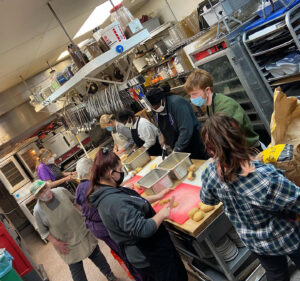
HPU students met Woodchuck at Asheville’s Haywood Street United Methodist Church. He helped them prepare a meal for those in need. He also prepared a meal for himself. He then watched students turn into waiters and waitresses, handing out menus and dropping by each table asking, “May I take your order?”
Around 30 minutes later, Noah Franks, ’25, a graphic design major, and the other HPU students ran into Woodchuck outside the church. When he saw the students, he had something to say.
“Thanks, y’all, for coming and seeing our community,” he told them. “Today is a good day for me. I’ve been 90 days without a seizure and 10 days sober. But the past year has been tough. I’ve lost 44 friends.”
 Later that night, at the home where they were staying, Davis asked the students, “How did God move you today?”
Franks spoke first. He talked about Woodchuck.
“I can’t even fathom losing four friends,” he said, “not to mention 44.”
For Davis, that’s what students see. HPU’s pilgrimages turn into life lessons where students become witnesses of everyday struggle and see people as, according to Davis, “their brothers and sisters.”
The HPU Pilgrimage: A Faith Stabilizer
Near the end of a three-mile hike through downtown Greensboro, North Carolina, after seeing historic sites and reading scripture at every stop, MacKenzie Wiles, ’23, and other HPU students circled up. They gathered behind Greensboro Urban Ministry, a nonprofit that helps shelter and feed people experiencing homelessness.
It was lunchtime outside Potter’s House, the nonprofit’s community kitchen, and people walked out carrying cardboard trays of sandwiches on white bread. Outside nearby, a man slept on the sidewalk, and an arm’s length away sat another man with his head between his knees.
As Olivia Lender, ’23, began reciting verses from a weathered Bible owned by their tour guide, Rev. Frank Dew, the retired chaplain for the Greensboro Urban Ministry, a man rolled up on a scooter.
“Are y’all praying?” he asked. “I just lost my home.”
Wiles invited him into the circle. They all prayed together.
Afterward, Wiles asked the man his name and looked at his eviction notice. He told her about his two dogs, his goldfish and the recent death of his mom. Wiles told him she’d pray for him.
His name was Marlon.
“I wanted to know his name because it comes down to impulse,” said Wiles, a double major in exercise science and Spanish from Advance, North Carolina. “He’s a person, and he was trying to make a connection with us. He wasn’t different from any of us, and he wanted to pray with us.
“I always think ‘What if I was in that situation? How would I react?’”
Wiles had been on four mission trips with her church, going around the country, painting and building homes, visiting the elderly and teaching children Spanish. Back in North Carolina, in downtown Winston-Salem where her dad worked, she has watched him model generosity and buy meals for people on the street.
“We know where our meals are coming from,” he told her. “They don’t.”
The Spring Pilgrimage to Greensboro and Winston-Salem was Wiles’ first.
“It stabilized my faith and helped me become more knowledgeable about our community,” she said of the five-day pilgrimage. “It’s our duty to know the community we live in so that we know how to help.”
Finding Courage, Finding Themselves
It was a Wednesday of their spring break. A few students from the pilgrimage through Greensboro and Winston-Salem gathered on HPU’s Kester International Promenade to talk about what they saw, felt and heard over the pilgrimage.
They talked about their conversations.
“It was so inspiring to hear their ideas,” said Lender, the human relations major from Fort Lauderdale, Florida, about the other students on her first pilgrimage. “You hear how we can make a change and how our generation can make a difference.”
They talked about their discoveries.
“There was a hole in my life that I’ve tried to fill, and I’ve realized God is the answer,” said Aleah Hayes, ’22, from Los Angeles, California. “He’s not an aloof God. He’s relatable, and I like that.
“I grew up with a whitewashed view of Christianity, but over the past few days, I saw how social justice and Christianity can be one of the same,” said Hayes of her first pilgrimage. “That gave me a sense of hope. I can still be an advocate for change.”
They also talked about impact.
“This is one of the best life skills experiences I’ve had in my life, and it happened right here on our pilgrimage,” said Alon Parker, ’22, a Concord, North Carolina native. “It’s prepared me even more for the real world in who I am and who I want to be.”
Parker landed a job with Amazon Web Services as a demand generator representative before graduating. Now living in Arlington, Virginia, he helps companies transition to cloud technology in his role.
The pilgrimage, Parker said, helped prepare him for that next step.
“I know it’ll be challenging being by myself, being an adult and moving away from North Carolina for the first time,” Parker said. “But I now have a stronger relationship with God, and I need that sense of belonging that I didn’t have before the pilgrimage.”
That, said Rev. Andria Williamson, is what the pilgrimage is all about –– helping students see themselves and others deeply, and understand that everyone is a powerful gift.
“College students are at an age of transition, and they may have that sense of discomfort from within,” said Williamson, HPU’s manager for chapel programs who has organized pilgrimages since 2017. “We want to be there to listen, walk with, challenge, nurture and connect them with people and resources that can help them succeed.
“As we journey together, students begin to see a fuller picture of the world and who they are, all while being in a compassionate space to ask tough questions.”
The students do. And they grow in more ways than one, especially after a global pandemic.
“They want to learn, they want to grow, and they want to love each other,” Williamson added. “You can feel that on these trips. They have the courage to ask, ‘How do I do that?’”