A large majority support having armed officers when school is in session.
HIGH POINT, N.C., March 31, 2023 – In a recent High Point University Poll, a large majority (73%) of North Carolinians said school safety is the No. 1 issue for the state government in Raleigh to resolve.
A large majority (74%) of North Carolinians also said they would strongly or somewhat support having one or more armed police officers on duty whenever school is in session. Most poll respondents said they would strongly or somewhat support having metal detectors at all school entrances (76%) and screening all students for mental health problems (68%). Less than 20% of poll respondents somewhat or strongly opposed any of these measures. Less than half (46%) said they supported allowing teachers or other school staff to carry guns in school and 41% opposed this in public schools.
“Schools are where we nurture our nation’s greatest assets,” said Dr. Amy Holcombe, dean of HPU’s Stout School of Education. “Our children deserve the highest levels of security and protection. This includes addressing the root causes of school violence and school shootings. We cannot forget that before they committed these heinous crimes, school shooters were once students, failed by our own system.”
School safety comes ahead of other issues that are very important to most North Carolinians including inflation (68%), health care in general (67%), education (67%), supporting veterans (64%), law enforcement (62%), opioids like Fentanyl (60%), job creation (59%), taxes (59%), civil rights (57%), housing prices (57%), voting integrity (56%), cybersecurity (54%), guns (53%), and agriculture (50%). Less than half of respondents said other issues were very important, including immigration (49%), abortion (48%), climate change (45%), transportation infrastructure (45%), and rural development (36%).
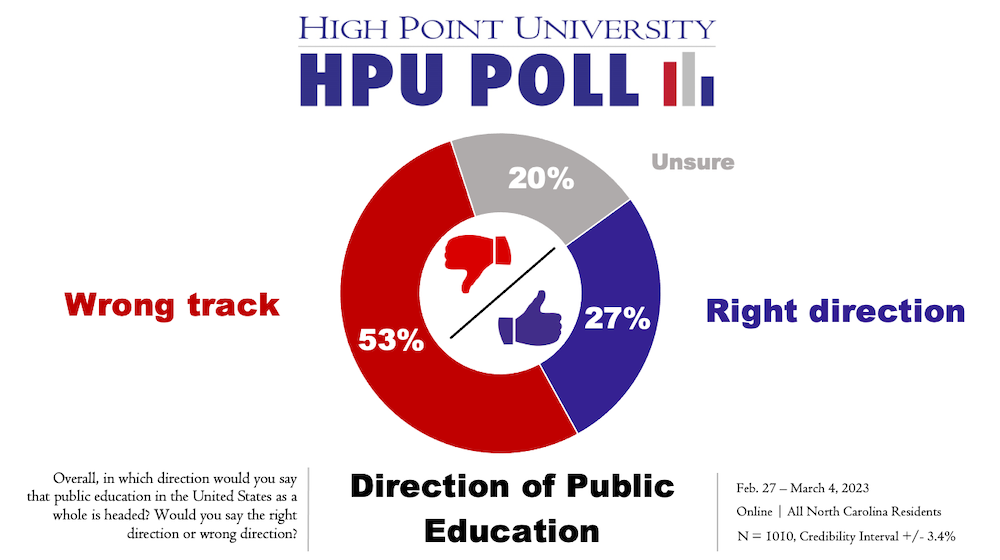
In this statewide survey, 53% of North Carolinians said they think public education in the United States is headed in the wrong direction, and 27% said it is headed in the right direction. Less than one-quarter (20%) did not offer an opinion one way or another. When asked about public education in North Carolina, 47% of North Carolinians said they think public education is headed in the wrong direction, and 29% said it is headed in the right direction. About one-quarter (24%) did not offer an opinion one way or another.
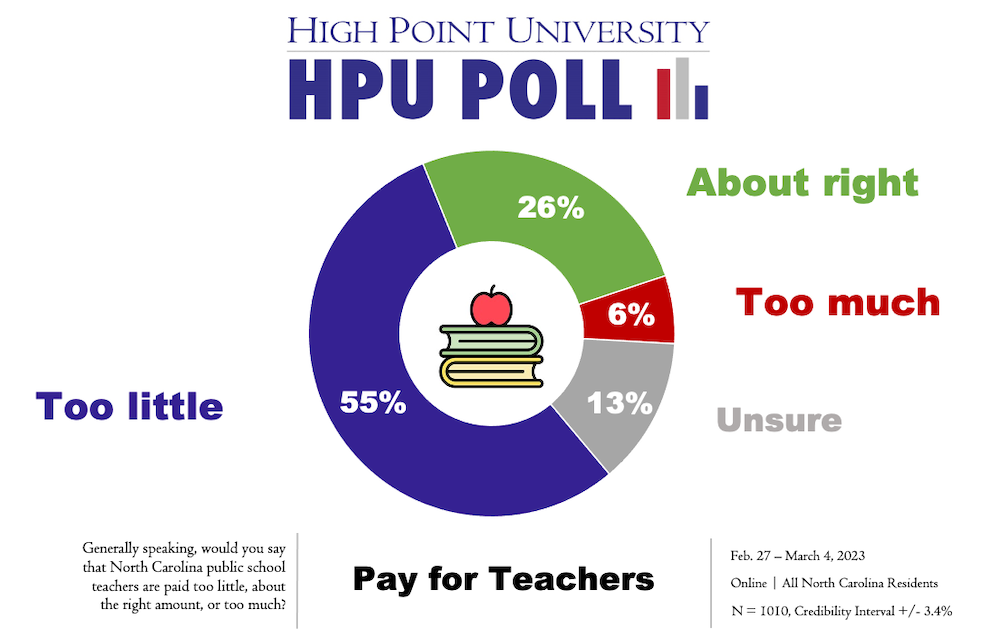
Majorities of North Carolinians said they believe North Carolina teachers are paid too little (55%), and almost half said they would be willing to pay more in taxes to raise teacher pay to the national average within five years (45%).
“The field of education is one that requires significant training and preparation with high accountability for outcomes,” said Holcombe. “Strategic reform of educator compensation models is our greatest lever for attracting and retaining the top talent that can achieve improved outcomes for our students.”
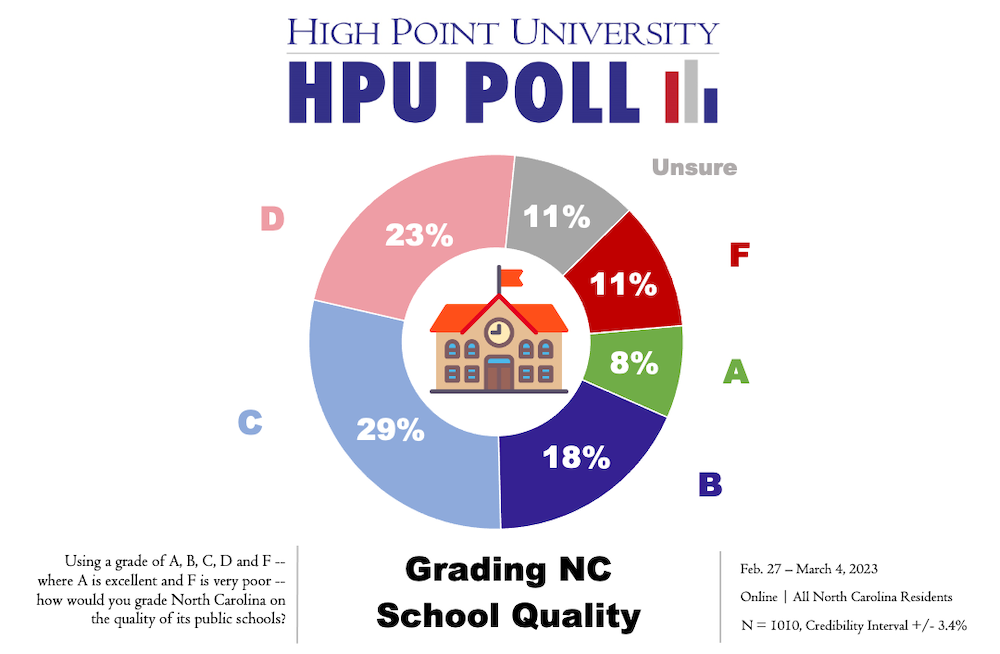
North Carolinians on average gave the United States, North Carolina and their local public schools Cs for their overall quality. When asked, 9% of North Carolina residents said national schools should receive a grade of A on a scale of A to F for their quality, and an additional 16% give national schools a B in overall quality. Only 8% of North Carolina residents said state public schools should receive a grade of A on a scale of A to F for their quality, and 18% gave those same North Carolina public schools a B in overall quality. Only 10% of residents said their local public schools should receive a grade of A on a scale of A to F for their quality, and 22% gave local schools a B for their overall quality.
Half (50%) of North Carolinians said the state should give schools a rating of A to F based on student test scores. Less than one-third (28%) said the state should not give such ratings. An additional 23% did not offer a response one way or another.
 They also believe ratings that report the quality of schools should emphasize overall improvement scores of students more than proficiency scores. More (40%) North Carolinians said they favored grading schools with emphasis on overall improvement rather than on the number of students who attain a proficiency standard (21%). Only about one-quarter (23%) said both.
A little more than one-quarter (28%) of poll respondents said they would want a child of theirs to become a public school teacher in their community, while 43% said they would not. Another 29% offered no opinion.
About two in five (42%) respondents said they have a great deal or a good amount of trust and confidence in public school teachers in their community. About the same amount of North Carolinians (45%) said they have just some or little or no trust in the public school teachers in their community.
These same poll respondents said they have trust and confidence in public school teachers in their community to handle each of these subjects appropriately: U.S. history (46%), civics (44%), media literacy/being informed consumers of news and information (41%), students’ social and emotional growth (36%), racial and ethnic diversity in society (36%), and issues related to gender and sexuality (30%).
Many schools focus on a science, technology, engineering and math (STEM) curriculum. Poll respondents said they either know a lot (21%), a little bit (39%) or not much at all (30%) about the STEM curriculum. When asked how well public schools are preparing students for STEM careers in the global economy, only about a third of North Carolinians said extremely well (10%) or very well (15%). Another quarter said pretty well (27%), and the rest said not very well (21%), or not at all well (7%).
NC residents – Direction of Public Education (March 2023)
Overall, in which direction would you say that public education in the United States as a whole is headed? Would you say the right direction or wrong direction?
Right direction – 27%
Wrong direction – 53%
Unsure – 20%
NC residents – Direction of NC Public Education (March 2023)
Overall, in which direction would you say that public education in North Carolina is headed? Would you say the right direction or wrong direction?
Right direction – 29%
Wrong direction – 47%
Unsure – 24%
NC residents – Grading US School Quality Overall (March 2023)
Students are often given the grades of A, B, C, D, and Fail to denote the quality of their work. Suppose the public schools themselves, in the United States, were graded in the same way. What grade would you give U.S. public schools?
A – 9%
B – 16%
C – 31%
D – 22%
F – 12%
Unsure – 10%
NC residents – Grading North Carolina School Quality Overall (March 2023)
Using a grade of A, B, C, D and F — where A is excellent, and F is very poor — how would you grade North Carolina on the quality of its public schools?
A – 8%
B – 18%
C – 29%
D – 23%
F – 11%
Unsure – 11%
NC residents – Grading Local Public School Quality Overall (March 2023)
Using a grade of A, B, C, D and F — where A is excellent, and F is very poor — how would you grade the quality of your local public schools?
A – 10%
B – 22%
C – 29%
D – 17%
F – 10%
Unsure – 13%
NC residents – State rating for schools (March 2023)
Do you believe that the state should give schools a rating of A, B, C, D, or F based on students’ test scores?
Yes – 50%
No – 28%
Unsure – 23%
NC residents – Improvement versus proficiency (March 2023)
I am going to read two statements about how to rate the quality of schools. Please tell me whether the first statement or the second statement is closer to your own view.
More emphasis on overall improvement – 40%
More emphasis on how many students attain proficiency – 21%
Neither – 7%
Both – 23%
Unsure – 8%
NC residents – Pay for Teachers (March 2023)
Generally speaking, would you say that North Carolina public school teachers are paid too little, about the right amount, or too much?
Too little – 55%
About right – 26%
Too much – 6%
Unsure – 13%
NC residents – More Taxes to Pay Teachers (March 2023)
Would you be willing to pay more in taxes so that North Carolina teachers would be paid at the level of the national average within five years?
Yes – 45%
No – 22%
Unsure – 34%
NC residents – Teacher as a Career (March 2023)
Would you like a child of yours to become a public school teacher in your community, or not?
Yes – 28%
No – 43%
Unsure – 29%
NC residents – Confidence in Teachers (March 2023)
Overall, how much trust and confidence do you have in the public school teachers in your community?
A great deal of trust – 15%
A good amount of trust – 27%
Just some trust – 9%
Little or no trust – 36%
Unsure – 13%
NC residents – Confidence in Subjects (March 2023)
| How much trust and confidence do you have in public school teachers in your community to handle each of these subjects appropriately? [Items presented in a random order] | |||||
| A great deal | A good amount | Just some | A little or none | Unsure | |
| U.S. history | 19 | 27 | 27 | 16 | 12 |
| Civics (citizenship, democracy, the role of government in society) | 18 | 26 | 27 | 16 | 13 |
| Students’ social and emotional growth | 17 | 26 | 29 | 16 | 12 |
| How the history of racism affects America today | 15 | 21 | 27 | 23 | 14 |
| Racial and ethnic diversity in society | 15 | 21 | 29 | 22 | 14 |
| Media literacy/being informed consumers of news and information | 15 | 26 | 30 | 15 | 14 |
| Issues related to gender and sexuality | 13 | 17 | 27 | 27 | 16 |
NC residents – School Safety (March 2023)
| On another topic, would or do you support or oppose the following at public schools? [Items presented in a random order] | |||||
| Strongly support | Somewhat support | Somewhat oppose | Strongly oppose | Unsure | |
| Having one or more armed police officers on duty whenever school is in session | 47 | 27 | 10 | 6 | 10 |
| Having metal detectors at all school entrances | 46 | 30 | 10 | 5 | 9 |
| Screening all students for mental health problems | 37 | 31 | 13 | 7 | 12 |
| Allowing teachers or other school staff to carry guns in school | 21 | 25 | 16 | 25 | 14 |
NC residents – STEM Knowledge (March 2023)
These days many schools focus on Science, Technology, Engineering, and Math–also known as “STEM”–curriculum. How much would you say you know about the STEM curriculum? Would you say you know a lot, a little bit, or not very much at all about the STEM curriculum?
A lot – 21%
A little bit – 39%
Not much at all – 30%
Unsure – 10%
NC residents – STEM Preparation (March 2023)
How well would you say public schools are preparing students for Science, Technology, Engineering, and Math-also known as “STEM”-careers in the global economy? Would you say extremely well, very well, pretty well, not very well, or not at all well?
Extremely well – 10%
Very well – 15%
Pretty well – 27%
Not very well – 21%
Not at all well – 7%
Unsure – 21%
NC residents – Raleigh Issues (March 2023)
| How important do you think it is for people in Raleigh to deal with each of these issues? Would you say very important, somewhat important, not very important, or not at all important? [Items presented in a random order] | |||||
| Very important | Somewhat important | Not very important | Not at all important | Unsure | |
| School safety | 73 | 16 | 4 | 1 | 6 |
| Inflation | 68 | 19 | 4 | 3 | 6 |
| Health care in general | 67 | 21 | 5 | 1 | 6 |
| Education | 67 | 21 | 5 | 2 | 6 |
| Supporting veterans | 64 | 22 | 5 | 3 | 6 |
| Law enforcement | 62 | 21 | 9 | 2 | 6 |
| Opioids like Fentanyl | 60 | 20 | 7 | 4 | 9 |
| Job creation | 59 | 28 | 6 | 1 | 6 |
| Taxes | 59 | 25 | 7 | 2 | 7 |
| Civil rights | 57 | 23 | 10 | 3 | 7 |
| Housing prices | 57 | 25 | 9 | 3 | 6 |
| Voting integrity | 56 | 22 | 12 | 3 | 8 |
| Cybersecurity | 54 | 28 | 8 | 3 | 8 |
| Guns | 53 | 19 | 13 | 8 | 7 |
| Agriculture | 50 | 32 | 8 | 2 | 8 |
| Immigration | 49 | 26 | 12 | 5 | 8 |
| Abortion | 48 | 21 | 12 | 10 | 9 |
| Climate change | 45 | 22 | 14 | 13 | 7 |
| Transportation infrastructure | 45 | 35 | 9 | 3 | 8 |
| Rural development | 36 | 33 | 17 | 5 | 9 |
The most recent HPU Poll of 1,010 respondents was fielded by the High Point University Survey Research Center on Feb. 27 through March 4, as an online survey using a panel of respondents recruited and maintained by Dynata. Dynata sent invitations to its panel of N.C. respondents and the SRC collected responses on its Qualtrics platform. The SRC did all data analysis. The online sample is from a panel of respondents, and their participation does not adhere to usual assumptions associated with random selection. Therefore, it is not appropriate to assign a classic margin of sampling error for the results. In this case, the SRC provides a credibility interval of plus or minus 3.4 percentage points to account for a traditional 95% confidence interval for the estimates (plus or minus 3.1 percentage points) and a design effect of 1.2 (based on the weighting). The data is weighed toward population estimates for age, gender, race/ethnicity and education based on U.S. Census numbers for North Carolina. Factors such as question wording and other methodological choices in conducting survey research can introduce additional errors into the findings of opinion polls.
Further results and methodological details from the most recent survey and past surveys can be found at the Survey Research Center website. The materials online include past press releases as well as memos summarizing the findings (including approval ratings) for each poll since 2010.
The HPU Poll reports methodological details in accordance with the standards set out by AAPOR’s Transparency Initiative, and the HPU Survey Research Center is a Charter Member of the Initiative.
You can follow the HPU Poll on Twitter.
Dr. Martin Kifer, chair and associate professor of political science, serves as the director of the HPU Poll, and Brian McDonald is the associate director of the HPU Poll.