
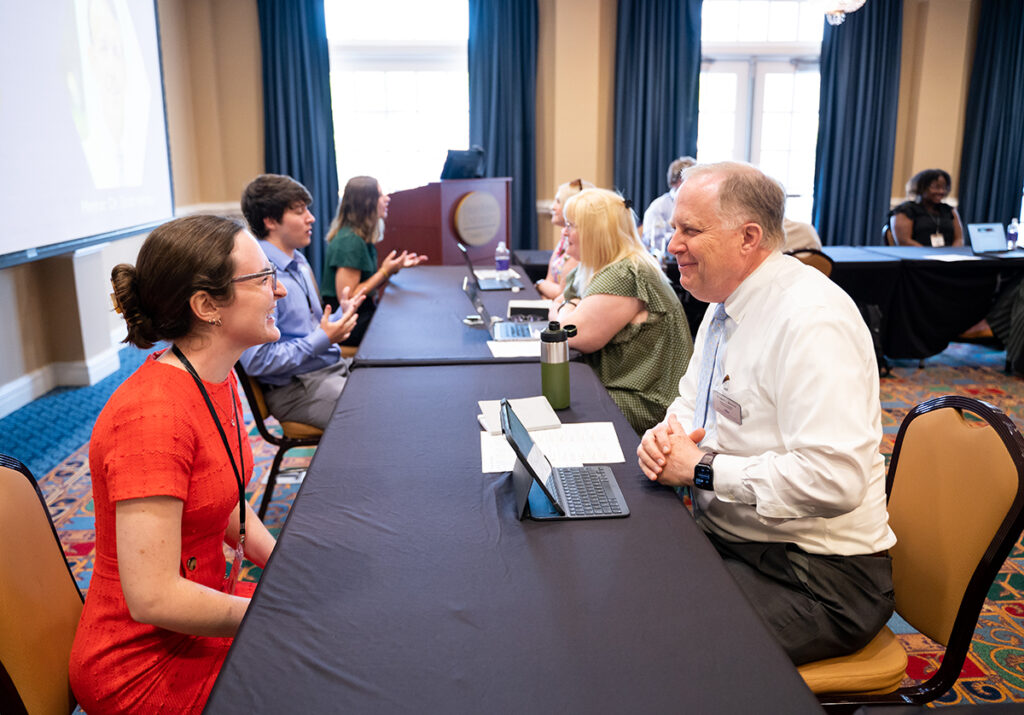
Pictured at front center, Catherine Waldeck, a junior psychology major from Wrentham, Massachusetts, greets an HPU staff member as students change seats to start a 90-second elevator pitch during the SuRI culminating event.
Students finished their research projects with public presentations and elevator-pitch style competitions to hone their life skills.
HIGH POINT, N.C., Aug. 1, 2023 – High Point University students and faculty wrapped up weeks-long summer research on various topics last week. On July 27-28, students presented their findings and results through culminating events in HPU’s unique summer research programs.
Here’s a glimpse at their final presentations and how they grew personally and professionally:
Summer Research Institute (SuRI)
Students who participated in SuRI (Summer Research Institute) took part in a competitive Elevator Pitch event on July 27. The event included 90-second, one-on-one conversations between students and staff members from across campus. The event allowed students to practice explaining why their research matters to people outside of their respective fields, which included history, neurology, pharmacy, natural sciences, biochemistry, criminal justice, religion and virtual production.
Dr. Joanne Altman, professor of psychology and director of HPU’s Undergraduate Research Center and Creative Works, led students through the speed dating-style format. Each of the 18 students received feedback based on their pitch.
“Undergraduate research is so valuable as a college experience because it helps students build the coveted skills employers are looking for in new graduates – especially critical thinking, problem solving and communication,” said Altman. “We double down on honing this skill of communication with our elevator pitch training. It’s not enough for students to be able to communicate within their disciplines. They need to be able to communicate across different ways of thinking and be able to sell themselves and their ideas.”
The judges selected Isabella Maldonado, a rising junior from Jackson Heights, New York, as winner of the elevator pitch competition. Maldonado pitched the topic of researching new medical treatments for opiate addictions.
“Even beyond learning laboratory and testing skills, I’ve learned the importance of communication in the field and reading the literature from other published authors about the same topic, making sure to comprehend and understand what’s out there as much as possible,” said Andrea Zaglin, a sophomore nursing major from Atlanta, Georgia, who teamed up with Maldonado for SuRI. Zaglin thinks the pharmacy-related project will help further her goal of becoming a psychiatric nurse.
Investigating the effect of mental health diagnosis on crime victims’ perceptions was the topic of Kelly Polk, a senior psychology major from Bethany Beach, Delaware. Returning for a second summer, her goal was not only to increase her graduate school chances but possibly change the legal system in a positive way.
“SuRI is a great experience to come alongside other people who are also dedicated to their research,” said Polk. “We’ve done interdisciplinary work with group members from other fields we would usually never work with. We get to create a project, flesh it out and really envision where that research is going to go.”
Interviewing Vietnam veterans was the focus of Jimmy Gallagher, a junior psychology major and business administration minor from Little Falls, New Jersey. He shared why oral histories of Vietnam veterans with combat experience should be important to the public.
“I’ve learned about the whole research process,” said Gallagher. “I think we’ve built an awesome community here that’s more than the research environment. It’s making friends who have similar interests.”
Summer Research Programs in the Sciences (SuRPS)
Students in Summer Research Programs in the Sciences (SuRPS) presented their research on July 27-28 in the Wanek School of Natural Sciences’ lobby and the impressive Culp Planetarium. Fourteen faculty mentors and 32 students from the departments of biology, chemistry, physics and electrical engineering have worked in labs for the past eight weeks to test research. Projects ranged from micro- and molecular biology to fieldwork to nanotechnology.
“The SuRPS program is a valuable experience for the students because they get exposure to trying to uncover the mysteries of cutting-edge scientific questions, working in a team closely with a faculty mentor, and getting to see how their classroom knowledge can be applied to solve scientific problems,” said Dr. Brian Augustine, professor of chemistry and dean of the Wanek School of Natural Sciences.
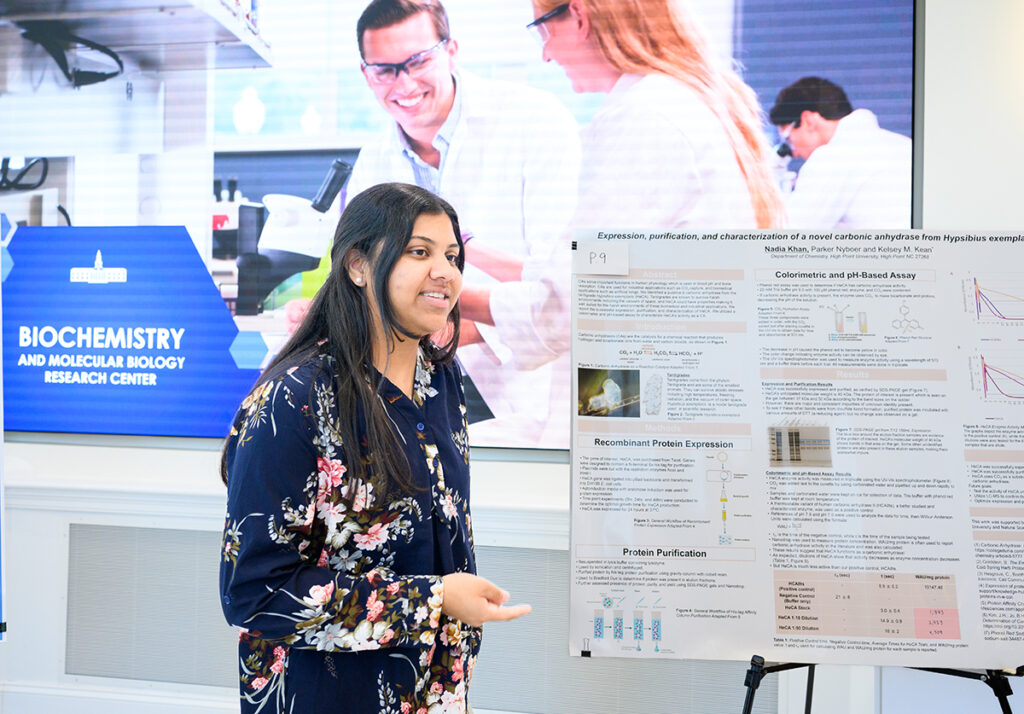
Teagan Graham, a junior physics major from Bedford, New Hampshire, said participating in SuRPS taught him technical skills for conducting research. He also learned from Dr. Briana Fiser, chair and associate professor of physics, and Dr. Brad Barlow, associate professor of astrophysics, that uncertainty does not disappear during weeks of research on antibiotic-resistant bacteria.
“I’ve learned that making mistakes is definitely part of it,” said Graham. “Uncertainty doesn’t go away once you’re published and that actually made me feel more confident with what I’m doing.”
Micayla Campbell, a senior biology major from High Point, North Carolina, agreed she learned laboratory techniques as she researched biochemical responses in red leaf spots, which commonly accompany plant infections.
“I wanted to be in a lab environment, and through this I was able to get lab practice because that’s what I want to do in my career,” said Campbell.
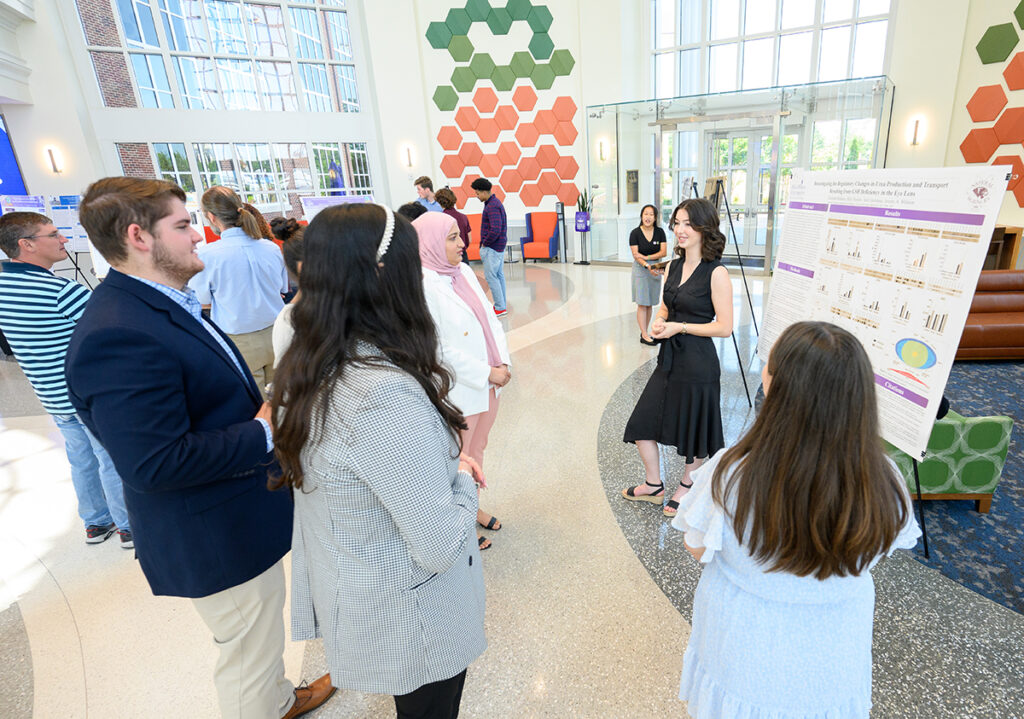
Dr. Kelsey Kean, assistant professor of chemistry and co-director of SuRPS, said the program provides students an immersive experience that supplements what they learn during the academic year.
“They get to know the faculty well on a unique personal level because they work side-by-side with us every day for eight weeks,” said Kean. “We build a sense of community among all SuRPS students and faculty involved. We have a lot of rising sophomores who are getting an intensive research experience early in their academic career, which sets them up to go on to more prestigious external programs in the future.”
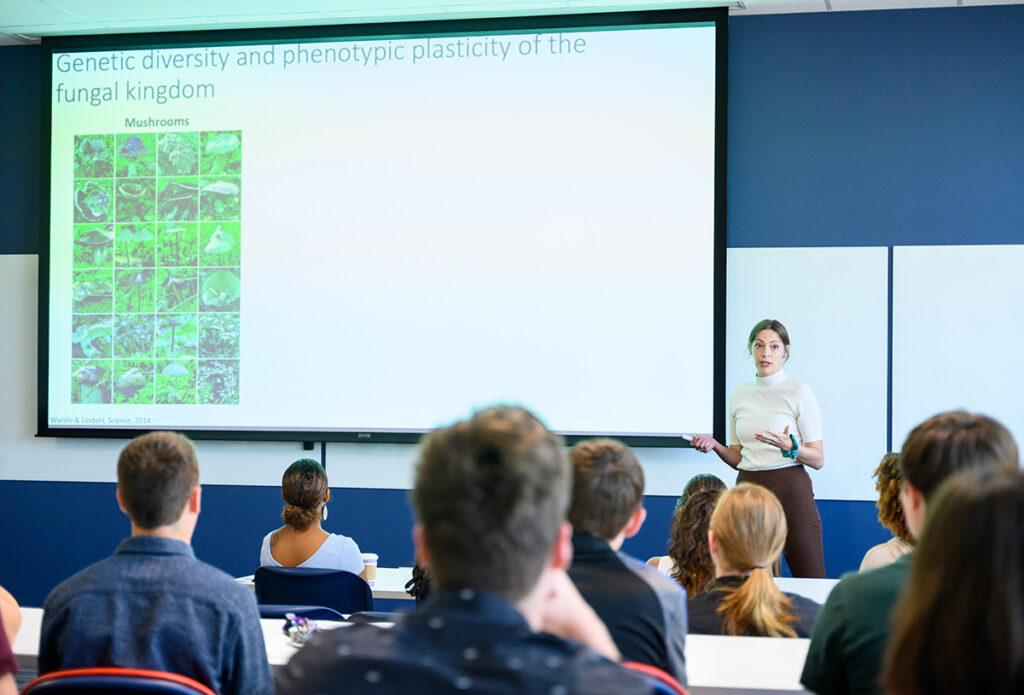
Dr. Calla Telzrow, ’16, a biology graduate who participated in HPU’s first SuRPS when she was a student, said it felt surreal to return to campus as keynote speaker for the students. She received her Ph.D. in microbiology and molecular genetics in 2022 from Duke University and is a senior proposal scientist at PPD, a global research organization that is part of Thermo Fisher Scientific.
“When I participated in SuRPS in 2015, I was incredibly impressed by the keynote speaker and all she had achieved during her graduate career so it’s hard to believe I’m now in a similar position,” said Telzrow. “I’m very grateful for the mentorship I received during SuRPS as this experience allowed me to realize the potential of graduate school and helped me build the skills to be successful there. I hope that by sharing my journey with current SuRPS students, they recognize they have the freedom to explore any of their scientific interests and the potential to succeed in any scientific career they choose.”