HPU Pharmacy Students Get Tested During Mock “Shark Tank” Presentations
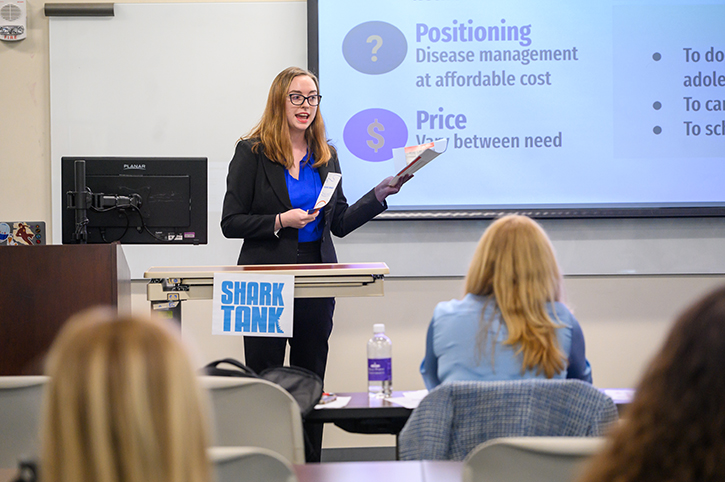
HIGH POINT, N.C., Dec. 13, 2023 – A group of High Point University pharmacy students recently got to experience what it’s like to be put on the spot and answer tough questions from a panel of stakeholders in a mock version of ABC’s “Shark Tank.”
As part of a semester-long project designed to teach business and clinical principles, second-year pharmacy students in an Ambulatory Care Skills course co-coordinated by
Dr. Angela Baalmann teamed up to create fictitious pharmacy service programs designed to treat patients. The teams had to consider every aspect of how to make their programs financially successful, from putting together a detailed budget to creating a catchy clinic name.
The teams then pitched their programs to a mock panel of stakeholders that included a faculty pharmacist and three faculty members from the Earl N. Phillips School of Business – Dr. Christopher Harrington, professor of the practice of management, and Ginger Moore and Lyssa Haynes, professors of the practice of marketing and sales.
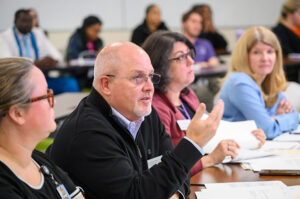
In typical “Shark Tank” fashion, the faculty and other members of the panel asked difficult questions that forced the teams of students to think on the fly and defend the viability of their fictitious programs.
“I felt like this was a really good real-world experience to give them in a safer environment with the faculty who just want them to learn before they actually have to go into the real world, where most people won’t necessarily want them to succeed,” said Baalmann, an assistant professor in the Fred Wilson School of Pharmacy. “I’ve watched ‘Shark Tank,’ and I love it. It’s still relevant for most people their age.”
Teams designed programs to help a wide variety of patients outside of the hospital setting. One program focused on the care of individuals with high cholesterol, while another program was designed to provide protective equipment to prevent chronic obstructive pulmonary disease, better known as COPD, at the workplace.
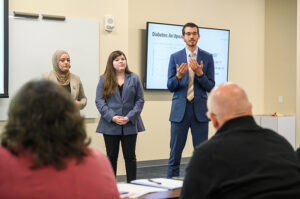
Andrew Cavanaugh, a second-year pharmacy student from Canton, Connecticut, was part of a team that created a fictious program called “Sugar Smart” to help children with diabetes manage their disease. He said his team had never considered the cost to rent and set up utilities in a physical site for “Sugar Smart” until the panel of stakeholders asked them about it during their pitch.
“That was definitely a new experience, a little nerve-wracking, but it was kind of cool to see it from their perspective. It was more business-oriented,” Cavanaugh said. “Usually, we think very clinical. A lot of the questions were targeted towards the feasibility of our program as a business decision, so it was just a different way of thinking.”
The mock panel of stakeholders caught another team by surprise after one of the students in the group mentioned how they would implement artificial intelligence (AI) into the business model for their immunization clinic. The stakeholders jumped on the opportunity to ask the team several questions about AI, which the students hadn’t prepared for leading up to their presentation.
“We haven’t really had any projects like this before, and for me personally, I am not as interested in the clinical side of pharmacy,” said Jenna Brady, a second-year pharmacy student from Newark, Delaware. “I am more interested in industry pharmacy, so this was helpful in allowing me to get both pharmacy and business aspects in one class.”