
A Record Number of Students Showcase Research and Creative Works at High-PURCS
Biology student Lindsey Logan explained her research exploring the molecular mechanisms of endometriosis to investigate why the gynecological condition develops in some women.
HIGH POINT, N.C., April 19, 2024 – A record number of High Point University students shared the results of their long-term research projects at the university’s 12th annual Undergraduate Research and Creativity Symposium on April 16. Known as High-PURCS, the day-long event took place in the Nido and Mariana Qubein Arena and Conference Center and was sponsored by HPU’s Office of Undergraduate Research and Career Works.
A record 300 undergraduate students teamed up to create 196 research presentations across 28 disciplines while being mentored by 80 faculty members at this year’s High-PURCS. They filled the Qubein Arena concourse with poster displays that highlighted their fact-finding investigations during the fall 2023 and spring 2024 semesters. Research ranged from biochemistry and biology to psychology and physics.
High-PURCS allows students to conduct year- and semester-long extracurricular research projects and share their results on campus with other students, faculty and staff. Some teams and solo researchers at this year’s symposium gave oral presentations, while others presented their work using poster-style exhibits. The day-long event also included an hour of dance, vocal and musical performances.
“Students are flexing their professional development skills,” said Dr. Joanne Altman, director of the Office of Undergraduate Research and Creative Works. “These are the skills that will make them the most marketable for their first job. Whether they want to go to graduate school or professional school, this is what they talk about in an interview when they want to show what they know and how they’re passionate. College has not just been classes and tests, but they truly discovered something and shared it with the world.”
Research shows employers are looking for communication, critical-thinking and problem-solving skills. Altman said this event checks all those boxes and is evidence of what students can do for employers and graduate and professional schools.
Lauren Vossen, a sophomore neuroscience major from Lynchburg, Virginia, collaborated with Drs. Heather Miller and Meghan Blackledge to further their research on antibiotic-resistant bacteria. Methicillin-resistant Staphylococcus Aureus (MRSA) is one of the pathogens that develops antibiotic resistance. Vossen and student Halie Balogh presented research about the group’s investigation into how hemolysis genes in MRSA are expressed differently when antibiotic adjuvants are present. Previous research identified loratadine (the active ingredient in Claritin) as an effective adjuvant against MRSA.
In 2022, the National Institutes of Health (NIH) awarded Miller and her team nearly $440,000 to continue research on antibiotic resistant bacteria for three more years. The grant money is being used to help HPU undergraduate students conduct summer research and purchase new instrumentation, reagents and services for laboratories. The end goal is to develop novel treatments to combat persistent and antibiotic-resistant bacterial infections.
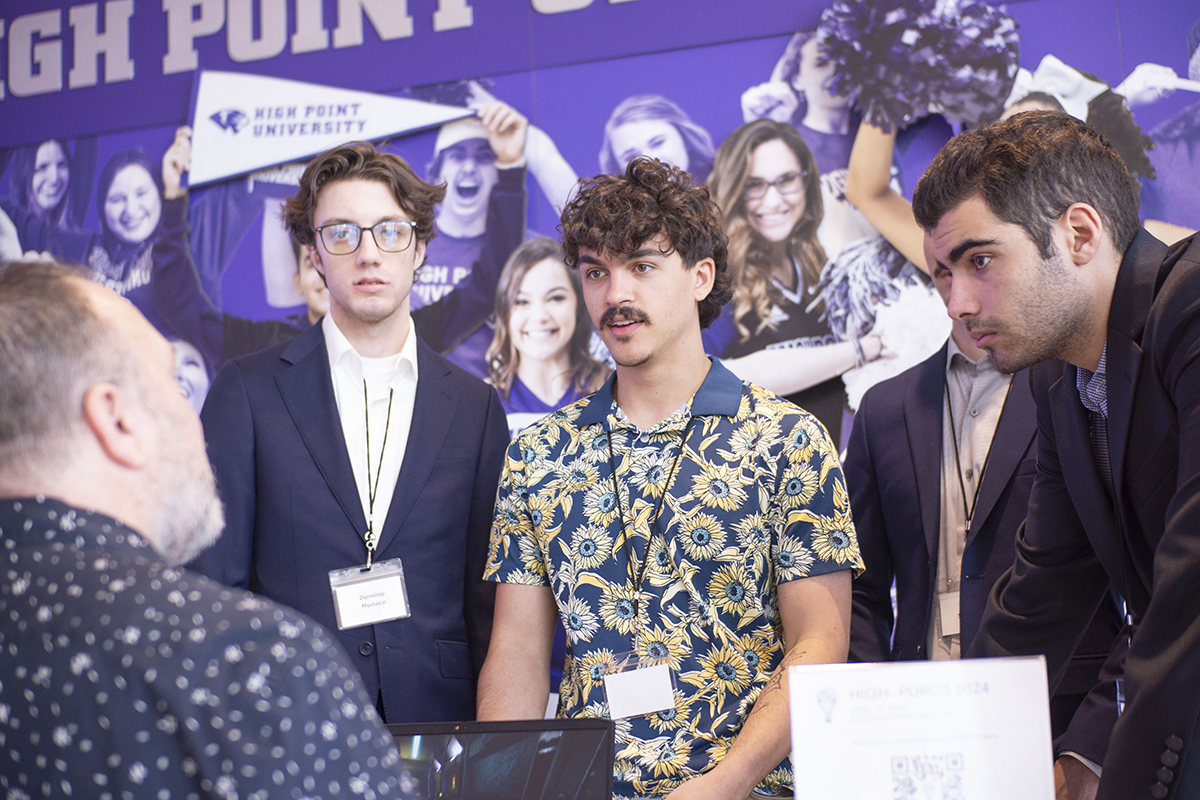
Game design students presented their games in technical exhibits at High-PURCS. Teams of students collaborated with Brian Heagney, assistant professor of game design, to develop original games throughout the semester. Paul Shumlas, a senior game design major from Sparta, New Jersey, was part of a six-member team that developed the game Lux Radorium.
“Everything in this game is from scratch,” Shumlas said. “Our team was able to build everything ourselves with the end goal to make a whole finished game. This is the first time we’ve been able to show the game, see how people react and get feedback.”
Psychology majors Mackenzie Kraras and Catherine Gallagher collaborated with Dr. Kirsten Li-Barber, associate professor and chair of the psychology department, to examine what family dinner experiences are linked with positive mental health outcomes.
“We looked at specific topics of conversation and family dinner rules at the dinner table,” said Kraras, a senior from Philadelphia, Pennsylvania. “We found that topics such as overview of the day and pop culture news, easy topics that can be talked about at the dinner table for a long period of time, tend to have generally the biggest impact on positive mental health. We also found certain family dinner rules have a major impact. Basically, it all came down to everyone at the dinner table feeling equal and comforted. Based on the rules, I would say absolutely no phones at the table, no TV and everyone being present sitting at a round table rather than a square table.”

Junior event management student Charlotte Miller collaborated with Dr. Jessica Wiitala, assistant professor of event management and co-director of HPU’s Communication Fellows, to explore the impact of resilience on event professionals’ willingness to adopt artificial intelligence technology.
“We found the more resilient they are, the higher intention they’ll have to use AI,” said Miller, who is from New Egypt, New Jersey. “I’m trying to make sure professionals know that AI is here to help rather than replace. That’s why I’m also looking at age and gender as a moderator, because I feel like a lot of older generation professionals think AI is bad and don’t want it. As a younger generation, I have seen AI help me with my tasks. Rather than using it to do my job, I’m using it to assist my job.”

Senior biology majors Rhianna Schantz from Long Island, New York, and Rayne Philpott from Wilson, North Carolina, collaborated with Kenneth McKenna, assistant professor of biology, to examine butterfly wing color patterns.
“Butterfly wings are really diverse, and they develop three different symmetry systems,” said Schantz. “There’s a signaling pathway, called Wnt, that affects the central symmetry system. We injected something that inhibits that pathway and it’s a little lighter color, so we know what we injected inhibits what’s developing in that central band. Basically, our findings show the Wnt signaling pathway affects the symmetry system for butterfly wings’ development.”