HPU Poll: North Carolinians Still Concerned about Inflation
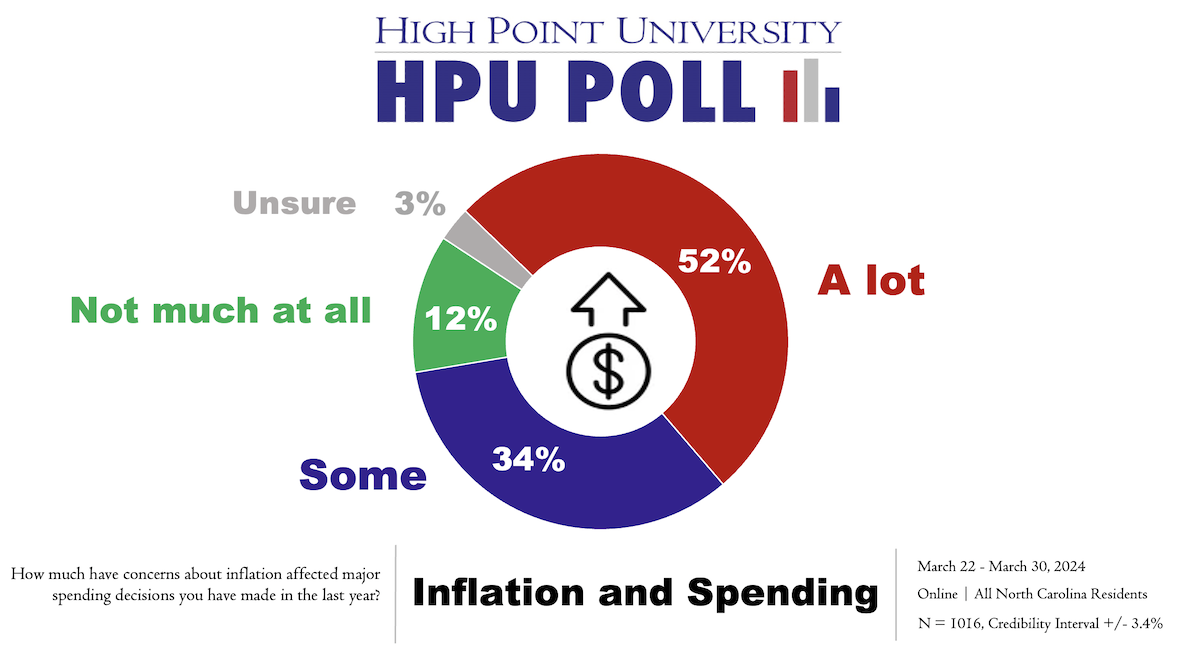
HIGH POINT, N.C., Apr. 19, 2024 – Inflation is still on the minds of North Carolinians interviewed for the latest High Point University Poll. Half (52%) of North Carolina residents responding to the survey said inflation concerns have affected a lot of their spending decisions in the last year. About one-third (34%) said inflation concerns have affected some of their spending decisions, and only 12% said inflation concerns haven’t affected them much at all.
North Carolinians were also asked to consider how the prices they are currently paying for products compared to last year. The majority said prices are much higher for meat (54%). Less than half of the poll respondents said they are paying a much higher price for gas for their cars (47%), electricity for their houses (44%), eggs (44%), fruits and vegetables (41%), milk (39%), bread (38%), clothing (36%), electronics (34%), natural gas for their houses (32%) and water (28%).
Just about two in five (44%) North Carolina residents said the inflation over the past few months had been worse than they expected. Just one-third (31%) said inflation has been about as they expected, and only 21% said inflation has been not as bad as expected.
“The U.S. economy remains robust despite ongoing concerns regarding elevated interest rates and inflation,” said Dr. Nasir Assar, associate professor of economics at HPU. “It seems like measures to address inflation have created a ‘soft landing,’ effectively managing inflation without triggering a recession.”
Consumer Sentiment Remains Low
According to this latest poll, the Consumer Sentiment Index shows North Carolinians’ opinions about the economy and their personal finances remain steady, recorded at 68.6. That number hasn’t changed much from when the HPU Poll last reported an index of 68.0 from the January 2024 poll.
The HPU Poll’s measure of consumer sentiment is an index that comprises five separate questions asking respondents about different aspects of how they view the U.S. economy and their own personal finances.
NC residents – Prices Currently Paying (March 2024)
Thinking about the prices you are currently paying for products on this list compared to last year, would you say prices are much higher, somewhat higher, about the same as last year, somewhat lower or much lower? [Items presented in a random order]
| Much higher price | Somewhat higher price | About the same | Somewhat lower | Much lower | Unsure or don’t buy | |
| Meat | 54 | 28 | 11 | 3 | 1 | 4 |
| Gas for your car | 47 | 29 | 15 | 4 | 1 | 3 |
| Electricity for your house | 44 | 33 | 16 | 2 | 1 | 4 |
| Eggs | 44 | 31 | 15 | 5 | 2 | 4 |
| Fruits and vegetables | 41 | 38 | 15 | 2 | 2 | 3 |
| Milk | 39 | 33 | 20 | 3 | 2 | 5 |
| Bread | 38 | 34 | 21 | 2 | 1 | 4 |
| Clothing | 36 | 32 | 22 | 3 | 1 | 6 |
| Electronics | 34 | 32 | 21 | 3 | 1 | 9 |
| Natural gas for your house | 32 | 23 | 12 | 3 | 1 | 29 |
| Water | 28 | 30 | 30 | 2 | 1 | 9 |
NC residents – Inflation and Spending Decisions (March 2024)
How much have concerns about inflation affected major spending decisions you have made in the last year?
A lot – 52%
Some – 34%
Not much at all – 12%
Unsure – 3%
NC residents – Inflation Expectations (March 2024)
Generally speaking, has the inflation we have seen over the past few months been worse than you expected, not as bad as you expected or about what you expected?
Worse than expected – 44%
Not as bad as expected – 21%
About as expected – 31%
Unsure – 5%
March 2024 Consumer Sentiment Index Results:
We are interested in how people are getting along financially these days. Would you say that you (and your family living there) are better off or worse off financially than you were a year ago?
Better off – 23%
Worse off – 44%
Same/Neither – 29%
Unsure – 4%
Now looking ahead, do you think that a year from now you (and your family living there) will be better off financially, or worse off, or just about the same as now.
Better off – 31%
Worse off – 25%
About the same – 33%
Unsure – 12%
Now turning to business conditions in the country as a whole, do you think that during the next 12 months we’ll have good times financially, or bad times, or what?
Good times – 18%
Bad times – 27%
Neither – 27%
Good times with qualifications – 12%
Bad times with qualifications – 8%
Unsure – 10%
Looking ahead, which would you say is more likely, that in the country as a whole we’ll have continuous good times during the next five years or so, or that we have periods of widespread unemployment or depression, or what?
Widespread unemployment or depression – 22%
Continuous good times – 15%
Neither – 9%
Mix of both – 42%
Unsure – 12%
About the big things people buy for their homes, such as furniture, a refrigerator, stove, television, and things like that. Generally speaking, do you think now is a good time or bad time for people to buy major household items?
Good time – 22%
Bad time – 40%
Neither good time nor bad time – 29%
Unsure – 9%
HPU Poll 102 was fielded by the High Point University Survey Research Center on March 22 through March 30 as an online survey using a panel of respondents recruited and maintained by Dynata. Dynata sent invitations to its panel of N.C. respondents and the SRC collected 1,016 total responses on its Qualtrics platform. The SRC verified that the demographics of this sub-sample were similar to those of the full sample. The SRC did all data analysis. The online sample is from a panel of respondents, and their participation does not adhere to usual assumptions associated with random selection. Therefore, it is not appropriate to assign a classic margin of sampling error for the results. In this case, the SRC provides a credibility interval of plus or minus 3.4 percentage points to account for a traditional 95% confidence interval for the estimates (plus or minus 3.1 percentage points) and a design effect of 1.2 (based on the weighting). The data is weighted toward population estimates for age, gender, race, ethnicity, and education based on U.S. Census numbers for North Carolina. Factors such as question wording and other methodological choices in conducting survey research can introduce additional errors into the findings of opinion polls. Percentages may not add to 100 because of rounding.
Further results and methodological details from the most recent survey and past surveys can be found at the Survey Research Center website. Materials online include past press releases as well as memos summarizing the findings (including approval ratings) for each poll since 2010.
The HPU Poll reports methodological details in accordance with the standards set out by AAPOR’s Transparency Initiative, and the HPU Survey Research Center is a Charter Member of the Initiative.
You can follow the HPU Poll on X.
Dr. Martin Kifer, chair and associate professor of political science, serves as the director of the HPU Poll, and Brian McDonald is the associate director of the HPU Poll.