HPU Poll: Most North Carolinians Know October is Breast Cancer Awareness Month
Only one-quarter (26%) of North Carolinians say they know a lot about breast cancer.
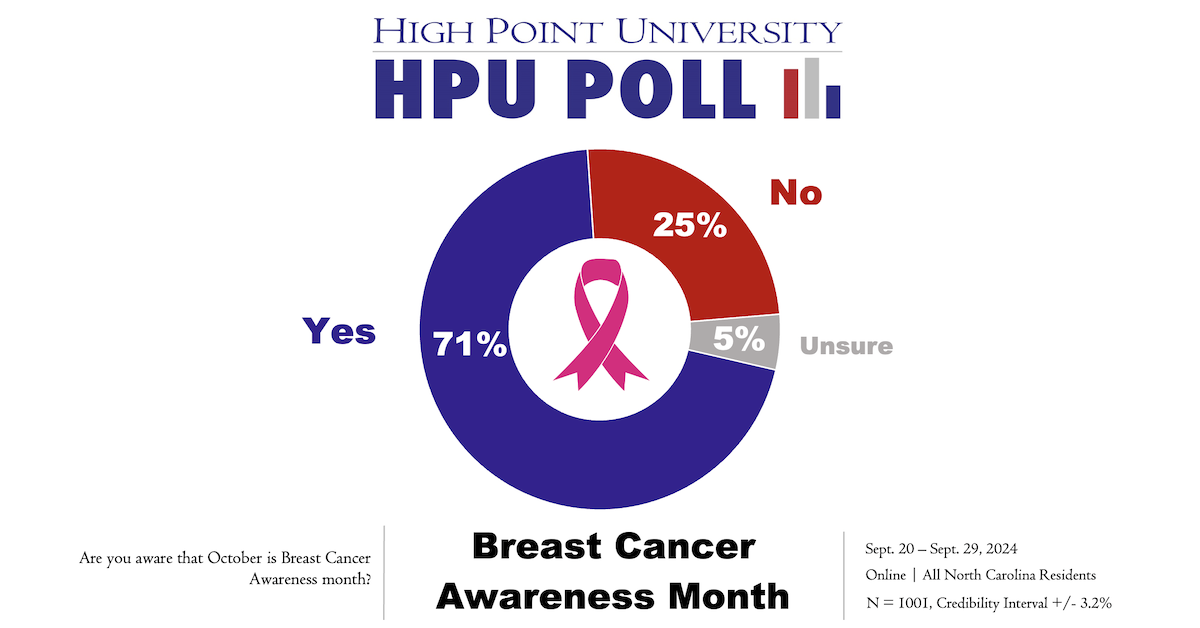
HIGH POINT, N.C., Oct. 25, 2024 – According to a recent High Point University Poll, a large majority of North Carolinians (71%) know that October is Breast Cancer Awareness Month and just more than a quarter (26%) say they know “a lot” about breast cancer.
North Carolinians report knowing less about other common types of cancer. For example, less than a quarter of North Carolina residents say they know “a lot” about cancers of the skin (22%), lungs (21%), prostate (18%), colon (18%), ovaries (15%), brain (14%) and testicles (11%).
“As a professor of Community and Public Health Nursing, the HPU Poll shows encouraging awareness of breast cancer, with 71% of North Carolinians recognizing Breast Cancer Awareness Month,” said Dr. Lorrie R. Davis-Dick, an assistant professor in HPU’s Teresa Caine School of Nursing. “However, the lower awareness of other cancers, such as skin, lung and prostate, highlights the need for broader public health education to promote early detection and prevention across all cancer types.”
North Carolinians were asked whether they or someone close to them had been diagnosed with cancer of some kind. Eight percent of respondents say they have themselves been diagnosed with cancer. Nearly half (48%) say someone close to them had been diagnosed with cancer, and an additional 6% percent say both they and someone else close to them had been diagnosed with cancer.
Of the people who said they had, in fact, been diagnosed with cancer, about one-third (32%) said they had had breast cancer. Less than a third of those respondents who had cancer were diagnosed with cancers of the prostate (25%), colon (21%) or lungs (10%). Another third say they have been diagnosed with some other cancer.
“This data underscores the significant prevalence of breast cancer among those diagnosed with cancer in North Carolina, with 32% reporting a breast cancer diagnosis,” Davis-Dick said. “While prostate, colon and lung cancers also affect many, it’s notable that a considerable portion of individuals face other, less commonly discussed cancers. These findings highlight the importance of personalized care and education for North Carolinians to increase knowledge of all cancer types, ensuring patients receive comprehensive support and awareness across the spectrum of cancer diagnoses.”
For those respondents who had someone close to them diagnosed with cancer, about one in five (21%) say at least one person had been diagnosed with breast cancer. Less than one-fifth of respondents say that at least one person close to them had been diagnosed with cancers of the lungs (11%), prostate (7%) or colon (7%). Another third (33%) say the person close to them had been diagnosed with some other cancer, and 31% preferred not to name the cancer with which the person close to them had been diagnosed.
“The data reveals the deep personal impact of breast cancer, with 21% of respondents having someone close to them diagnosed,” said Davis-Dick. “Similarly, the variety of other cancers affecting loved ones, such as lung, prostate and colon cancers, as well as the 31% who preferred not to name the cancer, underscores the emotional and sensitive nature of a cancer diagnosis. It highlights the need for supportive care and education that respects the personal experiences of patients and their families across all cancer types.”
North Carolina Residents – Knowledge of Types of Cancer (September 2024)
Here is a list of different types of cancer. For each one, please select whether you think you know a lot, a little or not much at all about that type of cancer. [Types of cancer were presented in random order]
| A lot | A little | Not much at all | |
| Breast | 26 | 47 | 27 |
| Skin | 22 | 50 | 29 |
| Lung | 21 | 49 | 30 |
| Prostate | 18 | 43 | 39 |
| Colon | 18 | 46 | 37 |
| Ovarian | 15 | 44 | 41 |
| Brain | 14 | 42 | 45 |
| Testicular | 11 | 38 | 50 |
North Carolina Residents – Cancer Diagnosis (September 2024)
Have you or someone close to you been diagnosed with cancer(s)?
| Yes, me | 8 |
| Yes, someone close to me | 48 |
| Yes, both me and at least one person close to me | 6 |
| No | 36 |
| Prefer not to respond | 3 |
North Carolina Residents – Respondent Type of Cancer Diagnosis (September 2024)
With what type(s) of cancer have you been diagnosed?
[n = 138 for All Adults, n = 123 for Registered Voters (only respondents who indicated they had been diagnosed with cancer). Respondents could indicate any that applied to them]
| All Adults | |
| Prostate | 25 |
| Breast | 32 |
| Colon | 21 |
| Lung | 10 |
| Other | 32 |
| Prefer not to respond | 9 |
North Carolina Residents – Close Friends or Relative Diagnosis (September 2024)
With what type(s) of cancer have people close to you been diagnosed?
[n = 537 for All Adults, n = 439 for Registered Voters (only respondents who indicated someone close to them had been diagnosed with cancer) Respondents could indicate any that applied to them]
| Prostate | 7 |
| Breast | 21 |
| Colon | 7 |
| Lung | 11 |
| Other | 33 |
| Prefer not to respond | 31 |
North Carolina Residents – Breast Cancer Awareness Month (September 2024)
Are you aware that October is Breast Cancer Awareness month?
| Yes | 71 |
| No | 25 |
| Unsure | 5 |
HPU Poll 106 was fielded by the High Point University Survey Research Center on Sept. 20 through Sept. 29, as an online survey using a panel of respondents recruited and maintained by Dynata. Dynata sent invitations to its panel of N.C. respondents and the SRC collected 1,001 responses (an all-adults sample) on its Qualtrics platform. All respondents were asked two screening questions to identify them as registered voters. A total of 814 respondents identified themselves as registered voters. The SRC did all data analysis. The online sample is from a panel of respondents, and their participation does not adhere to usual assumptions associated with random selection. Therefore, it is not appropriate to assign a classic margin of sampling error for the results. In this case, for the all-adults sample, the SRC provides a credibility interval of plus or minus 3.2 percentage points to account for a traditional 95% confidence interval for the estimates (plus or minus 3.1 percentage points) and a design effect of 1.1 (based on the weighting). For the registered voters, the SRC provides a credibility interval of plus or minus 3.6 percentage points to account for a traditional 95% confidence interval for the estimates (plus or minus 3.4 percentage points) and a design effect of 1.1 (based on the weighting). The all-adults data is weighted toward population estimates for age, gender, race, ethnicity, and education based on U.S. Census numbers for North Carolina. The sample was also weighted using a past presidential vote questionnaire item and the North Carolina 2020 presidential election results (North Carolina State Board of Elections https://www.ncsbe.gov/ ). The High Point University Survey Research Center (SRC) produces weights through an iterative procedure within SPSS. Factors such as question wording and other methodological choices in conducting survey research can introduce additional errors into the findings of opinion polls.
Further results and methodological details from the most recent survey and past surveys can be found at the Survey Research Center website. Materials online include past press releases as well as memos summarizing the findings (including approval ratings) for each poll since 2010.
The HPU Poll reports methodological details in accordance with the standards set out by AAPOR’s Transparency Initiative, and the HPU Survey Research Center is a Charter Member of the Initiative.
Dr. Martin Kifer, chair and professor of political science, serves as the director of the HPU Poll.