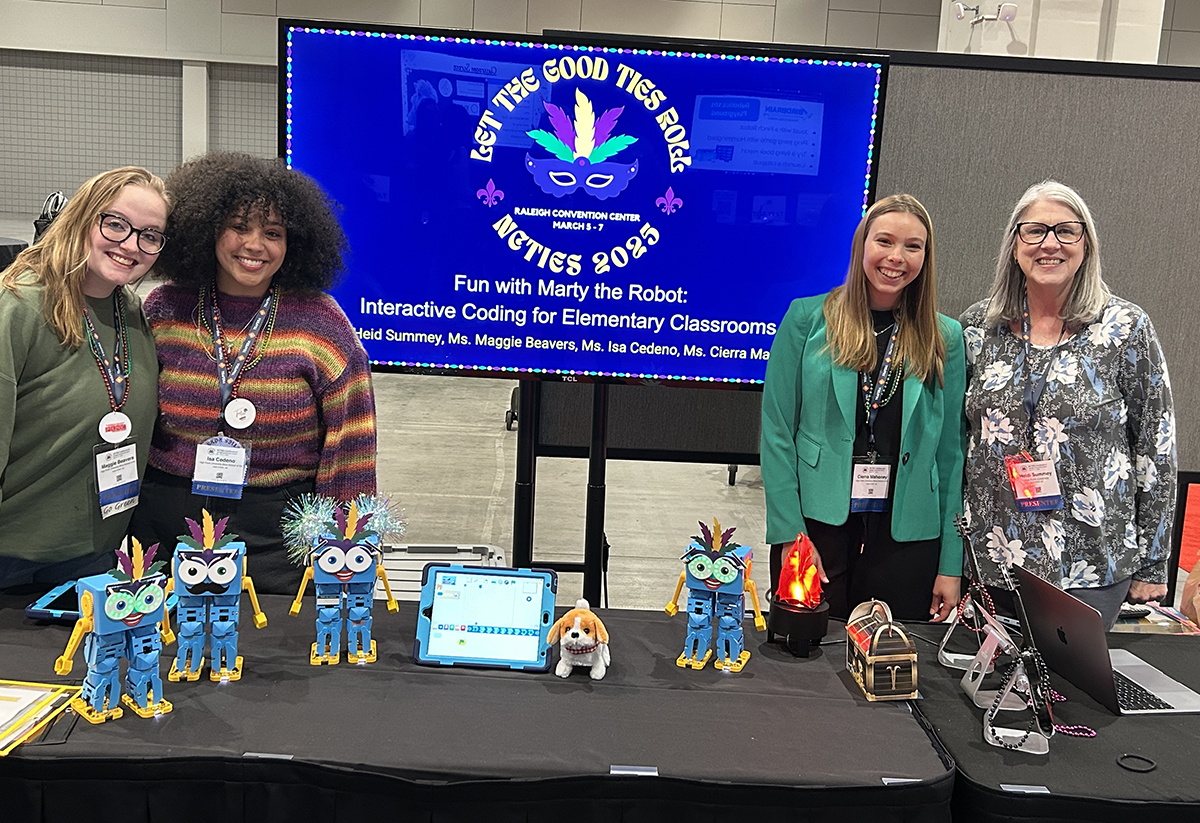
Three High Point University students presented robotics as a tool for elementary teaching at the North Carolina Technology in Education Society (NCTIES) conference, held March 5-7 in Raleigh, North Carolina. Pictured from left were Maggie Beavers, Isa Cedeño and Cierra Mahoney with Dr. Heidi Summey, assistant professor in the Stout School of Education’s Department of Educator Preparation, as they showcased Marty the Robot as an engaging and accessible tool for young learners.
HIGH POINT, N.C., March 27, 2025 – Members of the High Point University community frequently conduct, publish and share research and creative works in a variety of ways. Below is a recap of recent research and innovation initiatives.
HPU Students Present Robots at Educational Technology Conference
Three HPU students presented robotics as a tool for elementary teaching at the North Carolina Technology in Education Society (NCTIES) Conference, held March 5-7 in Raleigh, North Carolina. The statewide conference brings together educators, technology specialists and leaders from across the nation to explore innovative ways to integrate technology into teaching and learning.
The students presented ways that educators can implement Marty the Robot, a small robot that can walk and dance, into their classrooms. Marty is considered a leading STEM resource that is now used in more than 1,000 schools worldwide.
“Our students had an incredible opportunity to present their work on robotics in the elementary classroom, specifically showcasing how to use Marty the Robot as an engaging and accessible tool for young learners,” said Dr. Heidi Summey, assistant professor in the Stout School of Education’s Department of Educator Preparation. “Their presentation highlighted ways to integrate robotics into elementary instruction, fostering problem-solving, critical thinking and STEM engagement for students.”
Presenting at the NCTIES Conference not only enhanced the students’ own learning but also helped them see firsthand how innovative teaching practices can impact education. This experience allowed students to develop confidence, gain professional presentation experience and network with educators and technology specialists, Summey said.
Isa Cedeño, a senior elementary education major with a psychology minor, said she enjoyed presenting Marty at the conference with her classmates Maggie Beavers and Cierra Mahoney. The students were originally intimidated about presenting to teachers and administrators and worried their robotics wouldn’t be taken seriously, said Cedeño, who is originally from Normal, Illinois but now lives in Parkland, Florida.
“Fortunately, they were excited to learn about Marty, especially since we were showing how to use it and allowing them to try it out for themselves,” Cedeño said. “This experience has helped me gain confidence and experience with professional events within my future career. Being able to present a tech tool such as Marty as a pre-service teacher has increased my perspective on what in-service teachers think of newer technology. Learning and using Marty in class is different than applying it within a classroom, so it was interesting to hear how they would implement it if they could.”
Student Research Awarded at Sports Neuroscience Conference
Faith Bradley, an undergraduate neuroscience student, won third prize for best poster and third prize for her one-minute presentation at the annual Society for Sports Neuroscience Conference, which focused on neuroscience research related to athletes, exercise, nutrition and training. She was the first HPU student to attend this international conference, which was held Feb. 21-22 in Deerfield Beach, Florida.
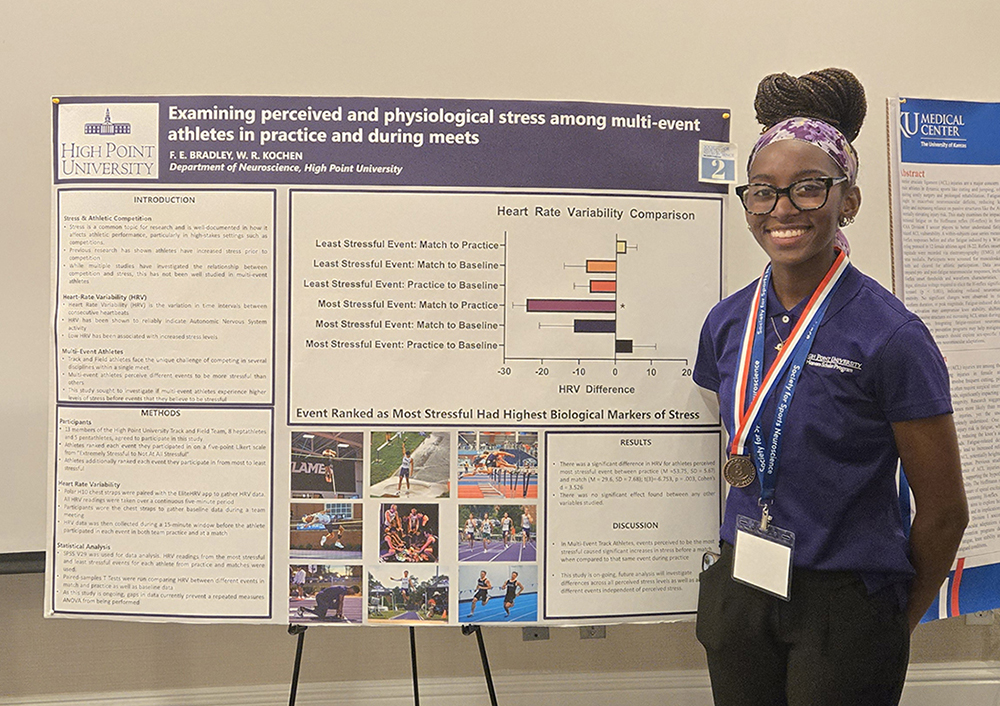
Bradley, a sophomore behavior neuroscience major with a double minor in sport management and musical theater, competed against other students and professors in the Data Blitz, a one-minute presentation of her research, titled “Examining perceived stress and physiological stress among multi-event athletes in practice and during competition.”
“I think the skills I learned throughout the whole process are going to be important going into my future,” said Bradley, who is from Woodbridge, Virginia. “For research, I had to create a protocol for the study to follow, and that will be beneficial to know how to do, not only in a science context but in managing my time and schedule. As for the conference, I was exposed to a variety of people who are successful in their fields, so I learned how to initiate the conversations with them and make professional connections.”
This was her first time attending a science conference and presenting a research poster, although she had experienced presenting at the Southern Regional Honors Conference.
“The Society for Sports Neuroscience focuses on the intersection between exercise science research and neuroscience,” said Dr. Bill Kochen, chair and assistant professor of neuroscience. “This year, attendees learned about concussion management in sports, the effect of diet and exercise on attention, and many other exciting research developments.”
Kochen, who is also editor-in-chief of the Journal of the Society for Sports Neuroscience, said he plans to accompany more HPU students to the Society for Sports Neuroscience Conference in the future.
HPU Hosts Mathematical Association of America’s Regional Meeting
HPU hosted the 104th meeting of the Mathematical Association of America’s Southeastern Section (MAA-SE) from Feb. 27 to March 1. The Mathematical Association of America is the world’s largest community of mathematicians, students and enthusiasts, and the Southeastern Section is its largest regional section.
HPU’s Department of Mathematical Sciences welcomed more than 300 faculty and students from a five-state region – North Carolina, South Carolina, Georgia, Tennessee and Alabama – for workshops, presentations, a graduate school fair, student poster session and an undergraduate Jeopardy competition.

“We were grateful to welcome mathematicians, statisticians and students from around the region to our campus,” said Dr. Jenny Sharpe, professor and chair of the Department of Mathematical Sciences. “Conference attendees shared ideas about mathematical and statistical research, teaching methods, mentorship and more. Additionally, we were glad to expose High Point University students to the mathematical and statistical research happening around the region.”
In addition to mathematical posters and presentations, a math treasure hunt and an opportunity fair for employers, graduate schools and summer research programs were offered during the meeting. HPU had been scheduled to host this meeting in 2020, but it was canceled due to the start of the COVID-19 pandemic.
“We have a beautiful campus and beautiful facilities,” HPU Provost Daniel Erb told the audience at the meeting. “Part of our job is to share that with our students to enable their learning and their development, but also to share it with the disciplines that our faculty represent.”
As a member of HPU’s Math Jeopardy team, the experience was fun and interesting for Zach Ready, a freshman math and physics major with a computer science minor.
“The puzzle-like questions forced me to consider math from many different angles, and being on a team with people I find very fun made the event a positive experience,” said Ready, who is from Henderson, Nevada. “The diversity of math and its applications that were presented opened my eyes to just how connected math is with the world, confirming my passion to continue in the field to a professional level. Overall, the MAA-SE meeting encouraged me to present something I’m passionate about at future conferences and share what I learned through research.”
Participating in Math Jeopardy was also intellectually stimulating for Abby Hyatt, a senior math major from Valdese, North Carolina.
“It reinforced the importance of thinking quickly, working collaboratively and applying mathematical concepts in creative ways,” Hyatt said. “Our team performed well, and I got the opportunity to work closely with other math majors in the department. Presenting my own research helped me grow as a communicator, which will be invaluable in my future studies and career. Being able to explain complex ideas to an audience strengthens my understanding and builds confidence for future academic and professional presentations. I also received several helpful insights from my audience, which I will take into consideration as I continue my project.”