HPU Students Study Abroad Through ‘Maymester’ and ‘Global Experience’ Programs
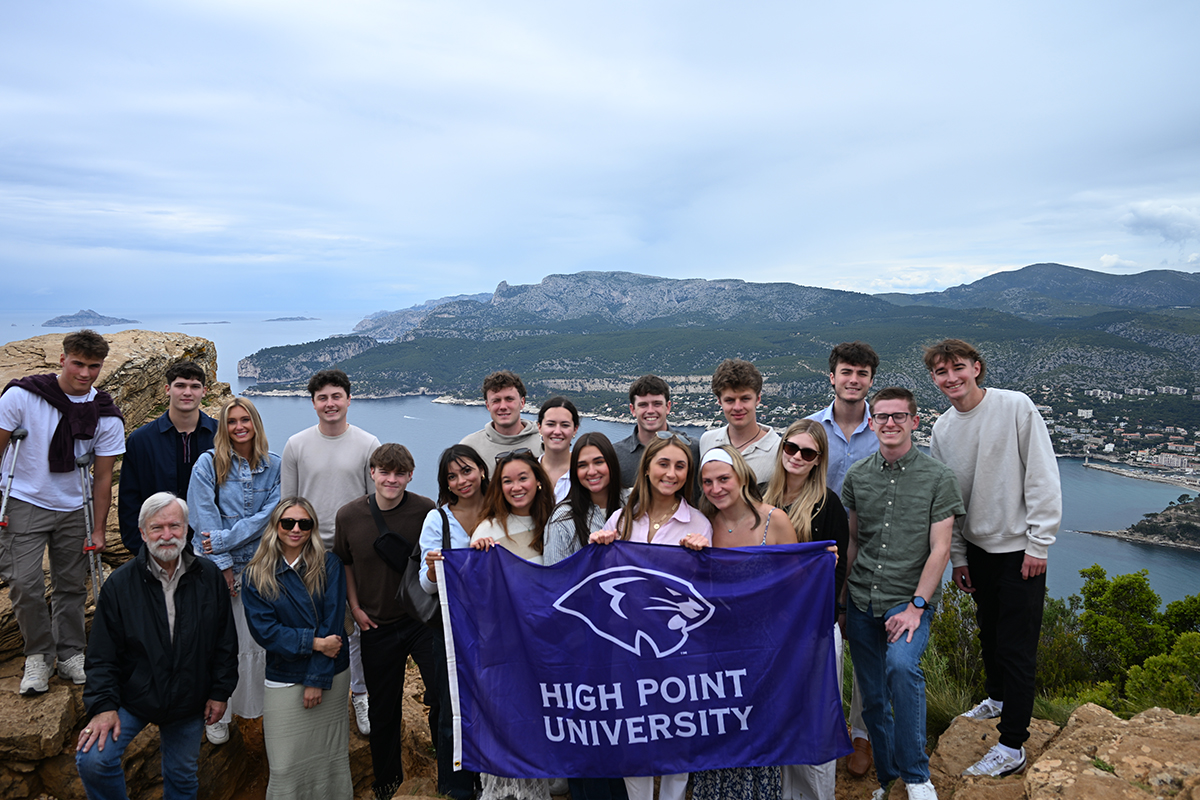
HPU students paused on top of Cap Canaille, in the parc national des Calanques near Cassis, France.
HIGH POINT, N.C., June 26, 2025 – A record number of High Point University students and faculty traveled abroad to learn more about different countries and cultures this summer through faculty-led “Maymester” and “Global Experience” programs.
Short-term study abroad programs allow students to get real-world experiences and travel internationally with their professors to a variety of destinations, including Austria, Australia, the Czech Republic, Ecuador, England, France, Germany, Italy, Japan, the Netherlands, Scotland, Spain, Taiwan, Thailand and Vietnam. The first groups of students departed May 4, and more groups headed overseas in June.
“Study abroad is not merely a stamp in your passport and a chance to see a faraway place,” said Dr. Jeffrey M. Palis, assistant vice president for Global Education. “Each ‘Global Experience’ and ‘Maymester’ program is custom-built to the specifications of the teaching faculty member to immerse students in the local culture while learning about the subject matter of the course. This is truly experiential learning. Students this year visited port facilities near Ho Chi Minh City on a global supply chain course. They attended IMEX Frankfurt, the premier global exhibition for meetings and events professionals. They read Robert Burns while spending a month in Scotland. They visited the Charles Darwin Research Station in the Galapagos while studying conservation biology and so much more. These rich academic experiences become the highlight of their HPU journey. No wonder record numbers of students participated this year.”
“Global Experience” programs are semester-long courses taught on HPU’s campus with a two-week international travel component at the end of the semester. “Maymester” programs are month-long, self-contained courses generally taught while abroad in May and June.
France and Finance
Thomas James, professor of the practice of finance, and Denis Depinoy, associate professor of French, led students through France in the Financial Management in Aix-en-Provence program.
During their first week overseas, HPU students explored the coastal charm of Cassis with a boat ride, a stroll through the town market and stunning cliffside views of the Mediterranean Sea. The trip continued with a visit to Dona Tigana Winery, where students got a firsthand look at the wine production process — from hand-picking grapes to fermentation in tanks and aging in oak barrels. They also learned about the winery’s business model from the daughter of the owner, Jean Tagana, a retired world-famous soccer player.
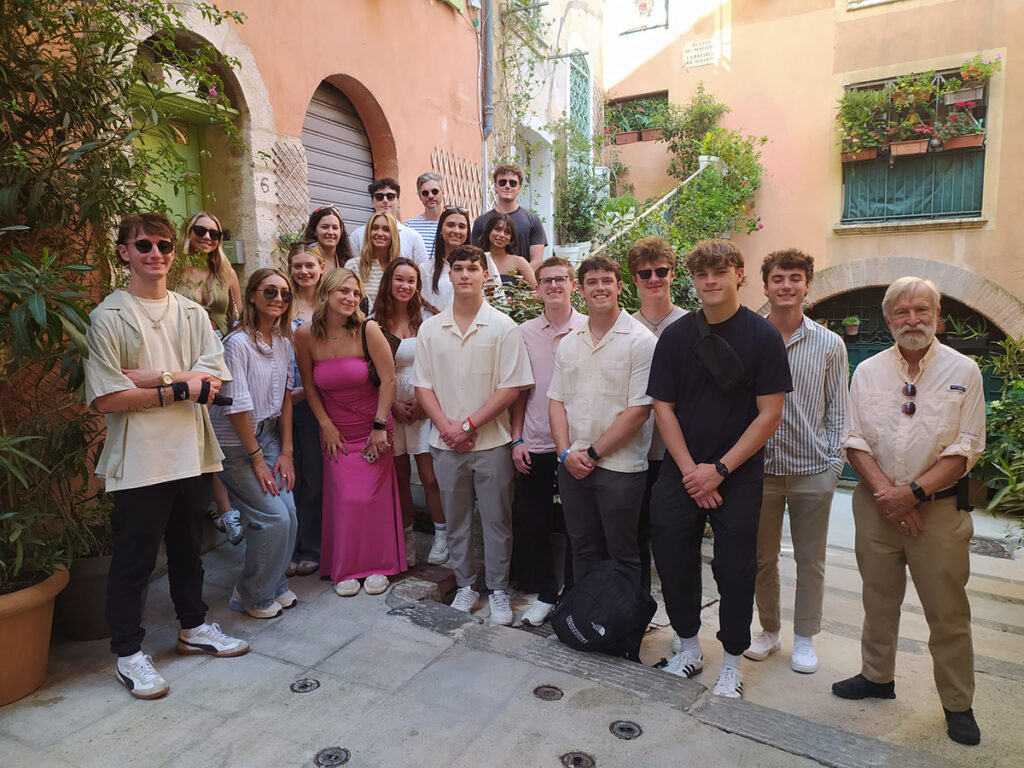
In their second week, students visited the French Riviera. Starting with a visit to Grasse, the perfume capital of the world, they took a tour and then tried their hands at developing their own special perfume. They also heard from a third-generation member of a family-owned perfume company. Students took a walking tour of Nice, a large city with a rich history and culture. They also visited the picturesque town of Eze, where they explored the exotic gardens and enjoyed incredible views of the Mediterranean.
During their third week, students went to Marseille to visit a new business incubator. They also visited a 150-year-old business, the Leonard Parli calissons facility, to see the manufacturing process for the regionally famous candy. The class heard start-up stories from two U.S. women entrepreneurs who moved to France to start their businesses — one developing a special blend of Kentucky bourbon for the French palate, the other a line of elegant linen clothing. Each entrepreneur discussed the differences between U.S. and French business customs, and the challenges and rewards of doing business in France.
“It was wonderful to be able to learn about corporate finance and see those principles in action in French businesses, including a winery, a perfumery and an olive oil mill,” said Marie Streng, a senior biology major and accounting minor who is from Greensboro, North Carolina. “We also heard from several entrepreneurs who shared their experiences starting businesses in France, which was a great way to get a glimpse of the differences and similarities between French and American business culture. Having broadened my understanding of business and culture, this experience has taught me that there are many ways to approach issues of business and life in general, each with its own merits. This lesson will help me to keep an open mind as I enter my career in the coming years.”
Spanish Language & Culture in Sevilla
Spanish Instructor Carmen Salama described leading the Spanish Language and Culture in Sevilla course as incredibly rewarding. The trip was from May 4-31.
“It goes beyond teaching Spanish. It’s about guiding students to immerse themselves in a new culture, gain a deeper understanding of life beyond their own country and develop the skills necessary to become engaged global citizens,” Salama said. “These experiences challenge them to expand their perspectives and equip them to navigate and contribute meaningfully to an increasingly interconnected world. It’s truly fulfilling to witness their personal and academic growth throughout this journey.”
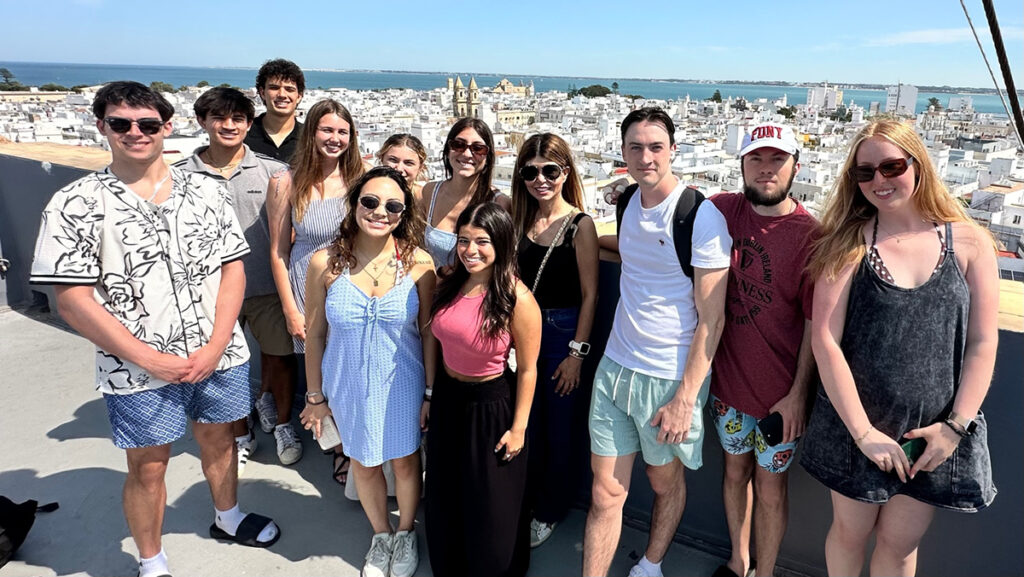
Studying abroad in Sevilla helped increase Spanish language proficiency, cultural adaptability and personal growth for Ivy Scott, a religion major with a Spanish minor.
“Through a rich combination of coursework at HPU, immersive cultural experiences and visits to significant historical and artistic sites, I’ve gained a deeper appreciation for both the material I’m studying and the context in which it exists,” Scott said. “Living with a host family has been especially transformative, offering daily opportunities to engage in real-life conversations entirely in Spanish — an experience that has strengthened both my confidence and cultural understanding. This journey has truly extended my education beyond the classroom, allowing me to apply what I’m learning in a tangible, impactful way each day.”

Natalie Croop, a cybersecurity major who is pursuing dual minors in Spanish and strategic communications, also raved about the Sevilla course.
“As someone who hadn’t traveled much beyond the East Coast of the U.S., participating in the ‘Maymester’ program in Sevilla, Spain, was a bold step outside my comfort zone. And it turned out to be one of the most transformative experiences of my life,” said Croop, who is from Fairport, New York. “Through daily interactions with locals, visits to historic sites and immersive coursework, I not only improved my Spanish skills but also gained a deeper understanding of Spanish culture and global citizenship. Living with a host family helped me connect more personally with the culture and made the language come alive in everyday situations. The ‘Maymester’ program didn’t just teach me Spanish. It helped me grow academically, culturally and personally. Sevilla has left a lasting impact on my worldview and my heart.”
Global Marketing in Spain
The Marketing in Spain “Maymester” was led by Dr. Miguel Sahagun, the Charles T. Ingram associate professor of marketing and director of HPU’s BEACON Laboratory. He accompanied students into the Basque country with stops in Burgos, San Sebastian, Bilbao, Segovia, La Granja, Guarda-Portugal, La Alberca, Merida, Seville and Madrid.
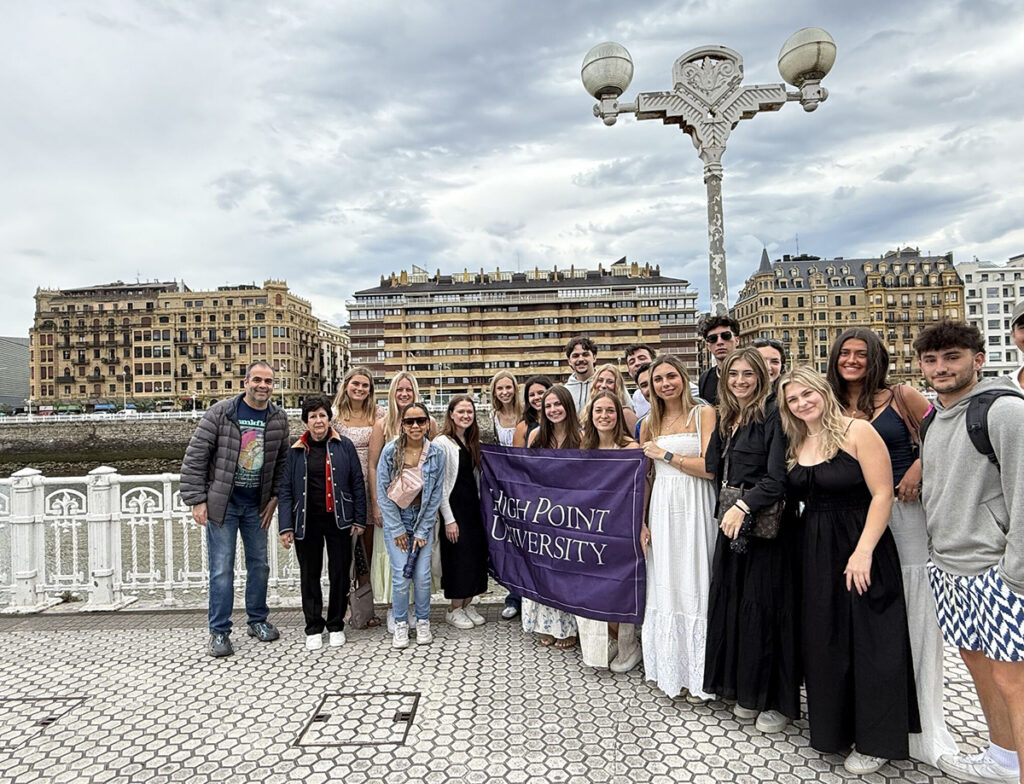
In addition to visiting Burgos’ iconic cathedral, students explored the ways that cultural differences shape marketing strategies and paid attention to how companies adapt their messaging to resonate with diverse audiences. A stop at the Guggenheim Museum in Bilbao highlighted how art and design intersect with branding and experiential marketing. Students attended a soccer match and cheered for Real Betis Balompié, one of the two major soccer clubs in Sevilla, and gained a sense of the ways that sport builds pride, tradition and a strong sense of community in the city.
“It’s been an enriching experience for my students, who are not only learning theory but witnessing firsthand how cultural insights drive effective marketing communication,” Sahagun said. “It was a perfect blend of cultural learning, historical appreciation and outdoor fun.”
After wrapping up their second week of classes, students explored the historic city of Segovia, where they visited the Roman aqueduct, the Alcázar, the cathedral and the Palacio de San Ildefonso in La Granja. They also had an opportunity to cross into Portugal to visit the town of Guarda. To close out the week, they immersed themselves in nature at La Alberca, where some students went zip lining.
The group also learned about one of Spain’s most iconic culinary treasures — the Iberian ham industry — and ate samples of it. From the selection of pigs to the long and meticulous curing stages, the entire process blends tradition, patience and craftsmanship.
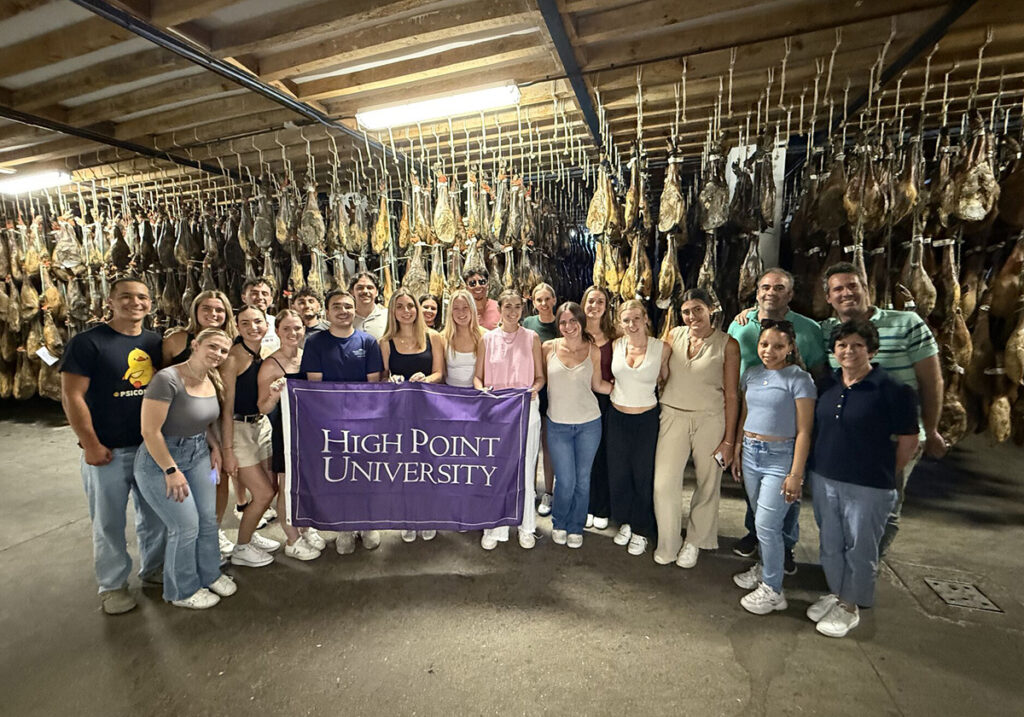
Studying abroad in Spain with the “Maymester” program was one of the best experiences for Paige Knudsen, a senior business administration major with triple minors in sales, global commerce and healthcare management.
“Before this trip, I had never been out of the country, so everything felt new and exciting from the start,” said Knudsen, who is from Brookline, New Hampshire. “I didn’t know what to expect, but I quickly realized how much I could learn by stepping outside my comfort zone. I’ve learned how culture really changes the way businesses market their products. Seeing it in person made everything we talked about in class feel real. Over the past four weeks, we’ve visited cathedrals, walked through historic plazas and learned so much just by being present in each place. This trip opened my mind and gave me a better understanding of how culture and business connect. This class showed us what you really need to know when working at a global company. I feel more prepared for my future career, especially when it comes to working with people from different backgrounds and staying adaptable in fast-changing environments.”
Sammie Cohen, a senior business administration major with a double minor in marketing and sales, felt incredibly grateful for this program and all the knowledge, experiences and friendships it has brought.
“With cooking classes, dance lessons and weekend trips around the country, I was able to immerse myself in the culture and see how marketing plays out in everyday life and then compare it to the USA,” said Cohen, who is from Long Island, New York. “Seeing how people in Spain live, shop and interact gave me a perspective that a classroom alone couldn’t provide. My goal is to pursue a career in marketing, so this trip was incredibly valuable — it helped me understand how culture influences consumer behavior, and that’s something I’ll take with me moving forward.”
The global marketing class was also valuable for Taylor Wibberley, a senior marketing major.
“One major takeaway is understanding the importance of adapting marketing strategies to fit different countries and cultures,” said Wibberley, who is originally from Gaithersburg, Maryland, and now lives in Fort Lauderdale, Florida. “Every market has unique consumer behaviors, values, languages and economic conditions, and it’s crucial to tailor your approach accordingly. What works in one country might not resonate in another. Being able to see these differences firsthand rather than just reading about them in a textbook made the learning experience much more impactful. Whether it was through case studies, projects or real-world examples, I gained valuable insight into how global brands adjust their messaging, products and campaigns to connect with local audiences. This hands-on exposure helped me truly grasp the complexity and creativity required in global marketing.”
United Kingdom
Greg Page, professor of the practice of Healthcare Management, and Dr. Premalata Sundaram, associate professor of accounting, accompanied students to London for the Global Business and Global Perspectives of National Healthcare Systems courses. In addition to comparing healthcare systems of the United Kingdom and U.S., they considered the healthcare systems of Canada, France and Germany. Alongside inspiring classroom sessions, they explored iconic spots, from the historic Edinburgh Castle to the Meridian and Maritime Museum in Greenwich.
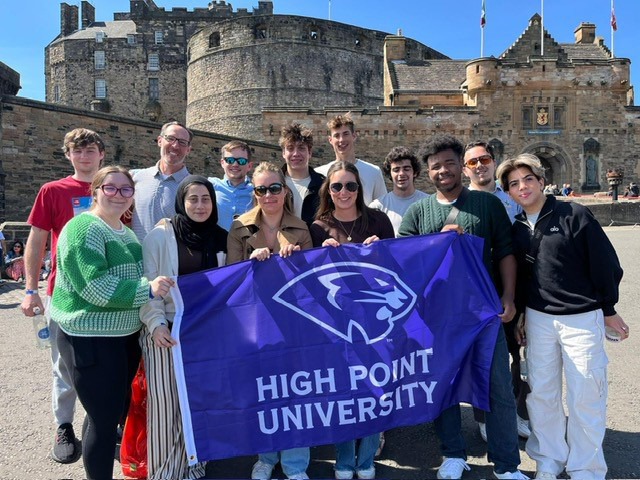
Students gained valuable insights into the comparisons between different healthcare systems, as well as in-person experiences directly related to the healthcare field, said Emily Lawler, a senior business administration major with minors in biology and healthcare management. The class met with members of the National Health System, providing a firsthand look into the inner workings of the United Kingdom’s healthcare system.
“We also visited historical sites tied to the foundations of healthcare, such as the Florence Nightingale Museum, which deepened my understanding of how healthcare practices have evolved over time,” said Lawler, who is from Garnet Valley, Pennsylvania. “Having grown up in the United States, I had never experienced another system of care. This experiential learning course allowed me to step into a different model and better understand how access, funding and priorities can vary significantly between countries. This experience has not only deepened my global perspective but has also strengthened my commitment to pursuing a future in healthcare. Learning about a publicly funded system helped me think more critically about cost-efficiency, patient outcomes and the role of accessibility in care delivery. Looking ahead to both my career and higher education plans, having this international experience, paired with practical, real-world insights, will help me stand out and approach future opportunities with a more informed mindset.”
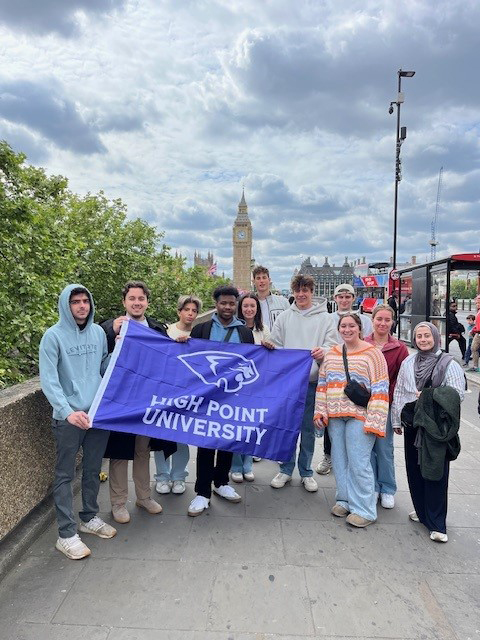
Dr. Amanda Allen, assistant professor of history, led her students through the History in London “Maymester.” Students learned about the rise and fall of the Tudor Dynasty, and how propaganda was used to solidify their claim to the throne. As part of the class, students visited historical sites around London, including the Victoria and Albert Museum, Westminster Abbey, Hampton Court Palace, the Golden Hinde ship and the Tower of London. They also took trips outside of London to Bath, Oxford and Edinburgh, the capital of Scotland.
“Outside of class we learned how to navigate the busy London streets, including their various transportation methods,” said Matthew Todd, a senior computer science major from Merrimack, New Hampshire. “This will help me in my future as I progress through life because it taught me to ask questions about what I see and what the intentions are behind it. This is especially true for things that are meant to last and be on display. Nothing in this world has no thought behind it; everything is intentional. While navigating may seem limited, it’s more about the critical thinking behind it. Learning to make decisions on the fly due to unforeseen circumstances is crucial to my goals later in life.”
Isabella Gould, a junior double majoring in English and history from New Orleans, Louisiana, said students learned how to adapt to another culture and enjoyed the different excursions around the United Kingdom.
Literary Scotland
Matthew Carlson, associate professor of English, led students through the Literary Scotland “Maymester” program, which focuses on Scottish authors and explores the ways that Scottish culture shaped them and how they, in turn, have shaped Scottish culture.
“Our first readings — and our first couple of day trips — revolved around the two authors who have influenced Scottish national identity more than almost anyone else: Robert Burns and Sir Walter Scott,” Carlson said.
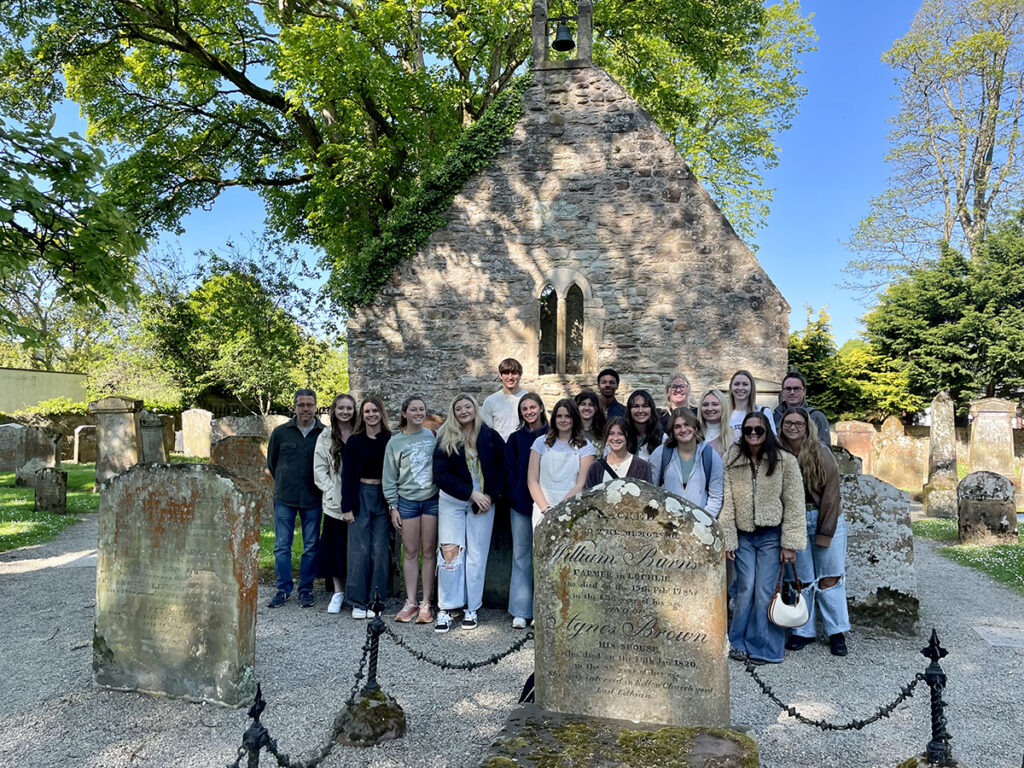
Students visited the Robert Burns Birthplace Museum & National Heritage Park and the Auld Kirk, a supposedly haunted and ruined church that inspired “Tam O’Shanter,” one of Burns’ most famous and spookiest poems. The next day, they traveled to Abbotsford, the fairytale-like home of Walter Scott, who was one of the most widely read authors of the nineteenth century.
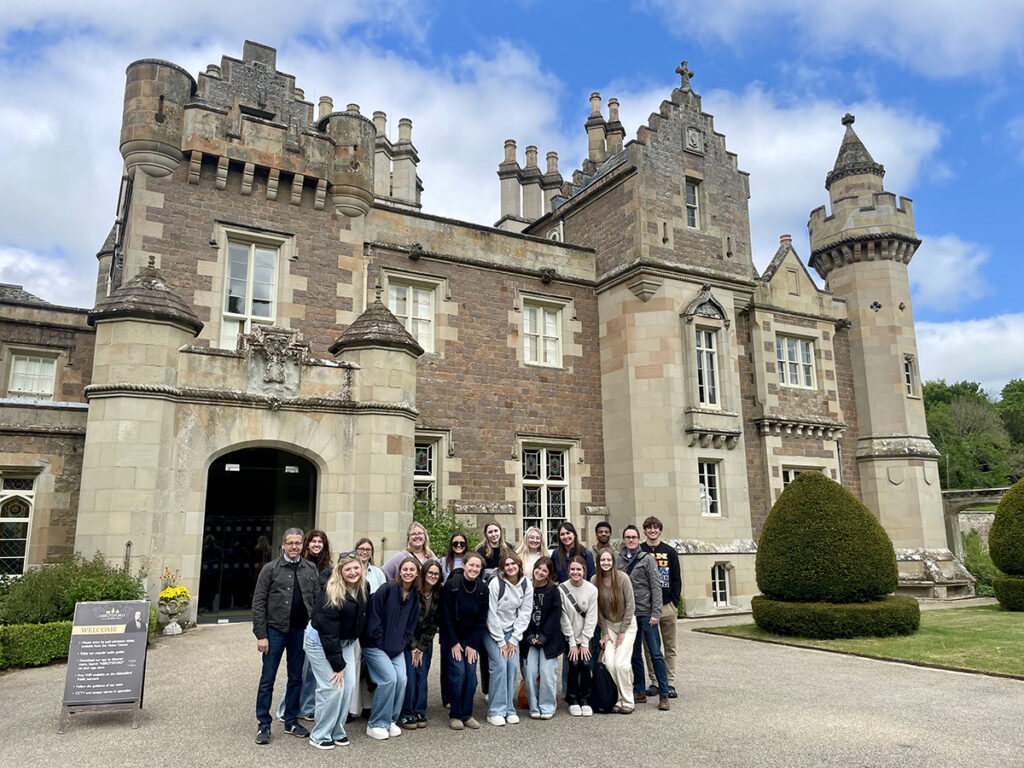
The Literary Scotland course was an incredible experience for Maddie Molis, a junior English major on the pre-law track with a double-minor in legal studies and public and professional writing.
“The opportunity to study Scottish literature in the very landscapes that inspired it truly has brought the material to life in a way that’s hard to replicate in a traditional classroom,” said Molis, who is from Clarendon Hills, Illinois. “Engaging with the works of authors like Robert Burns, Sir Walter Scott and contemporary Scottish writers has helped me to better understand how place, culture and history shape storytelling and narrative, which is a perspective that I believe will enrich both my writing and analytical skills moving forward. As someone planning to pursue a legal career, this course has also helped refine my ability to think critically, communicate clearly and approach texts with a more layered perspective. These are all essential skills in the legal field, and I’m confident that the insights I’ve gained here will serve me well in both law school and beyond.”
Sport in the Netherlands and Germany
The Sport in Society Global Experience in the Netherlands and Germany included a stop at the Dutch Olympic Committee’s National Training Centre at Papendal. Their guided tour of the grounds and sports facilities offered insight into the high-performance training environment. They also visited the German Sports and Olympic Museum, the campus of the German Sports University and the Cologne Cathedral, which is one of the most iconic landmarks in Germany and a masterpiece of Gothic architecture.

Students climbed 533 steps to ascend the cathedral tower for spectacular views of Cologne and enjoyed a guided walking tour through the Old Town along the Rhine River and the Old Market Square.
Walker Ripley, a senior history major with a minor in sport management, said he learned more about the sports industry and other cultures around the world through this trip to Germany and the Netherlands.
“It was a great opportunity to see what sport functions are like outside of the U.S.,” said Ripley, who is from Steamboat Springs, Colorado. “This will allow me to think of other ways to incorporate sports into a society of people. I believe this trip will help me in my future career as I observed different ways of training, building a sense of pride around a goal, and how sport organizations can create success out of little funding.”
Madison Mingo, a junior sport management major with a minor in legal studies, described participating in the global experience program as an incredible opportunity.
“Engaging with new cultures and learning about how sports operate globally has deepened my understanding of the industry and inspired me to think more critically about the role of sport in society,” said Mingo, who is from Boca Raton, Florida. “Speaking with professionals at Adidas and other leading organizations opened my eyes to career paths I hadn’t considered before, from global brand management to athlete relations on an international scale. These conversations helped me understand how dynamic and interconnected the sports world truly is. This experience not only deepened my passion for working in sports but also gave me clarity and motivation as I work toward becoming a sports agent.”
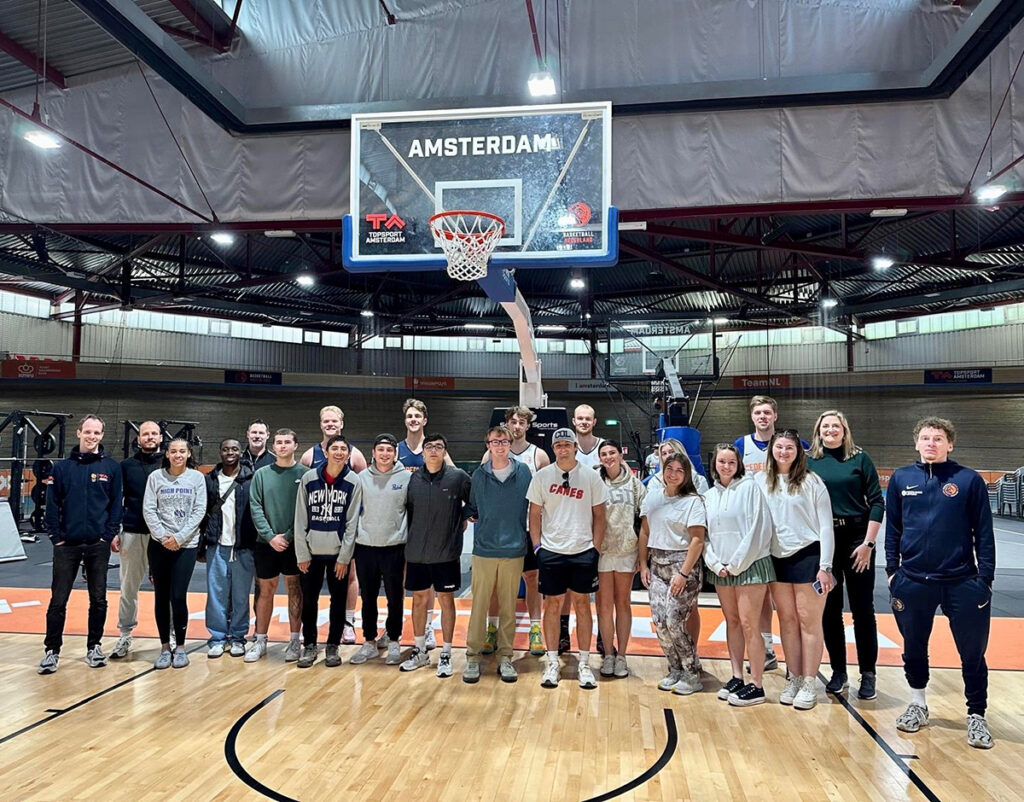
The opportunity to engage with sport professionals, global companies and professors from top European universities also resonated with Haiden Giles, a junior from Baltimore, Maryland.
“As a sport management major and marketing minor focused on brand partnerships and marketing, these conversations gave me clearer insight into potential career paths and practical steps to reach them,” Giles said. “From topics like talent recognition to partnership development, I gained valuable knowledge I can apply directly within the sports and business industries.”
Italian Studies
Two groups of HPU students traveled with faculty to Italy.
Dr. Daniel Armenti, assistant professor of Italian, described the Italian Studies course in Sicily and Siracusa as fantastic. Students explored the city of Syracuse and the surrounding area, including the historic center of Palermo, the temples of Agrigento, the nature reserves of Pantalica and Vendicari, and a hike up the Mount Etna volcano.
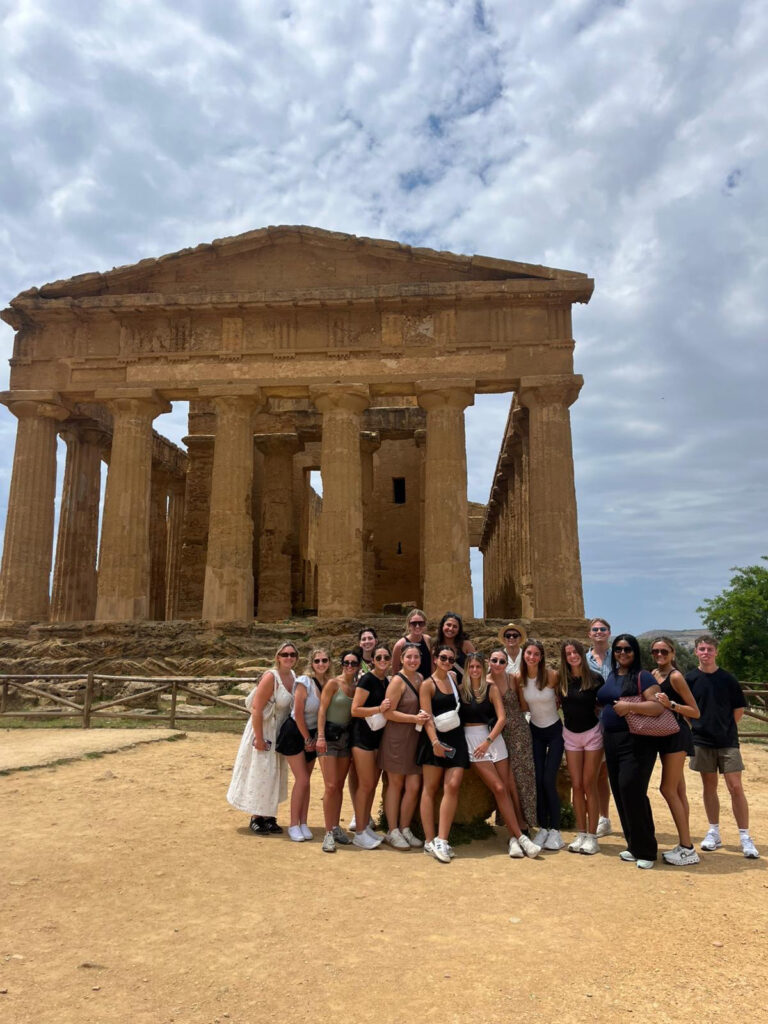
“Students learned about the long and palimpsestic history of the island of Sicily, with its intersecting cultures and its centrality to the Mediterranean,” Armenti said. “And of course, they ate lots of gelato.”
Isabelle Vitali, a senior media production major with a minor in Italian, said she learned more about Sicilian culture, specifically how the different groups that inhabited Sicily formed their identities.
“This trip helped further my education by providing me with a hands-on learning experience for my Italian minor,” said Vitali, who is from Manalapan, New Jersey. “I was able to not only learn more about the culture but also practice my language skills.”