Mark Bradburn Advises Students on Managing Stress and Risks as HPU’s Wealth Management Expert in Residence
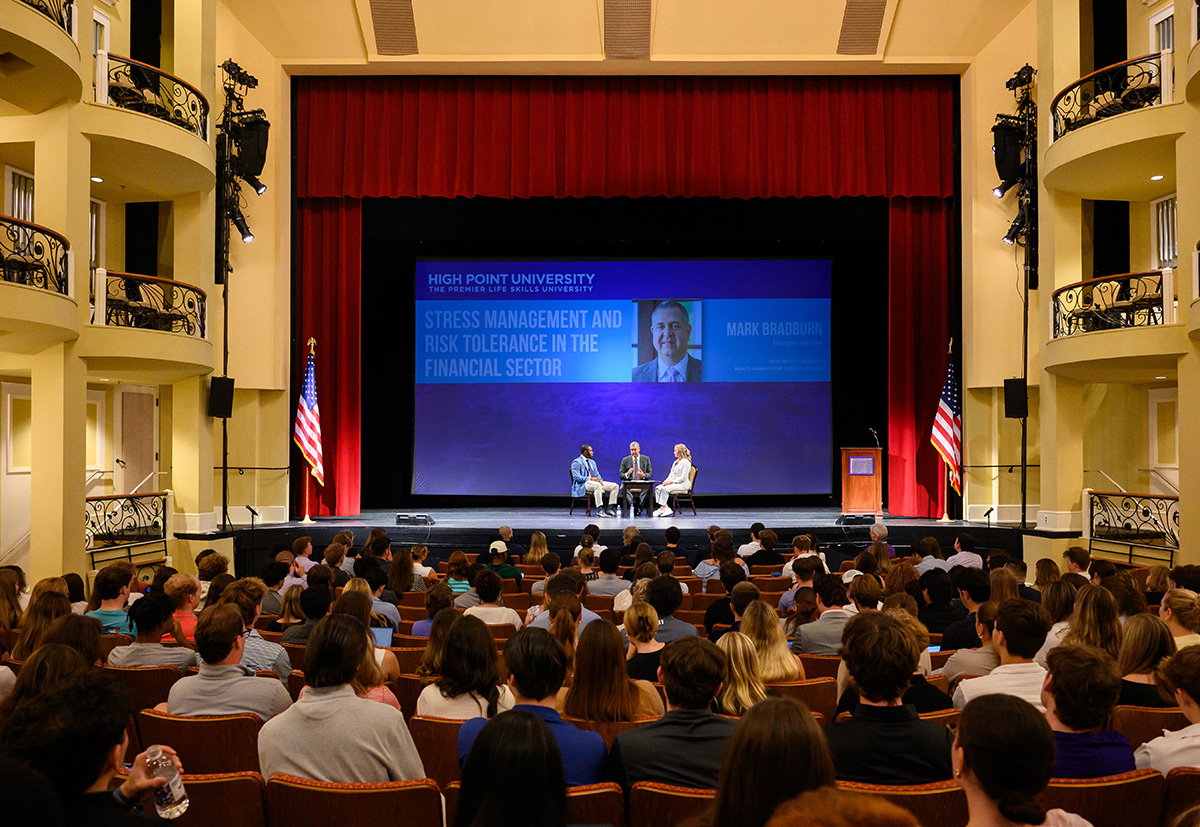
Mark Bradburn, High Point University’s Wealth Management Expert in Residence and founder and co-managing financial advisor of The Bradburn Group at Morgan Stanley, mentored students during a recent visit to campus. He participated in a Q&A session on “Stress Management and Risk Tolerance in the Financial Sector” in the Hayworth Fine Arts Center on Sept. 25.
HIGH POINT, N.C., Oct. 1, 2025 – Mark Bradburn, High Point University’s Wealth Management Expert in Residence and founder and co-managing financial advisor of The Bradburn Group at Morgan Stanley, mentored students and advised them to remain calm when making financial decisions during a recent visit to campus.
Bradburn spoke to the entire freshman class during HPU President Nido Qubein’s First-Year Seminar on Life Skills in the Nido and Mariana Qubein Arena and Conference Center on Sept. 25. He also addressed a class of financial management students and participated in a Q&A session on “Stress Management and Risk Tolerance in the Financial Sector.”

“When you’re dealing with billions of dollars, which is what I manage, you can’t panic,” Bradburn told students during the Q&A in the Hayworth Fine Arts Center. “People are trusting you to make sound financial decisions, so staying calm and being thoughtful with your responses and their reputations is super critical.”
Bradburn gave students permission to take a few moments to gather their thoughts before they reply during stressful moments. He asked them to consider how a patient responds to a doctor’s report delivered in an alarming manner versus a calm diagnosis.
“I hear all the time that emotional intelligence is the #1 factor employers are looking for today,” whether the job is managing finances or collecting garbage, he said. “Stress is stress. It’s about how you process it.”
Bradburn admitted staying in the right mindset was a challenge for him when the dot-com stock market bubble burst in March 2000, but it also was a turning point because he changed his focus to what he could control rather than the stock market or the weather that he could not control. He said he tried to be the kind of financial advisor his mother needed following his father’s death 40 years ago when he was age 10.
During the Q&A session, Bradburn answered questions posed by his daughter, Blythe Marshall, a junior psychology major, and Tomiwa Bello, a senior finance major who completed a summer internship with Morgan Stanley and has been offered a job with the company. Students from various majors asked questions at the end of the session.
“My biggest takeaway is to understand the situation and know what you’re dealing with,” said Bello, who is from Bowie, Maryland. “Being able to manage the emotions of clients, to reassure them in hard times when things aren’t going well and the market is turning red is the biggest thing. As a student, the way I can implement those things in my life is to take a step back and analyze the situation, leaning on my mentors and my team to ensure I’m bringing forth the best of myself. To ensure I’m taking care of myself as well as getting feedback from others on how I’m doing is a great way to make sure I am taking care of myself in analyzing risk and stress well.”
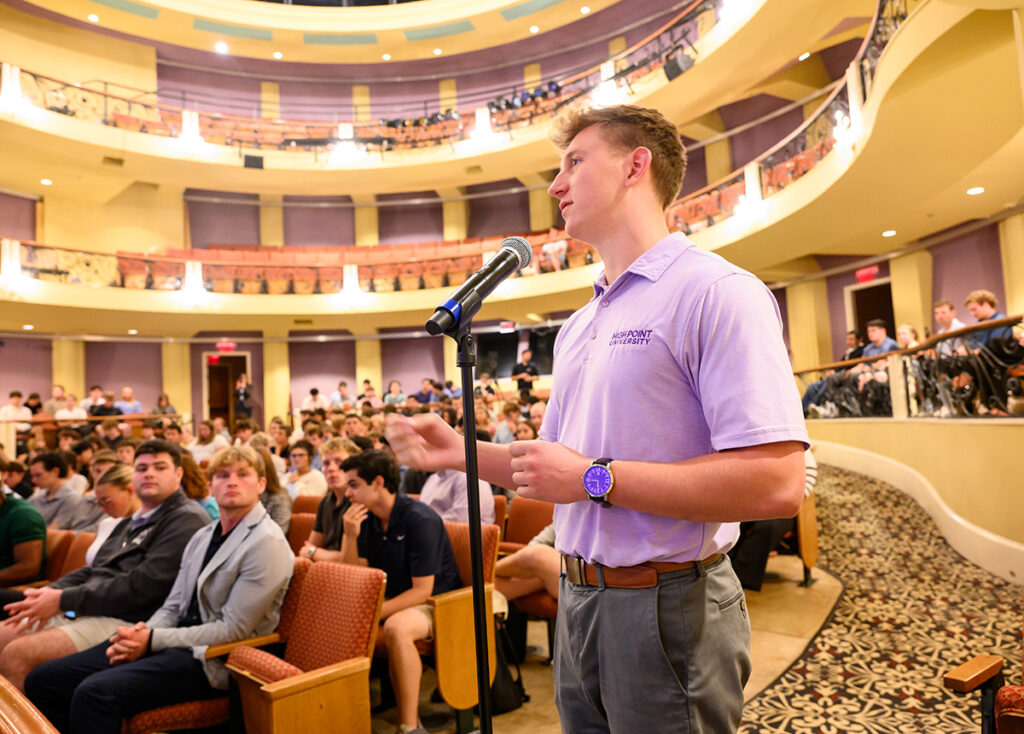
Alex Muravski, a sophomore business analytics major, shared his two main takeaways from Bradburn’s remarks.
“He talked about keeping your emotions steady,” said Muravski, who is from Tulsa, Oklahoma. “Some people think that’s not freaking out when something bad is happening, but another thing he touched on is not being overly out of control when good things are happening. Realize the bad times are going to pass, but the good times are also going to pass, so don’t celebrate every minor victory like it’s the World Cup. He said to keep your emotions at a six to seven level no matter where you’re at. That way whatever comes next, you’re prepared and in a good state for it.”
Bradburn also told Muravski little things made a difference in his career and helped separate him from his competitors. For example, his clients are shocked that Bradburn works from 7 a.m. to 6 p.m., returns their calls during the weekend and provides annual reports on New Year’s Day.
“Doing the small things consistently will help you get somewhere faster than doing big things inconsistently,” Muravski said.
“My takeaway was you have to be able to learn from a mistake and move forward from it,” said Adam McKay, a freshman from Raleigh, North Carolina. “If you don’t learn from your mistakes and move on, someone else who is more level-headed than you will take the risk that you wouldn’t and is going to take your position.”