Former Google Executive Discusses Ways to Thrive During an AI Era with Students
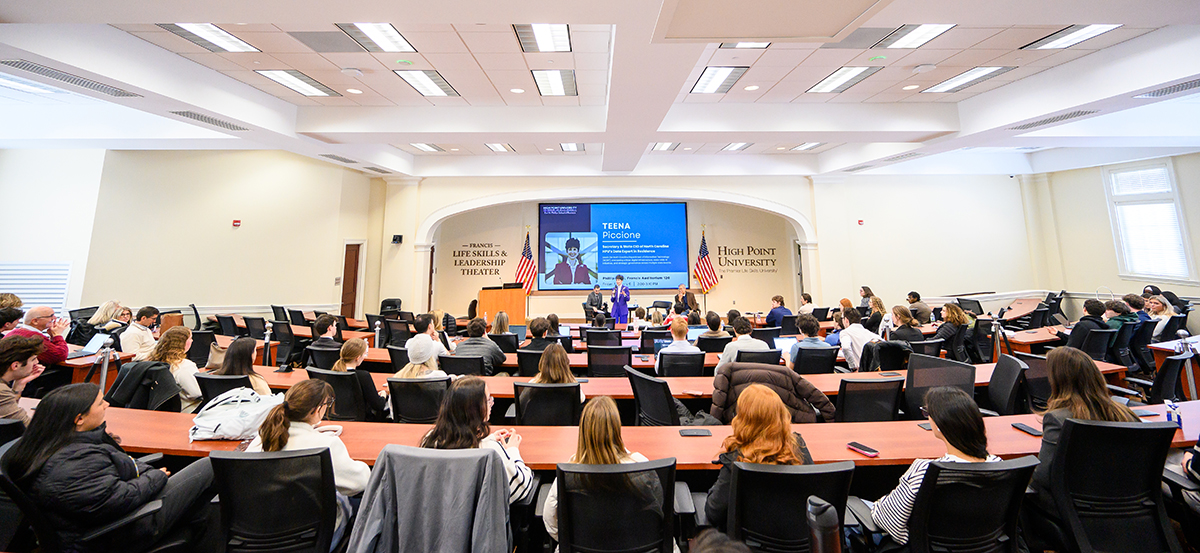
Teena Piccione, who serves as High Point University’s Data Expert in Residence in addition to her role as secretary of the North Carolina Department of Information Technology, spoke with students about using their skills to help improve artificial intelligence during her Feb. 6 visit to campus.
HIGH POINT, N.C., Feb. 24, 2026 – Teena Piccione, who serves as High Point University’s Data Expert in Residence in addition to her role as secretary of the North Carolina Department of Information Technology (NCDIT), spoke with students about using their skills to make an impact and help improve artificial intelligence during her recent visit to campus.
Piccione, the state’s chief information officer and the former Google global transformation and operations executive, accepted North Carolina Governor Josh Stein’s request last year to move from big tech to a state government role.
“When you look at your career and what’s next, you look at where you can have a significant impact,” Piccione said. “There is no better place to have a significant impact than where you live and work and play, and that’s in my home state of North Carolina. When the governor called me, I remember he said, ‘You’ll have the biggest impact if you come here’ — and he wasn’t wrong.”
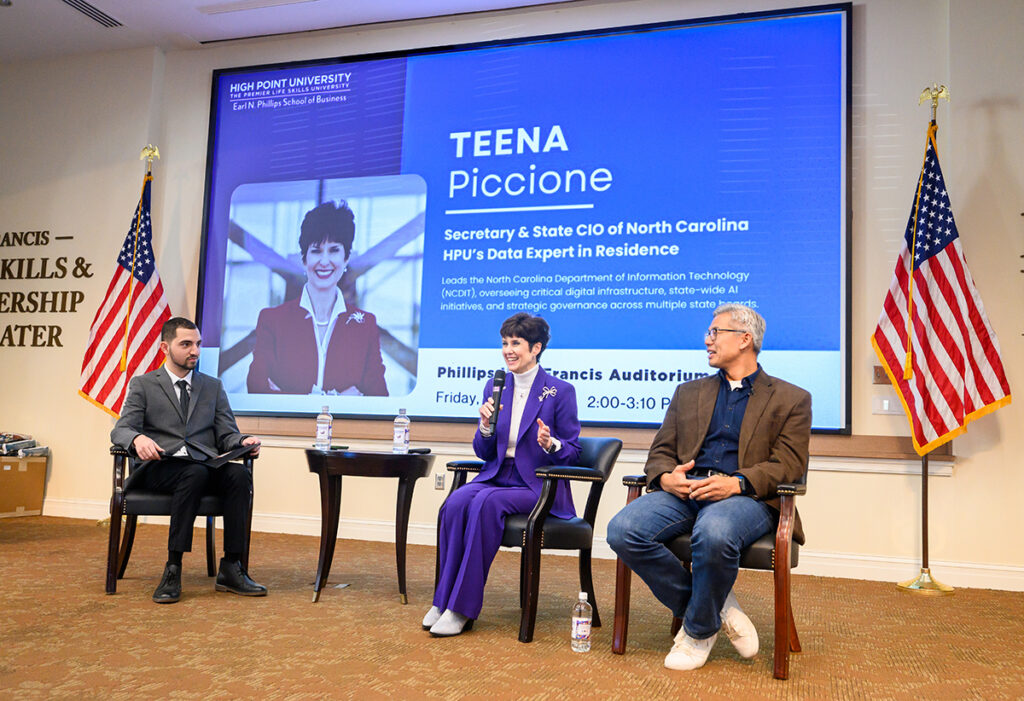
As chair of North Carolina’s 911 board, Piccione oversees 124 911 centers across the state. Her department is responsible for broadband connectivity from the coast to the mountains and all the state policies that involve AI. NCDIT also oversees operations and data centers that connect North Carolinians.
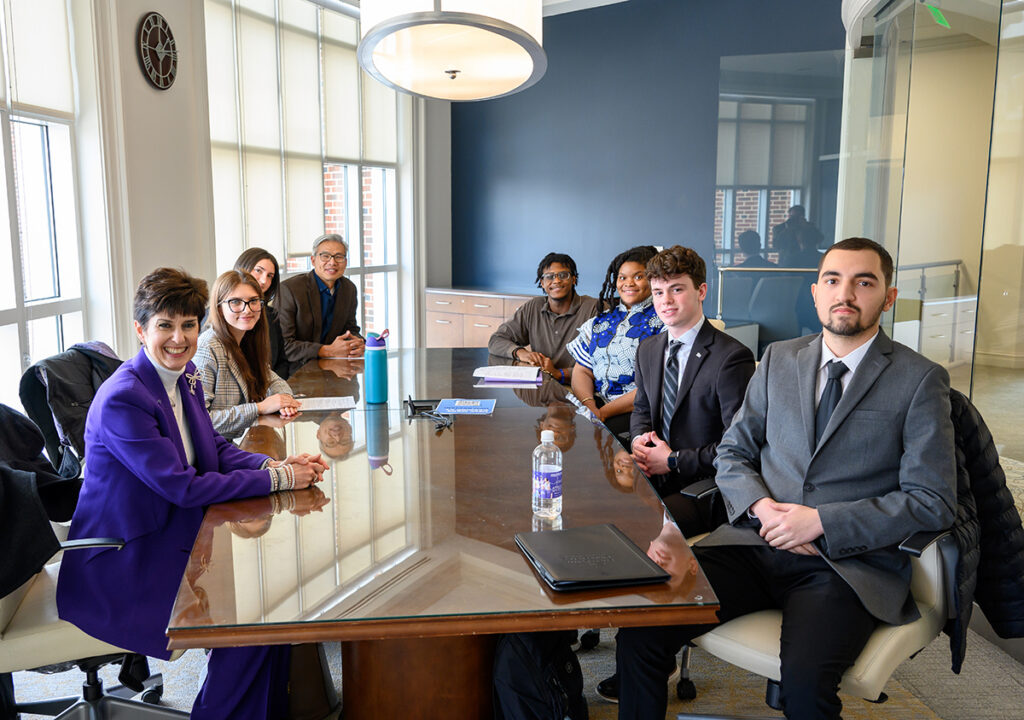
“For me, it’s one of the best jobs in the world because now I have the impact of making sure things work for you every single time that you’re in our state,” Piccione said. While on campus, she also led executive coaching sessions, presented to a strategic management class and shared lunch with business students.
I-Sah Hsieh, the NCDIT’s deputy secretary for AI and policy, joined Piccione in the Phillips School of Business where they spoke to business majors. He encouraged students to have a willingness to work and said there is much work needed to improve AI.
Hsieh holds the first position created in North Carolina that is dedicated to coordinating statewide AI efforts. He noted he agrees with one of his early managers, who said, “Skills, I can teach you; attitude I can’t.”
He found Piccione shares his willingness to hire recent college graduates.
“At a time when a lot of big businesses are slowly pumping the brakes on hiring new grads, Teena has flipped it and gone the other way to say, ‘We’re only hiring new grads.’ We’ve got a smart, young, hungry generation of able-minded people who are looking to make a difference,” Hsieh said.
Under their leadership, North Carolina partnered with the Washington D.C. Office of Unified Communications, AT&T and Johnston County 911 to deliver 911 calls to a mobile communications command center in the nation’s capital. During the exercise, 911 calls originating in Johnston County were securely routed to Washington, D.C., where Johnston County telecommunicators answered calls inside a mobile unit and relayed critical information back to Johnston County for dispatch.
This exercise highlighted how innovation and technology can save lives and demonstrated that geography is no longer a barrier, Piccione said.
Piccione advised students to think about how they devote their time when listing their skills on resumes. For example, a job candidate who volunteers at a food bank shows an extra level of effort. Students also should intensely review their own social media accounts before applying, research the employer and arrive for interviews with thoughtful questions to ask, she said. Hsieh said students can ask AI for help if they cannot think of any thoughtful questions to ask during an interview.
NCDIT has lowered its experience requirements for new hires to encourage more undergraduate and graduate students to use their creativity and skills to help the state. Hsieh said two interns recently used their cyber security skills to find an anomaly and prevent an attack on North Carolina.
“For me, the biggest takeaway from this was how they explained discipline and how the little things you do in life can lead to a really bright career and life in general,” said Katie Rowe, a senior sports management major from Fairfax, Virginia, who is pursuing a marketing minor. “Even little things she said like making your bed, going to bed early and having a schedule make a big impact. She reinforced how being involved in the community, volunteering and joining things make you stand out differently.”
The importance of being able to ask interviewers questions without fear was one thing William Guerrero, a junior finance major, said he learned from the session.
“Also, I learned to build and use your connections everywhere you go because in the future those people you connected with may be able to help you be able to explore your options for internships and career,” said Gerrero, who is from Winston-Salem, North Carolina.