Lord Andrew Roberts Delivers Special Lecture at HPU During America’s 250th Year
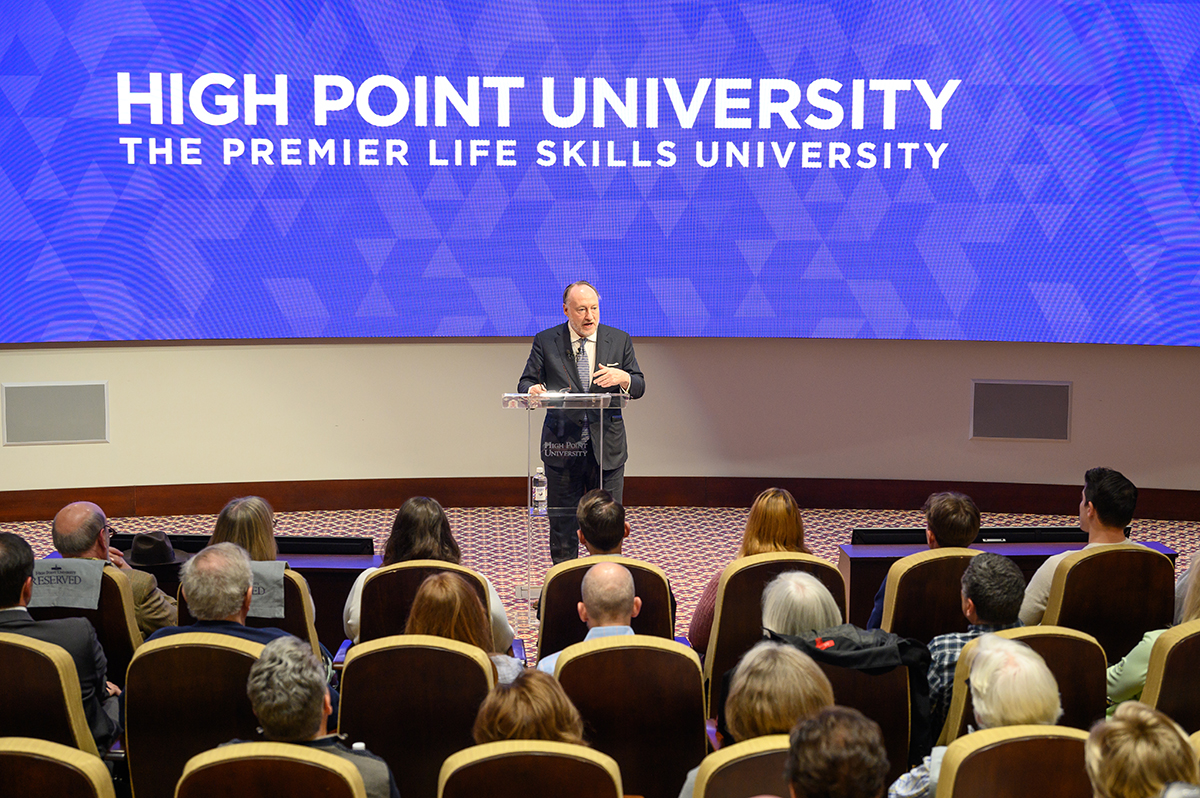
High Point University welcomed renowned historian and author Lord Andrew Roberts to campus for a special lecture commemorating America’s 250th year.
HIGH POINT, N.C., March 27, 2026 – High Point University welcomed renowned historian and author Lord Andrew Roberts to campus for a special lecture commemorating America’s 250th year, offering students and community members a compelling historical perspective on the ideas, leadership and global context that shaped the nation’s founding.
The lecture, held on March 25 in the Callicutt Life Skills Theater, reflected HPU’s commitment to intellectual engagement, civic leadership and patriotism.
Lord Roberts drew on his extensive scholarship to examine America’s founding within a broader international context. He is the author of books such as “The Last King of America: The Misunderstood Reign of George III,” who was king during the American Revolution, and many other historical works.
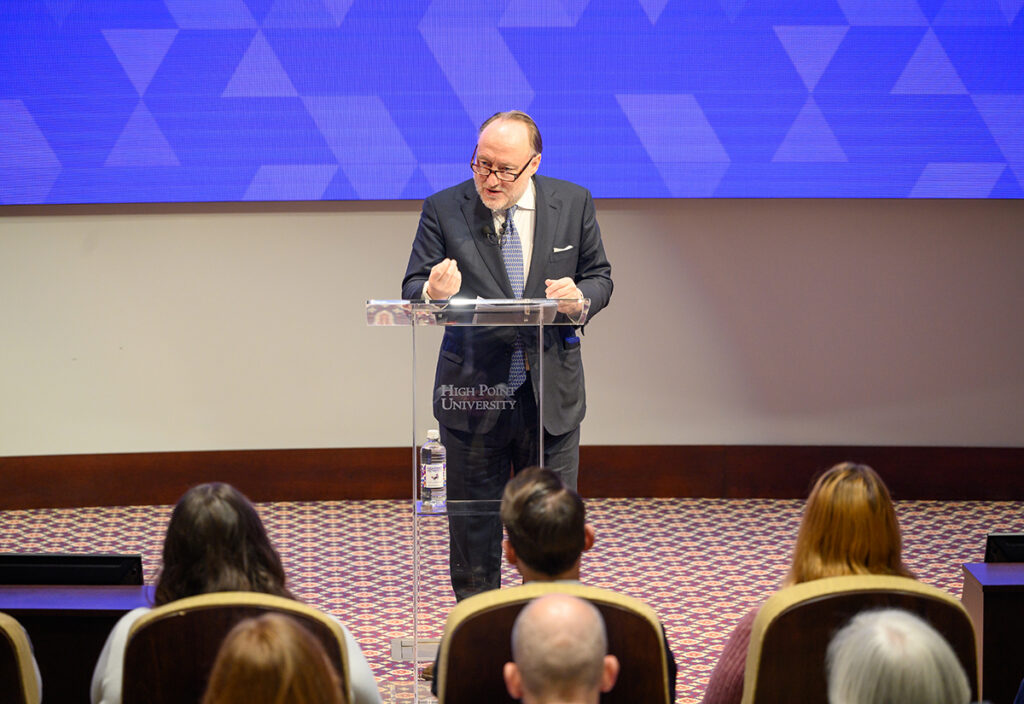
“To invite an Englishman to celebrate the 250th anniversary of the Declaration of Independence seems somewhat sadistic of you,” he joked. “But as [America has] invited his majesty the King to do the same thing in June, I’m not going to take it personally. There will be no sour grapes in this speech because the fact is that by the 1770s, it was the right time for America to become independent.”
Lord Roberts serves as a member of the House of Lords, the upper house of the United Kingdom’s Parliament, in addition to being a historian and journalist who has published 20 books that have been translated into 28 languages. His books include the New York Times bestseller “Churchill: Walking with Destiny,” a biography of the late United Kingdom Prime Minister Winston Churchill. The Wall Street Journal named it one of the best books of 2018.
He serves as the Bonnie and Tom McCloskey Distinguished Visiting Fellow at Stanford University’s Hoover Institution. He has delivered a lecture at the White House and spoken at such prestigious institutions as Princeton, Yale, the University of Cambridge and the University of Oxford. He is also a regular commentator on TV and radio, offering expert commentary about historical events.
The Right Leadership at the Right Time
One of the themes of his message was that the Founding Fathers are owed the ultimate respect for leading America to its independence.
“The Founding Fathers were immensely brave,” he said. “They took up arms against the most powerful nation in the world at that time. They also created the greatest document of the century – the U.S. Constitution – which co-defined the very best parts of the Enlightenment.”
Much of the success of the American Revolution, Roberts and other historians believe, was due to having the right people in leadership at the right time.
“The leadership shown by the Founding Fathers was utterly remarkable. It’s an incredible thought that in that decade – the 1770s – you had an organizer of the genius of John Adams, a wordsmith as brilliant as Thomas Jefferson, a general of the courage of George Washington, a commonest and essayist as acute as Alexander Hamilton, a statesman as talented as James Madison, a rabble-rouser of the quality of Samuel Adams and a diplomat as persuasive as John Jay.
“It was providential that they were all there and all living in the same decade at the same time in history. Totally infuriating as an Englishman,” he joked again.
A Modern Perspective on King George III
Most things written from an American standpoint about King George III, including that he was “the royal brute,” were largely wartime propaganda, Roberts argued.
“One can understand, wartime propaganda, of course. Everybody does it. The British have done it for hundreds of years,” Roberts said. “Now that you are a fully matured nation celebrating your semi-quincentennial, surely it’s time to dump some of the more ludicrous founding myths, mainly that George III was some kind of a tyrant and dictator.”
Roberts said that historical research shows otherwise, including that George III likely suffered from mental illness.
“Now that we live in a world that has finally destigmatized mental health disorders, I think that should not be held against him morally either. He was the very opposite of a brute. In fact, he was a model monarch of the Enlightenment.”
However, Roberts acknowledged there are at least two grievances against the king that did hold water in the Declaration of Independence – the 17th grievance about taxation rights and the 22nd grievance about Parliament’s legislative rights in the colonies.
“These in and of themselves entirely justified the American Revolution.”
Important Allies
Roberts also shared insight about the commonalities and the differences of how the British constitutional monarchy and America’s constitutional democracy operate.
There are different types of democracy, he said. The monarchical democracy, he argued, has proved a focus of national unity, especially during the two world wars and times of major disruption.
“Britains have found a family on the throne to be more emotionally satisfying than a flag or anthem or written constitution, but we still elect our real rulers and are therefore just as much of a democracy as you,” Roberts said. “With the top job already taken, politicians tend to go into the job for the right reasons – to serve – rather than in order to become the most important person in the country.”
He also noted that European constitutional monarchies tend to be better and closer allies to the United States than European countries that are republics.
He also said during a question-and-answer session after his presentation that it remains important today for America and Great Britain to remain strong allies.
1776 Remains Worth Celebrating
After sharing with a crowd of about 300 people his expertise and on the history of Britain’s monarchy and the Revolutionary War, Roberts concluded that America’s independence is certainly worth celebrating.
“If one was to accept that George III was not a tyrant, then the achievement of the Founding Fathers was all the greater,” Roberts said. “It’s a commonplace theme in history for peoples to escape tyranny – the Israelites escaping the Egyptians, the Greeks fighting against the Turks, the Italians throwing off the Austrians and so on. Fighting for independence, even though you’re not being tyrannized, is much rarer. The America of the 1760s and 1770s was one of the freest societies in the world. The taxation per capita was at 4% of their British cousins.
“Yet such was the desire for sovereign independence that the Founding Fathers were willing to risk everything in their rebellion. Ladies and gentlemen, they deserve celebrating 250 years later.”