HPU Poll 127: North Carolina Likely Voters Weigh in on U.S. Senate Race and More
HIGH POINT, N.C., Sept. 24, 2026 – A new High Point University Poll of North Carolina likely voters found that 50% said they would vote for Roy Cooper and 42% would vote for Michael Whatley in the 2026 U.S. Senate race.
The poll also found 46% of likely voters said they would vote for Anita Earls (Democrat) in the 2026 North Carolina Supreme Court race, while 44% said they would vote for Sarah Stevens (Republican).
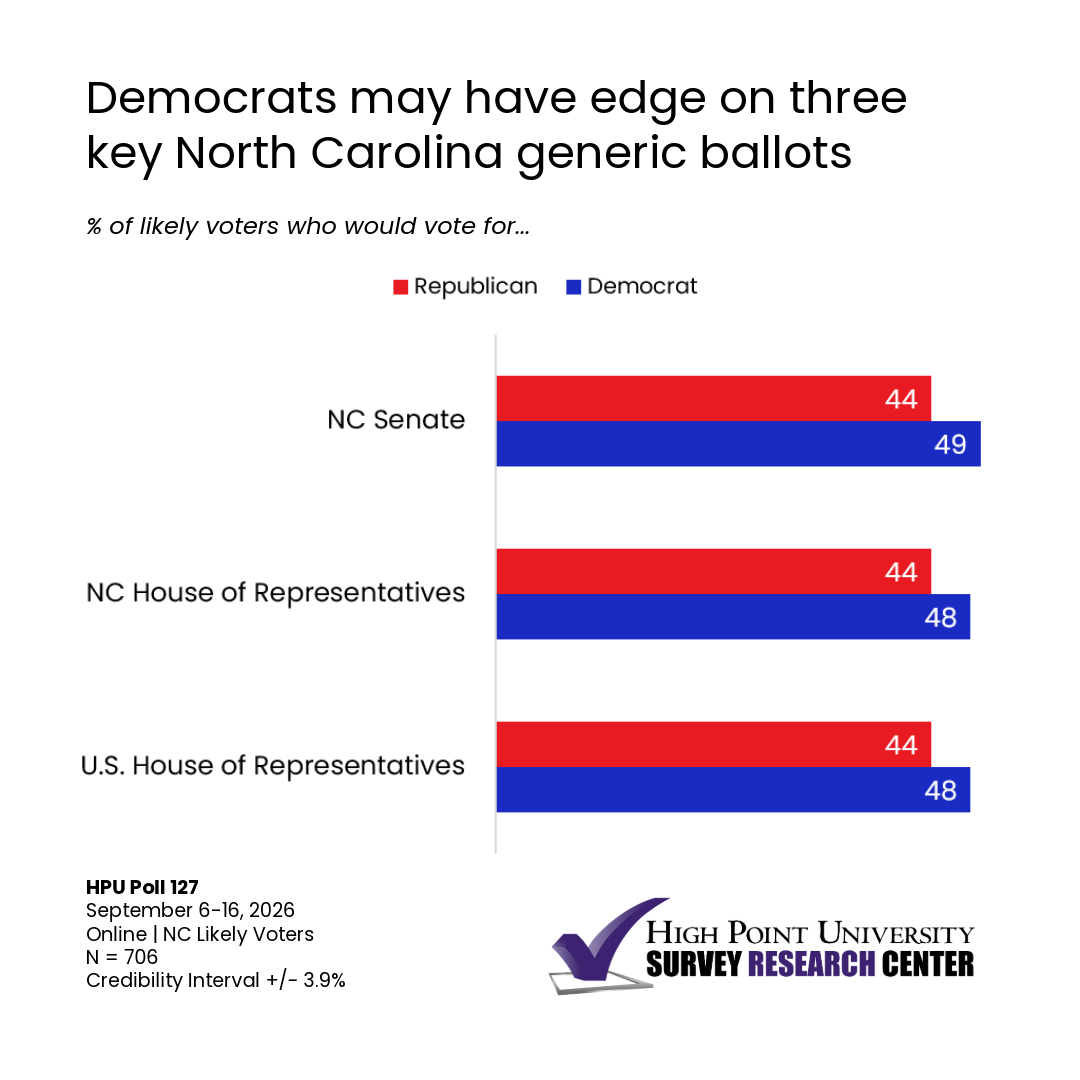
For the U.S. House of Representatives generic ballot, 48% of likely voters said they would vote for the Democratic candidate and 44% said they would vote for the Republican candidate.
In voting for a candidate for the North Carolina House of Representatives, 48% of likely voters indicated they would vote for the Democratic candidate over the Republican candidate (44%).
The election for the North Carolina Senate showed a similar pattern. Nearly half (49%) selected the Democratic candidate, and 44% selected the Republican candidate.
The poll also asked likely voters about the performance of elected officials and government institutions. Likely voters gave President Donald Trump an approval rating of 43%, while 52% disapproved. Vice President J.D. Vance received a 48% approval rating, while 43% disapproved.
When asked if they approved or disapproved of the way the U.S. Supreme Court is handling its job, 44% of likely voters indicated they approved, while 40% disapproved.
One-third of likely voters (33%) approved of the way the U.S. Congress is handling its job, and 53% said they disapproved.
A majority of likely voters (57%) said that the country is on the wrong track, while 37% said the country was headed in the right direction.
More than four in 10 likely voters (41%) said the state of North Carolina was headed in the right direction, while 46% said it was on the wrong track.
Question wordings:
North Carolina Likely Voters – U.S. Senate Election (September 2026)
If the elections for U.S. Senate were being held today, would you vote for Roy Cooper (the Democrat) or Michael Whatley (the Republican) for U.S. Senate?
Roy Cooper (Democrat) – 50%
Michael Whatley (Republican) – 42%
Another candidate – 3%
Unsure – 5%
North Carolina Likely Voters – North Carolina Supreme Court Election (September 2026)
If the elections for North Carolina Supreme Court were being held today, would you vote for Anita Earls (the Democrat) or Sarah Stevens (the Republican) for North Carolina Supreme Court?
Anita Earls (Democrat) – 46%
Sarah Stevens (Republican) – 44%
Another candidate – 3%
Unsure – 8%
North Carolina Likely Voters – U.S. House of Representatives Generic Ballot (September 2026)
If the elections for U.S. Congress were being held today, would you vote for the [Republican Party’s candidate or Democratic Party’s candidate] for U.S. House of Representatives in your district?
Democrat – 48%
Republican – 44%
Another party – 2%
Unsure – 7%
North Carolina Likely Voters – North Carolina House of Representatives Generic Ballot (September 2026)
If the elections for North Carolina House of Representatives in Raleigh were being held today, would you vote for the [Republican Party’s candidate or the Democratic Party’s candidate] for North Carolina House of Representatives in your district?
Democrat – 48%
Republican – 44%
Another party – 1%
Unsure – 7%
North Carolina Likely Voters – North Carolina Senate Generic Ballot (September 2026)
If the elections for North Carolina Senate in Raleigh were being held today, would you vote for the [Republican Party’s candidate or the Democratic Party’s candidate] for North Carolina Senate in your district?
Democrat – 49%
Republican – 44%
Another party – 1%
Unsure – 7%
North Carolina Likely Voters – Country Direction (September 2026)
Do you think things in this country are [generally going in the right direction or do you feel things have gotten pretty seriously off on the wrong track?
Right direction – 37%
Wrong track – 57%
Unsure – 5%
North Carolina Likely Voters – State Direction (September 2026)
Do you think things in North Carolina are [generally going in the right direction or do you feel things have gotten pretty seriously off on the wrong track]?
Right direction – 41%
Wrong track – 46%
Unsure – 12%
North Carolina Likely Voters – Presidential Approval (September 2026)
Do you [approve or disapprove] of the way Donald Trump is handling his job as president?
Approve – 43%
Disapprove – 52%
Unsure – 6%
North Carolina Likely Voters – Vice Presidential Approval (September 2026)
Do you [approve or disapprove] of the way J.D. Vance is handling his job as vice president?
Approve – 48%
Disapprove – 43%
Unsure – 9%
North Carolina Likely Voters – U.S. Supreme Court Approval (September 2026)
Do you [approve or disapprove] of the way that the U.S. Supreme Court is handling its job?
Approve – 44%
Disapprove – 40%
Unsure – 16%
North Carolina Likely Voters – U.S. Congress Approval (September 2026)
Do you [approve or disapprove] of the way that the U.S. Congress is handling its job?
Approve – 33%
Disapprove – 53%
Unsure – 14%
Methodology
HPU Poll 127 was fielded by the High Point University Survey Research Center from Sept. 6-16, as an online survey using a panel of respondents recruited and maintained by Dynata. Dynata sent invitations to its panel of North Carolina respondents, and the SRC collected 1003 responses from adults age 18 and older living in North Carolina using its Qualtrics platform. All interviews were conducted in English.
Respondents were asked screening questions to identify whether they were registered to vote. A total of 813 respondents identified themselves as registered voters. The SRC conducted all data analysis.
The SRC determined likely voters (n = 706) based on seven factors. Respondents received one point for responding to each of seven questions in ways associated with a higher likelihood of voting. The questions asked whether respondents voted in the 2024 general election; how much thought they had given to the upcoming presidential election; how much thought they had given to the upcoming U.S. Senate election; whether they knew where people in their neighborhood go to vote; how often they vote; whether they plan to vote in the election this November; and how they rated their chances of voting in November’s U.S. Senate election on a scale from 1 to 10. Self-identified registered voters who scored 5, 6 or 7 on the seven-item index were considered likely voters. All screening questions are reported in the memo accompanying this release (https://www.highpoint.edu/src/hpupoll/).
The HPU Survey Research Center drafted the survey instrument, which was approved by the HPU Institutional Review Board.
The online sample is from a panel of respondents, and their participation does not adhere to usual assumptions associated with random selection. Therefore, it is not appropriate to assign a classic margin of sampling error for the results.
The SRC provides a credibility interval for HPU Poll 127 of plus or minus 3.2 percentage points for the full (n = 1,003) sample to account for a traditional 95% confidence interval for the estimates (plus or minus 3.1 percentage points) and a design effect of 1.1 (based on the weighting).
For the 813 self-identified registered voters, the credibility interval is plus or minus 3.8 percentage points to account for a traditional 95% confidence interval for the estimates (plus or minus 3.4 percentage points) and a design effect of 1.24 (based on the weighting).
For the 706 respondents classified as likely voters, the credibility interval is 3.9 percentage points to account for a traditional 95% confidence interval for the estimates (plus or minus 3.7 percentage points) and a design effect of 1.1 (based on the weighting).
These are attempts to estimate error from the nature of the sample. Additional factors such as question wording and other methodological choices in conducting survey research can introduce additional error into the findings of opinion polls.
Percentages may not add to 100 due to rounding.
Further results and methodological details from the most recent survey and past surveys can be found at the Survey Research Center website (https://www.highpoint.edu/src/hpupoll/ ). Materials online include past press releases as well as memos summarizing the findings for each poll since 2010.
The HPU Poll reports methodological details in accordance with the standards set out by AAPOR’s Transparency Initiative, and the HPU Survey Research Center is a Charter Member of the Initiative.
Dr. Martin Kifer, chair and professor of political science, serves as the executive director of the HPU Poll for the Survey Research Center.
Dr. J.R. Moller serves as the staff director of the HPU Poll for the Survey Research Center.
Tiffany Medford serves as a program coordinator for the Survey Research Center.