HPU Research and Innovation: August 2026
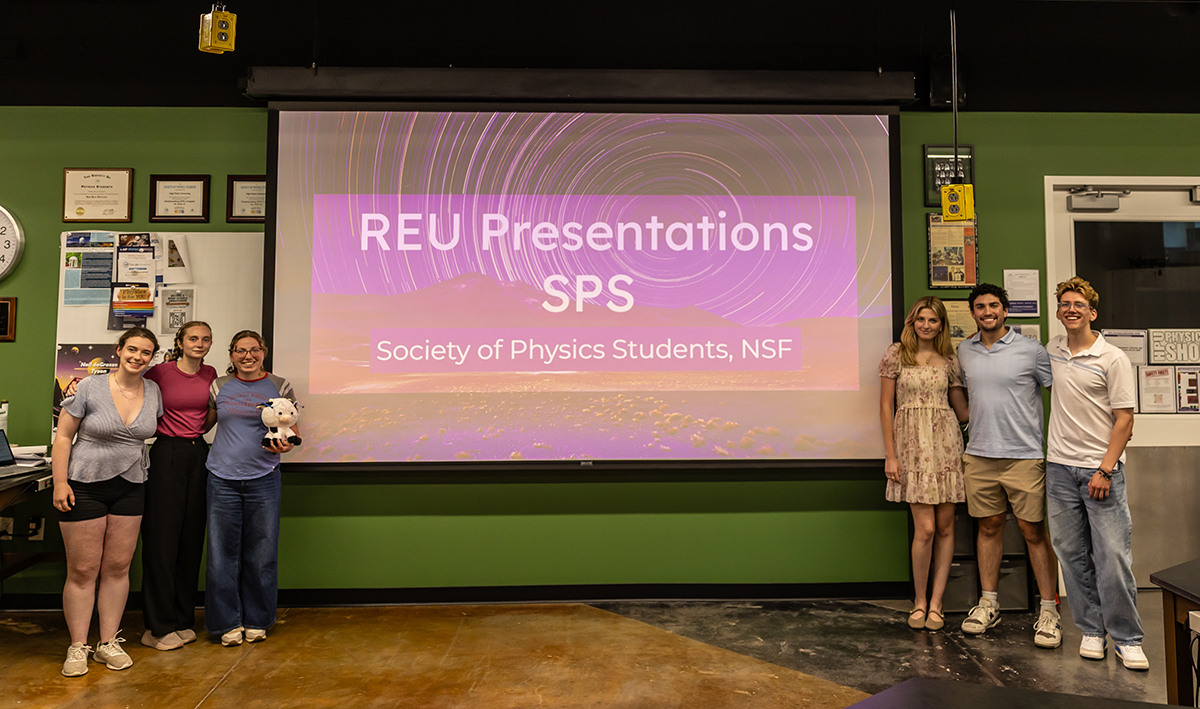
High Point University’s Society of Physics Students (SPS) collaborated with the Natural Science Fellowship (NSF) to host for the first time a program on Aug. 26 to feature six students who conducted hands-on scientific research during the summer. Pictured from left were student presenters Megan Mueller, Skyler Gangestad, Caitlyn Wingeart, Isabella Frankovic, Jake Ankrum and Josh Elbertson.
HIGH POINT, N.C., Sept. 3, 2026 – High Point University students, faculty and staff frequently conduct, publish and share research and creative works in a variety of ways.
Below is a recap of recent research and innovative initiatives.
Physics and Neuroscience Students Present Summer Research Experiences
High Point University’s Society of Physics Students (SPS) collaborated with the Natural Science Fellowship (NSF) to host a program featuring six students who conducted hands-on scientific research during the summer.
On Aug. 26, the students presented their work with Research Experience for Undergraduates (REU), a highly competitive, paid summer program funded by the U.S. National Science Foundation, in the Wanek School of Natural Sciences. Students in the program conduct 10 weeks of scientific research at top-notch research facilities and universities across the United States and internationally.
The six physics and neuroscience students who presented their REUs were Megan Mueller, SPS president and a former NSF officer; Skyler Gangestad, former SPS president; Caitlyn Wingeart, former SPS treasurer and a former NSF officer; Isabella Frankovic, NSF vice president; Jake Ankrum, a Goldwater and RISE scholar and NSF officer; and Josh Elbertson, a former SPS officer and Student Government Association representative.
Mueller, a junior physics major with a minor in mathematics, completed her REU 4,850 feet underground at the Sanford Underground Research Facility (SURF) in South Dakota. She studied nuclear astrophysics using a particle accelerator and a dark matter detector. As she worked underground each weekday to assist scientists with routine maintenance and experimental data collection, she learned about conducting large-scale scientific experiments.
“It showed me possible career opportunities in a scientific field I hadn’t been able to explore until this summer,” said Mueller, who is from Virginia Beach, Virginia. “It opened opportunities and gave me lifelong connections with scientists and professionals in a field I am now greatly interested in pursuing. I also learned new techniques for troubleshooting, which strengthened my knowledge on nuclear physics and what makes up the universe as we know it today.”
Ankrum, a junior biochemistry and physics major with minors in mathematics and biology, interned with the European Molecular Biology Laboratory (EMBL), an intergovernmental institute that conducts innovative scientific research. He worked within the Imaging Centre, a specialized department dedicated to the discovery and dissemination of novel techniques in microscopy with unprecedented detail.
“Most of my time was spent programming physics-inspired algorithms to improve image resolution and explain the effects of cryogenic temperatures on fluorescent dyes used to label cellular structures,” said Ankrum, who is from Monument, Colorado. “When I was not at my desk, I was culturing mammalian cancer cells, selectively modifying their DNA and operating cutting-edge microscopes.”
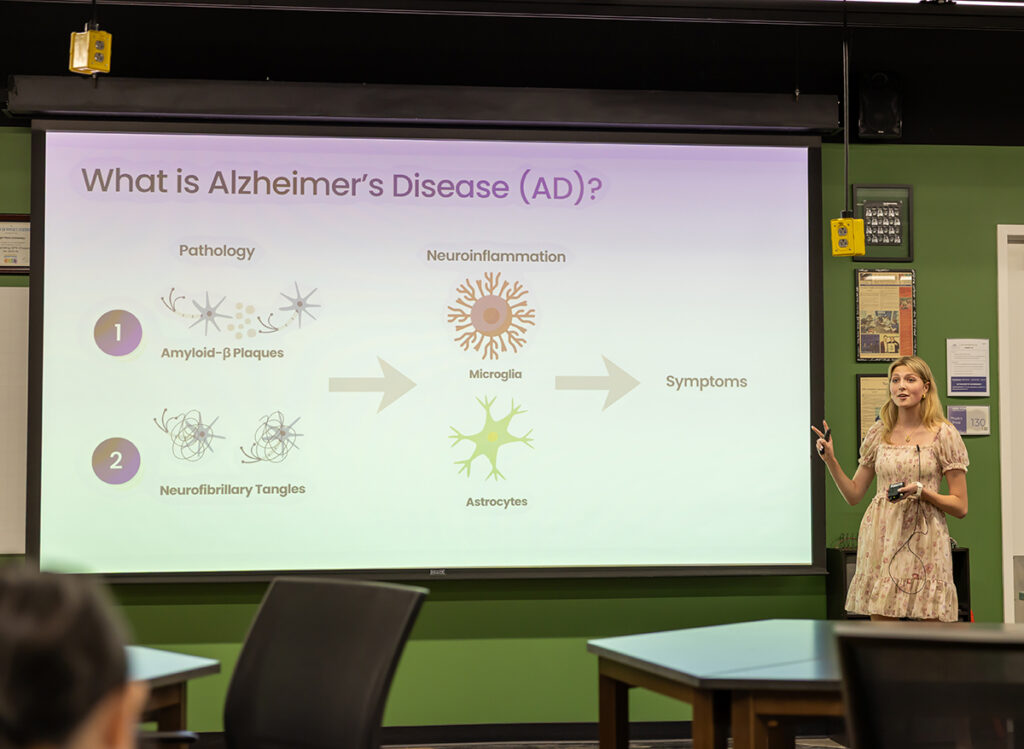
Isabella Frankovic, a junior neuroscience major with a minor in data analytics, participated in the 2026 INSPIRE Medical Neuroscience Summer Research Program at the Stark Neurosciences Research Institute at Indiana University’s School of Medicine. She was part of a first-of-its-kind research program funded by the National Institutes of Health and focused on training young scientists in Alzheimer’s disease and related dementia research.
“I investigated the previously uncharacterized role of an Alzheimer’s disease-associated gene using genetically modified mouse models,” said Frankovic, who is from Baltimore, Maryland.
The experience reinforced her goal to pursue a doctorate in clinical neuroscience and a career in pharmacy, specifically focusing on Alzheimer’s disease and other forms of neurodegenerative diseases. She worked with graduate students pursuing medical neuroscience doctorates and conducting Alzheimer’s disease research. The REU also provided an opportunity to visit Eli Lilly’s international headquarters and speak with scientists in its research and development division.
This wasn’t the first time Frankovic conducted summer research. In 2025, she worked with two other HPU students and Dr. Bill Kochen, professor and founding chair of neuroscience, to investigate the effects of dehydration and creatine on mild Traumatic Brain Injury, also known as concussions.
Elbertson, a junior double major in physics and mathematics, worked in a material sciences lab at Washington State University in Pullman, Washington. Each day in the lab, he took samples of different materials with the goal of observing electrical and chemical responses.
“There’s one big lesson I took away from working in a lab that is very academically focused, and it’s that you need to stay persistent,” said Elbertson, who is from Apex, North Carolina. “It’s critical to keep a positive attitude and stay at that specific task because consistency will bring about results eventually. Understanding that was a big part of my experience this summer, and if I keep that in my mind before I walk into the lab at High Point University and any future labs, I know that it will only be a matter of time before whatever big goal I’m reaching for will be accomplished.”
Professor Honored for Contributions to Physical Therapy Literature
The American Physical Therapy Association (APTA) recently presented Dr. David Sinacore, a physical therapist and professor of physical therapy (PT), with the Helen J. Hislop Award for Outstanding Contributions to Professional Literature. The award recognizes an individual physical therapist for significant contributions to literature in PT or other health care disciplines.
Only one of approximately 300,000 physical therapists nationwide receives this award each year.
“Dr. David Sinacore stands as one of the most prolific researchers globally, but his true legacy is how he actively opens doors for students to co-author and drive groundbreaking research,” said Dr. Lance Mabry, assistant professor of physical therapy. “His mentorship embodies the research excellence of High Point University, proving that our faculty don’t just contribute to science; they cultivate the next generation of innovators.”
Sinacore said the award was a great honor, especially since he had been extremely fortunate to have met and learned from Hislop. Her 1975 national address, “The Not So Impossible Dream,” placed an indelible mark on the PT profession and had a profound influence on him personally, he said.
“My most significant contributions to physical therapy and our professional literature has been focused on the recognition and management of diabetic foot ulcers, which precede 84% of non-traumatic lower extremity amputations performed in the United States,” Sinacore said.
His clinical research focuses on therapeutic interventions for individuals to restore their physical function and prevent amputation. He currently has 133 articles published in the National Library of Medicine’s MEDLINE database, which is six times more than the national average for a career researcher.
Last fall, Sinacore was included for a fourth consecutive year in Stanford University’s annual list of the Top 2% of scientists cited by other researchers around the world.
Sinacore is part of a five-year, $3.9-million grant from the National Institutes of Health to research a newly recognized condition, known as Chronic Kidney Disease-Mineral Bone Disorder (CKD-MBD) syndrome, in the foot. The goals of the grant are to determine the impact of type 2 diabetes, nerve damage and various stages of chronic kidney disease on the foot. The grant started Sept. 1, 2023, and continues through Aug. 31, 2028.
Professor Presents Cataract Research
Dr. Jeremy Whitson, assistant professor of biology, presented his research on age-related cataracts at Nerd Nite at the Kaleideum in Winston-Salem, North Carolina on Aug. 7. Kaleideum is a large children’s museum that opened in downtown Winston-Salem in 2024.

Whitson’s presentation, “The Eye as a Window to Aging,” focused on the crystalline lens (the curved lens inside the eye) as a model to study the effects of biological aging. The crystalline lens represents millions of years of evolution to perfectly focus light and remain transparent, and Whitson’s research examines whether this unique ability could provide more understanding about how humans age.
“Nerd Nite was a great opportunity to present my research to people outside of High Point and outside of the sciences in our local Piedmont Triad community,” Whitson said. “These types of events help to connect us across different fields and industries. I highly recommend that other HPU faculty give a talk at future Nerd Nite events.”