HPU Poll: More North Carolinians Favor Year-Round Daylight-Saving Time
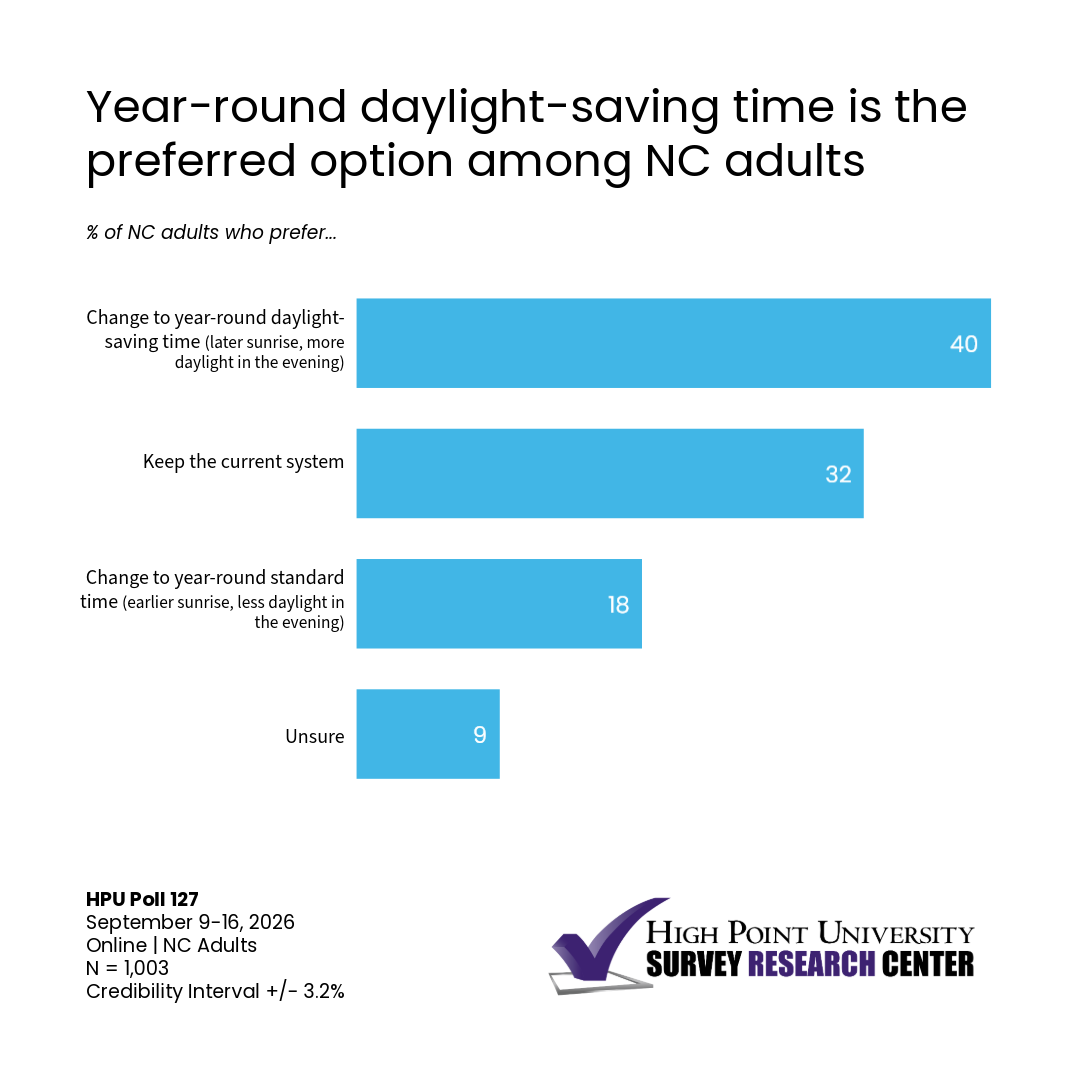
HIGH POINT, N.C., Oct. 27, 2026 – In a recent High Point University Poll, 40% of adults in North Carolina favored switching to year-round daylight-saving time, which would result in more evening daylight. However, 18% of North Carolinians favored changing to year-round standard time, which would result in an earlier sunrise and less evening daylight.
Nearly a third (32%) of North Carolinians preferred keeping the current system, where time jumps ahead an hour in the spring and falls back an hour in the fall to preserve daylight hours. Just less than one in 10 (9%) felt unsure about this topic of switching between standard time and daylight-saving time, which ends again at 2 a.m. on Sunday, Nov. 1.
Daylight-saving time changes can disrupt the body’s natural cycle, said Dr. Racquel Ingram, founding dean of HPU’s Teresa B. Caine School of Nursing.
“Shifting between daylight-saving time and standard time can disrupt the body’s circadian rhythm and affect physical and mental health,” Ingram said. “The change may disturb sleep, contributing to fatigue, depression, cardiovascular events and other health concerns. These effects are often strongest in the first few weeks, so preparing in advance can ease the adjustment.”
HPU Poll 113 reported similar results last November, with 40% of respondents indicating they wanted to switch to year-round daylight-saving time, 11% preferring year-round standard time, 23% desiring to keep the current system, and 25% were unsure.
“There are costs and benefits,” said Dr. Jerry Fox, chair of the Department of Economics within HPU’s Earl N. Phillips School of Business. “Year-round daylight-saving time (DST) eliminates twice-a-year clock changes. It trades late-afternoon daylight for winter morning darkness. Having more sunlight later in the day allows people to be outside and drive home in the daylight. This could reduce evening car accidents and crime. However, permanent DST could disturb the body’s natural rhythm. Morning darkness makes it harder to wake up and could lead to more sleep fatigue. It also creates safety hazards for morning driving and for kids waiting for the school bus in the dark.”
North Carolina Resident Adults – Saving Daylight: Daylight-Saving Time or Standard Time?
Currently in most of the country clocks are set forward by one hour in the spring, called daylight-saving time, and are set back by one hour in the fall to standard time. Which of these do you prefer – change to year-round daylight-saving time (later sunrise, more daylight in the evening), change to year-round standard time (earlier sunrise, less daylight in the evening), keep the current system?
- Change to year-round daylight-saving time (later sunrise, more daylight in the evening) – 40%
- Change to year-round standard time (earlier sunrise, less daylight in the evening) – 18%
- Keep the current system – 32%
- Unsure – 9%
Methodology:
The High Point University Survey Research Center (SRC) fielded HPU Poll 127 from Sept. 9 through Sept. 16, as an online survey using a panel of respondents recruited and maintained by Dynata. Dynata sent invitations to its panel of North Carolina respondents, and the SRC collected 1,003 responses from adults age 18 and older living in North Carolina using its Qualtrics platform. All interviews were conducted in English.
The SRC conducted all data analysis. The online sample is from a non-probability panel of respondents, so it is not appropriate to assign a classic margin of sampling error to the results. For the full all-adults sample (n = 1,003), the SRC provides a credibility interval of plus or minus 3.2 percentage points to account for a traditional 95% confidence interval for the estimates (plus or minus 3.1 percentage points) and a design effect of 1.1 based on the weighting.
HPU’s SRC worked with Dynata to fill quotas for age, gender, race and ethnicity based on estimates within the North Carolina adult population derived from U.S. Census reports. The all-adults data is weighted toward population parameters for age, gender, race, education and ethnicity published by the U.S. Census for North Carolina. The High Point University Survey Research Center produces weights through an iterative procedure within SPSS. Weights are based on demographic variables. Factors such as question wording and other methodological choices in conducting survey research can introduce additional error into the findings of opinion polls.
HPU Polls include at least one CAPTCHA and reCAPTCHA for screening out non-human respondents in addition to the screening done by Dynata. To enhance data quality, the survey included two response quality items that screened out respondents who did not answer them correctly.
The HPU SRC drafted the survey instrument, which was approved by the HPU Institutional Review Board. Interviews were collected through the HPU SRC, recording responses in Qualtrics. Dynata’s online panels invited respondents. Respondents were compensated according to their agreements with Dynata.
The HPU SRC did not use AI for generating responses, interviewing, cleaning data, producing estimates or coding/labeling data.
Further results and methodological details from the most recent survey and past surveys can be found at the Survey Research Center website. Materials online include past press releases as well as memos summarizing the findings for each poll since 2010.
The HPU Poll reports methodological details in accordance with the standards set out by AAPOR’s Transparency Initiative, and the HPU Survey Research Center is a Charter Member of the Initiative.
Dr. Martin Kifer, chair and professor of political science, serves as executive director of the HPU Poll for the Survey Research Center. Dr. J.R. Moller serves as staff director of the HPU Poll for the Survey Research Center. Tiffany Medford serves as program coordinator for the Survey Research Center.