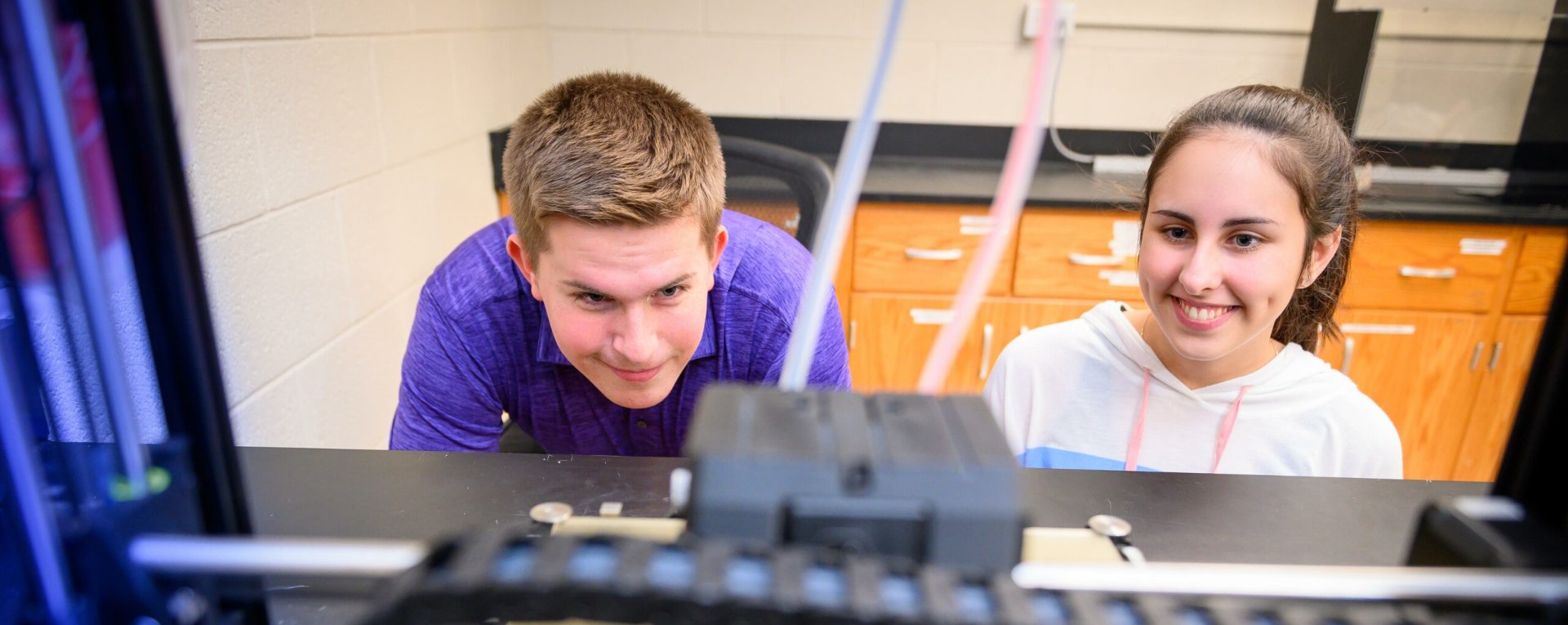
Mechanical, Electrical and Software in One Degree
Mechatronic engineering combines mechanical engineering, electrical engineering and computer science to design intelligent machines and systems. Students take Digital Logic, Circuits and Electronics alongside Dynamics and Advanced Programming, then bring the three disciplines together in Control Systems and Robotics.
Program Contact
Dr. Brian Bernard, [email protected]
Mechatronics Faculty
The program is led by Dr. Brian Bernard, chair and associate professor of mechanical engineering, with courses taught by faculty in mechanical, electrical and computer engineering and computer science across the Webb School of Engineering.
Across all majors, 99% of High Point University’s Class of 2025 was employed or continuing their education within 180 days of graduation, measured by National Association of Colleges and Employers (NACE) standards.
Key Mechatronic Engineering Courses
- ECE 2605: Digital Logic and Computer Systems. Number representation, binary arithmetic and combinational and sequential logic, built on real hardware.
- MME 2200: Dynamics. The motion of particles and rigid bodies and the forces that cause it.
- ECE 2610: Circuits I. Current, voltage, power, energy and resistance in DC and AC circuits.
- CSC 1720: Advanced Programming with Data Structures. Problem-solving strategies, algorithms and basic data structures in an object-oriented language such as C++.
- ECE 4200: Electronics I. Design of analog and digital electronic circuits using diodes and transistors.
- MME 3300: Control of Mechanical Systems. Modeling mechanical systems and designing the feedback controls that govern them.
- MME 4500: Robotics. The mechanics, sensing and control of robotic systems.
- MME or ECE 4900 and 4910: Senior Design Project. A two-semester capstone in which students design, build and test a project approved by a faculty advisor.
See the full Mechatronic Engineering course requirements.
B.S. in Mechatronic Engineering Degree Requirements
The B.S. in Mechatronic Engineering totals 131 credits: 90 credits of major requirements, excluding 8 credits embedded in the University Core, and 48 to 52 credits of University Core requirements.
Required courses include CSC 1710 Introduction to Programming, CSC 1720 Advanced Programming with Data Structures, CSC 4210 Operating Systems, ECE 2605 Digital Logic and Computer Systems, ECE 2610 Circuits I, ECE 4200 Electronics I, MME 2200 Dynamics, MME 2300 Strength of Materials, MME 3300 Control of Mechanical Systems, MME 3400 Vibrations and MME 4500 Robotics, along with four semesters of engineering mathematics. Students finish with a two-semester senior design project in either the MME or ECE sequence.
Seeing the Whole System
Mechatronic engineers work every stage of a project, from concept through blueprint and prototype: the mechanics of a robotic arm, the circuitry of a medical device, and the software that controls both.
The distinguishing skill is systems integration. Mechatronic engineers make mechanical parts, sensors, actuators and software work as one system, then troubleshoot and optimize its performance.
Robotics and artificial intelligence change the field quickly, so mechatronic engineers keep learning throughout their careers.
The Webb School Makerspace
The Makerspace in the Webb School of Engineering is open to students 24/7, starting freshman year with Introduction to Engineering Design. Equipment includes 3D printers, a laser cutter, a computer-controlled router, a vacuum former, a PCB mill, saws, soldering stations and a computer-controlled sewing machine for building electronics into garments.
Makerspace Director Matt Eaton, an instructor in the Webb School, maintains the equipment, works one-on-one with students on their projects and develops programming for makerspace activities. Students use the space for freshman and senior design courses and for their own projects. Questions about the Makerspace can go to [email protected].
Engineering Students Who Went Before
Mechatronic Engineering majors learn alongside Webb School of Engineering students who have already turned that preparation into jobs and internships. Sarah Freeman, an electrical engineering major, interned as a project leader with ASSA ABLOY. Luke Schooley, a computer engineering major, interned with Siemens Healthineers. Emily Lattanzio moved from computer engineering at HPU into embedded software work at STURDY Corporation.
“HPU helped me develop the life skills that are increasingly valuable in today’s technology-driven world.”
Freeman, electrical engineering major
The Princeton Review gives High Point University a 95 out of 99 rating for professor accessibility, based on its student surveys.
Mechatronic Engineering course requirements are listed in the HPU undergraduate bulletin. The Office of Career and Professional Development helps engineering students find internships, and the U.S. Bureau of Labor Statistics describes the work of electrical and electronics engineers. Explore all programs in the Webb School of Engineering.
Explore Mechatronic Engineering at High Point University
See how mechatronic engineering at HPU is accredited and where Webb School graduates go next.
Accreditation & Awards Careers & Student Organizations
Questions about the program? Email Dr. Brian Bernard at [email protected].