Associate Dean of Academics and Professor of Optometry
Over four years and 180 credit hours, students experience an innovative curriculum that combines focused 8-week didactic courses with longitudinal clinical education, allowing them to build knowledge, develop clinical skills, and confidently apply what they learn throughout the program.
This integrated approach creates a seamless progression from foundational science to patient care, preparing graduates to thrive in today's evolving healthcare environment.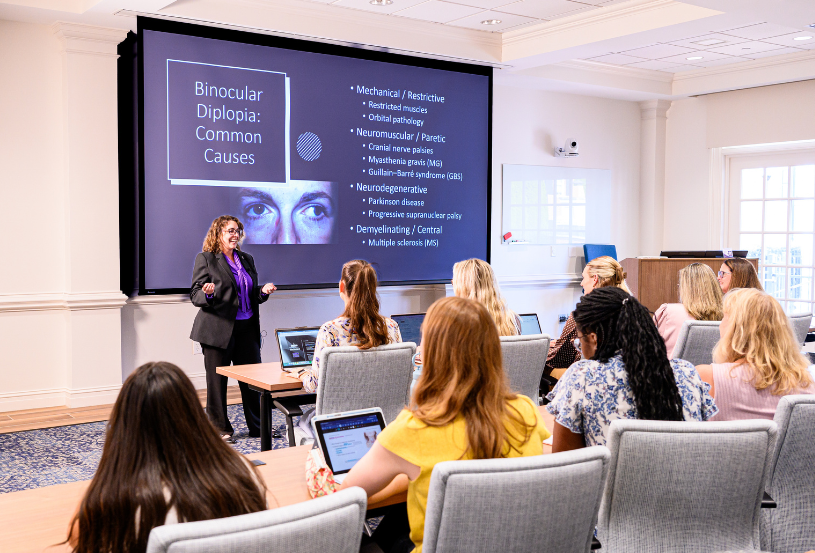
| Semester | Credits |
|---|---|
| Summer Session | 11.5 |
| Fall Semester | 19.25 |
| Spring Semester | 20.25 |
| Total | 51 |
| Course | Course Title | Credits |
|---|---|---|
| OPT 7000, Summer | Inclusive Health Care and Patient Communication | 4 |
| OPT 7010, Summer | Foundations of Clinical Neuroscience (with lab) | 4 |
| OPT 7020, Summer | Introduction to Vision Research I | 0.5 |
| OPT 7030, Summer | Foundations of Applied Basic Science in Optometry | 3 |
| Fall Semester | ||
| OPT 7100 | Clinical Skills I (with lab) | 2 |
| OPT 7110 | Clinical Case Analysis I | 1 |
| OPT 7120 | Introduction to Vision Research II | 0.5 |
| OPT 7130 | Optometric Clinical Experience I | 0.5 |
| OPT 7140 | Optometric Knowledge I | 0.25 |
| OPT 7150, semi-semester | Ocular Anatomy and Physiology I (with lab) | 4 |
| OPT 7160, semi-semester | Ocular Anatomy and Physiology II | 3 |
| OPT 7170, semi-semester | Applied Optics I: Foundations of Visual and Ophthalmic Optics (with lab) | 4 |
| OPT 7180, semi-semester | Applied Optics II: Clinical Visual and Ophthalmic Optics (with lab) | 4 |
| Spring Semester | ||
| OPT 7200 | Clinical Skills II (with lab) | 2 |
| OPT 7210 | Clinical Case Analysis II | 1 |
| OPT 7220 | Introduction to Vision Research III | 0.5 |
| OPT 7230 | Optometric Clinical Experience II | 0.5 |
| OPT 7240 | Optometric Knowledge II | 0.25 |
| OPT 7250, semi-semester | Foundations of Systemic Disease and Pharmacology in Optometry | 4 |
| OPT 7260, semi-semester | Diagnosis and Management of Anterior Segment Disease | 4 |
| OPT 7270, semi-semester | Contact Lenses (with lab) | 4 |
| OPT 7280, semi-semester | Specialty Contact Lenses and Prosthetics (with lab) | 4 |
| Total 1st Year Credit Hours | 51 | |
| Semester | Credits |
|---|---|
| Summer Session | 9.75 |
| Fall Semester | 18.75 |
| Spring Semester | 19.75 |
| Total | 48.25 |
| Course | Course Title | Credits |
|---|---|---|
| OPT 7500, Summer | Advanced Clinical Skills I (with lab) | 1 |
| OPT 7520, Summer | Vision Research Project I | 0.25 |
| OPT 7530, Summer | Optometric Clinical Experience III | 0.25 |
| OPT 7540, Summer | Optometric Knowledge III | 0.25 |
| OPT 7550, Summer | Visual Perception and Neuro-Optometry | 4 |
| OPT 7560, Summer | Diagnosis and Management of Glaucoma | 4 |
| Fall Semester | ||
| OPT 7600 | Advanced Clinical Skills II (with lab) | 2.5 |
| OPT 7610 | Advanced Clinical Case Analysis I | 1 |
| OPT 7620 | Vision Research Project II | 0.5 |
| OPT 7630 | Optometric Clinical Experience IV | 0.5 |
| OPT 7640 | Optometric Knowledge IV | 0.25 |
| OPT 7650, semi-semester | Surgical Procedures of the Anterior Segment and Advanced Technologies (with lab) | 3.5 |
| OPT 7660, semi-semester | Aging and Geriatrics | 3 |
| OPT 7670, semi-semester | Diagnosis and Management of Posterior Segment Disease | 4 |
| OPT 7680, semi-semester | Surgical Procedures of the Posterior Segment and Advanced Technologies (with lab) | 3.5 |
| Spring Semester | ||
| OPT 7700 | Advanced Clinical Skills III (with lab) | 2 |
| OPT 7710 | Advanced Clinical Case Analysis II | 1 |
| OPT 7720 | Vision Research Project III | 0.5 |
| OPT 7730 | Optometric Clinical Experience V | 0.5 |
| OPT 7740 | Optometric Knowledge V | 0.25 |
| OPT 7790 | Clinical Competency | 0.5 |
| OPT 7750, semi-semester | Foundational Science of Binocular Vision (with lab) | 4 |
| OPT 7760, semi-semester | Vision Rehabilitation (with lab) | 3.5 |
| OPT 7770, semi-semester | Vision Development and Pediatrics | 4 |
| OPT 7780, semi-semester | Low Vision and Inherited Ocular Conditions (with lab) | 3.5 |
| Total 2nd Year Credit Hours | 48.25 | |
The Optometric Life Skills track will provide in-depth information on the various modes of optometric practice and includes mini rotations during the second half of the Spring semester based on individual student interest. Students will complete and present their capstone vision research project during the Spring semester.
| Semester | Credits |
|---|---|
| Summer Session | 7.75 |
| Fall Semester | 16 |
| Spring Semester | 13 |
| Total | 36.75 |
| Course | Course Title | Credits |
|---|---|---|
| OPT 8000, Summer | Grand Rounds 1 | 1 |
| OPT 8010, Summer | Vision Research Capstone I | 0.5 |
| OPT 8020, Summer | Optometric Clinical Experience VI | 5 |
| OPT 8030, Summer | Optometric Life Skills I | 1 |
| OPT 8040, Summer | Advanced Optometric Knowledge I | 0.25 |
| Fall Semester | ||
| OPT 8100 | Grand Rounds II | 1 |
| OPT 8110 | Vision Research Capstone II | 1 |
| OPT 8120 | Optometric Clinical Experience VII | 9.5 |
| OPT 8130 | Optometric Life Skills II | 2 |
| OPT 8140 | Advanced Optometric Knowledge II | 0.5 |
| OPT 8150 | Advanced Diagnosis and Management of Ocular Manifestations of Systemic Disease | 2 |
| Spring Semester | ||
| OPT 8200 | Grand Rounds III | 1 |
| OPT 8210 | Vision Research Capstone III | 0.5 |
| OPT 8220 | Optometric Clinical Experience VIII | 9.5 |
| OPT 8230 | Optometric Life Skills III | 2 |
| Total 3rd Year Credit Hours | 36.75 | |
| Requirements | Credits |
|---|---|
| Total | 44 |
| Course | Course Title | Credits |
|---|---|---|
| OPT 8510 (Rotation 1) | Optometric Clinical Experience - 4th Year | 11 |
| OPT 8520 (Rotation 2) | Optometric Clinical Experience - 4th Year | 11 |
| OPT 8530 (Rotation 3) | Optometric Clinical Experience - 4th Year | 11 |
| OPT 8540 (Rotation 4) | Optometric Clinical Experience - 4th Year | 11 |
| The degree of Doctor of Optometry will be conferred on students who successfully complete the four-year professional curriculum in Optometry. Completion of the HPUSO program will academically qualify the graduate to apply for licensure in each of the 50 states. | ||

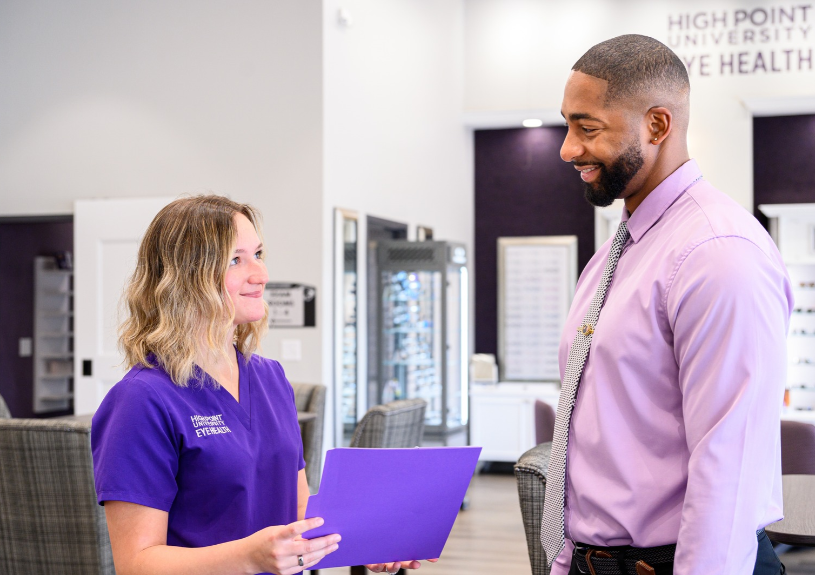
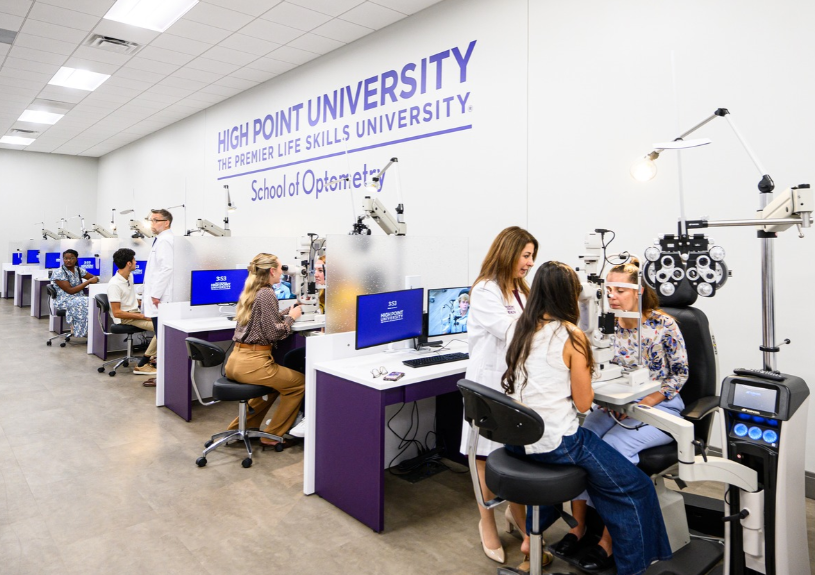
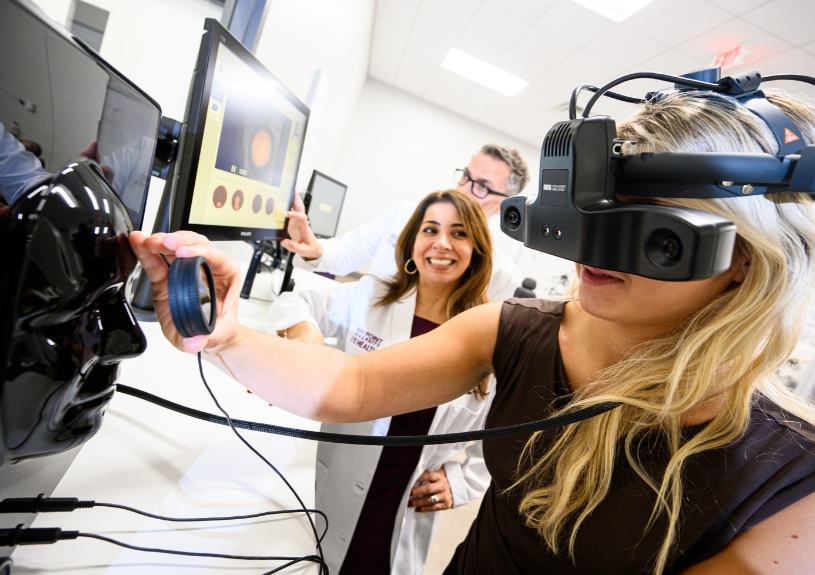
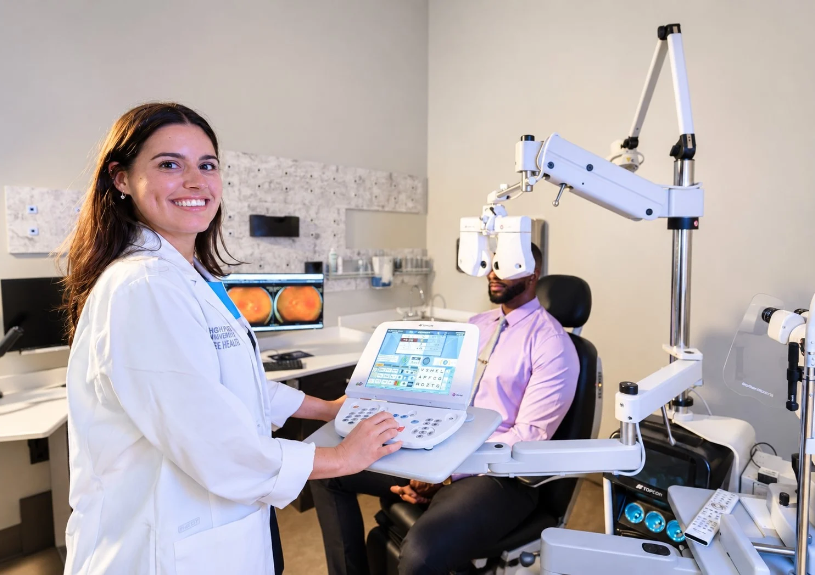
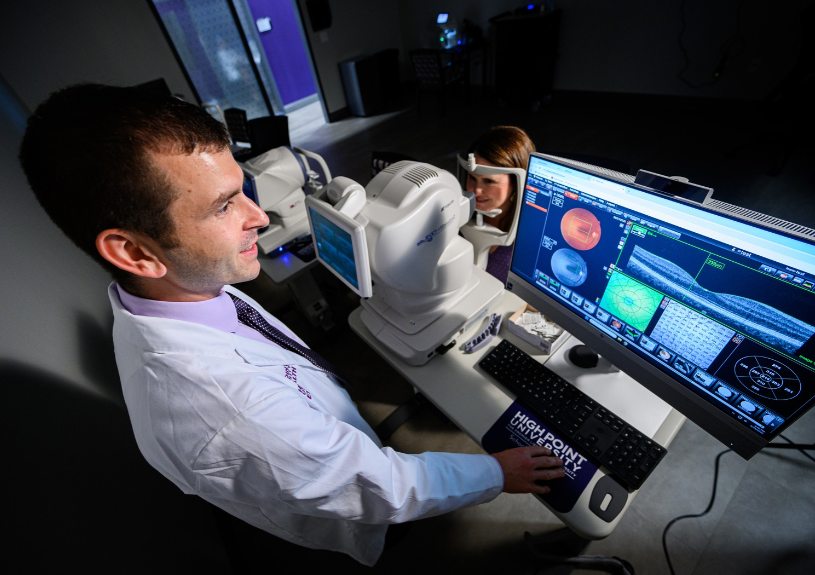
At High Point University School of Optometry, clinical education is intentionally designed to prepare students for the realities of modern optometric practice through a progressive, hands-on learning experience that begins in the first year. Students build confidence and clinical competence by moving seamlessly from foundational classroom instruction to simulation-based skills development in our state-of-the-art Pre-Clinical Laboratory before advancing to faculty-supervised patient care at the HP Eye Institute, the first clinical location of HPU Eye Health, LLC.
Throughout the program, students gain experience caring for diverse patient populations while managing a wide variety of ocular conditions using advanced diagnostic technology and evidence-based clinical practices. With each semester, students assume increasing responsibility in direct patient care under the guidance of experienced faculty, strengthening their clinical judgment, communication skills, and professionalism. During the fourth year, students complete four immersive externships in a variety of healthcare settings, providing broad clinical exposure and preparing them for independent practice or postgraduate residency training.