
One of the most straightforward ways to find resources available in Kahn Law Library and the main HPU Library is to search in the catalog, which is available at the very top of the library home page. The catalog is most helpful in two scenarios, which are almost opposite of each other: 1) if you know precisely what article, chapter, book, or other resource you are looking for, or 2) if you are at the very beginning of a research process and want to know the breadth of resources available. We will cover each scenario in this article.
1) I know what I am looking for, I just need access to it or to know where to locate it.
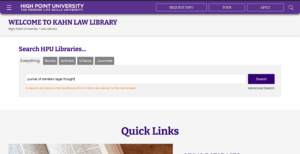
Let’s say you are looking for the print copy of the Journal of Christian Legal Thought that has Dean Gantt’s recent article in it. At the top of the law library home page, input search terms into the catalog search bar.
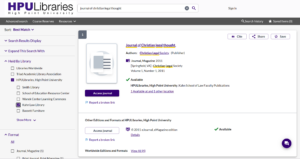
You know the print copy will be in the law library, you’re just not sure of its shelving location or call number. On the left hand side, you can limit the results of your search to only materials in the law library by clicking the box beside “Kahn Law Library.”
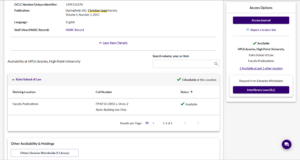
Clicking on the journal title will take you to the page for the item. If you scroll down, you can see that the journal issue is shelved in Faculty Publications and its call number is FP KF10.O852 v. 14 no. 2.
Let’s look at another possibility. A professor has recommended the essay “Archive Fever” by Jacques Derrida as supplemental reading for a class. She assures you it is available through the library, but does not provide the PDF. If you begin again at the basic search and input Archive Fever:
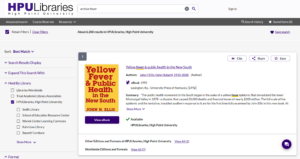
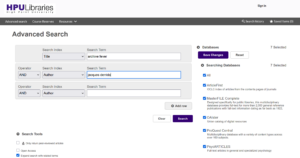
The top several results do not seem to be the essay you are looking for. However, this initial search is just for keywords. If you click on “Advanced Search” in the upper left corner, just under the HPU Libraries logo, you can be more specific. Enter the information you have and choose the type of information from the dropdown menu to the left; in this case, you can put Archive Fever in Title and Jacques Derrida in Author. If you had more information, even more specifics could be added, such as publication year or journal title.
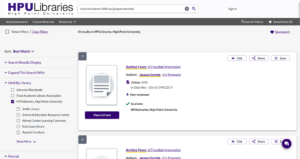
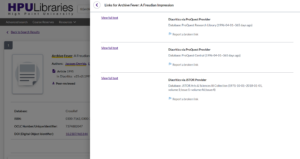
This search is much more successful. The top result offers three ways to access the full text of the essay, which can be read online or downloaded.
2) I have a research question and would like to see what resources are available related to my inquiry.
Let’s say you are interested in the Prisoner’s Dilemma and want to know how else game theory and law interact. You can start simply in the search box again.
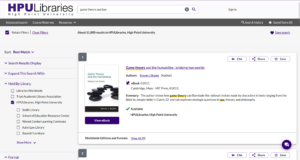
This search returns over 11,000 results, which is definitely too many to browse through for an interest or even an assignment. There are a couple of strategies from here. Either your inquiry is still too broad, you need to limit results to only specific types of resources like books or articles, and/or you need to limit results to resources that are very closely related to your search rather than only tangentially related. First, let’s try limiting results by type of resource. Let’s say you were looking for journal articles. Choose “Articles” in the checkboxes on the left of the screen.
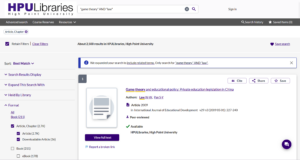
Additionally, you can make the catalog show you only results that include both game theory and law by restructuring your request with Boolean operators. Go back to the search bar and enter “game theory” AND “law”. The quotes mean that only results with those specific words and phrases will be included, and the AND in all capital letters will mean only results with both concepts will be included, not things with just one or the other. You can also click the option that eliminates related terms and only searches for your specific terms.

Now that you have a selection of articles that are probably closer to your topic, how do you choose what to examine more closely? Well, the first three results unfortunately came up because the author’s last name is Law, not because it is about legal topics. However, let’s look more closely at result #4. “Law” and “game theory” are both in the article title. The journal this article is from is the Oxford Journal of Legal Studies. It is fairly recent, published in 2020. This is probably a good option to start reading, or to save for later. You can download the article to a specific folder for your research project, or you can save it to a list by clicking the star in the upper right-hand corner. This is a good option if you want to save many options, then look through them all later for what to download.
Don’t forget that you can go back to the menu on the left and modify the results to look at books instead of articles, if you want to discover more long-form discussions of the topic at hand.