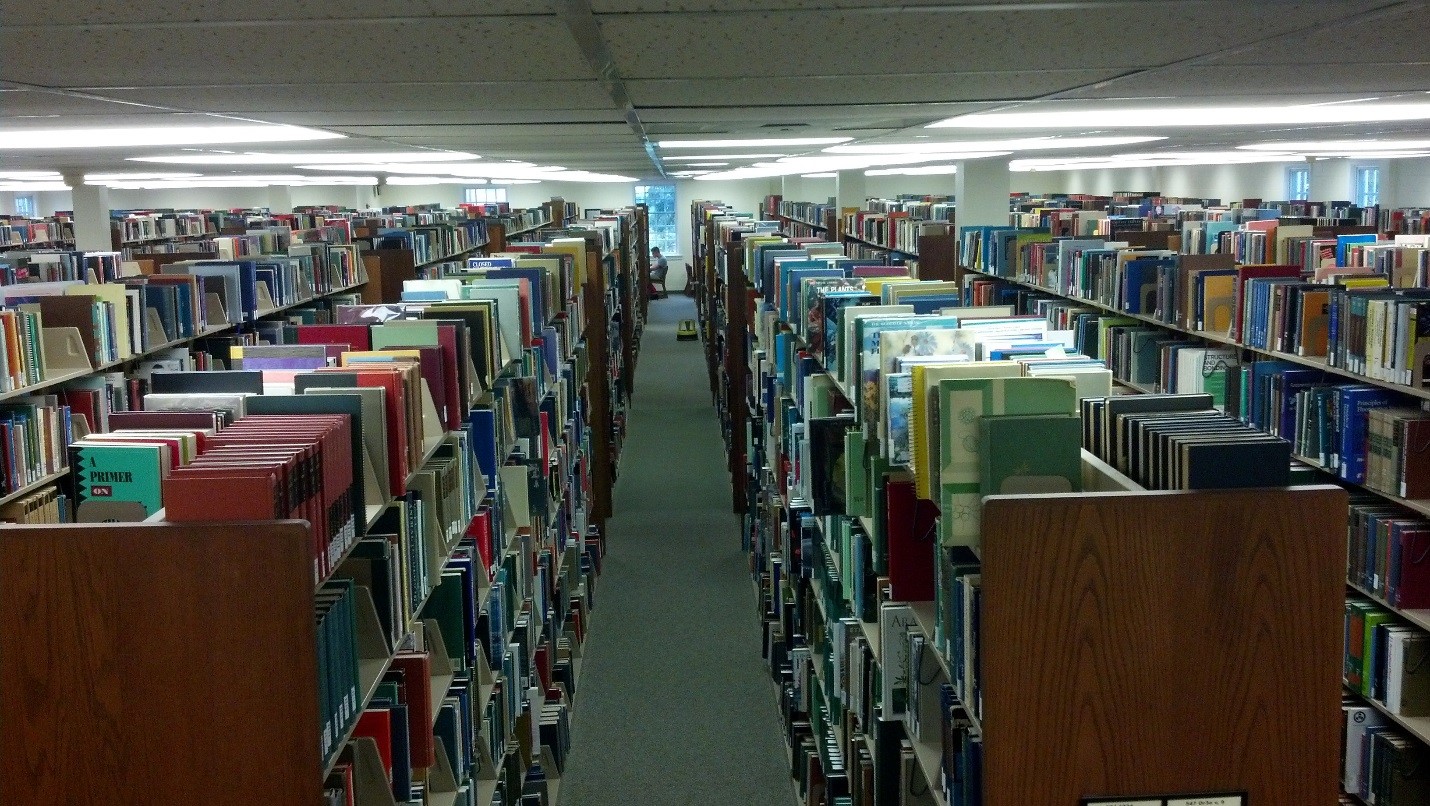
With almost 150,000 items stored on the 3rd floor of Smith Library, finding the book that you’re looking for can be difficult. The public catalog is the tool that we use to help us find the location of a book in the stacks. When you locate an item of interest, the item’s record in the catalog will show the item’s location, status, and call number.
The call number is designed to take you right to the item. The Dewey Decimal Classification System is the tool we use to assign call numbers, and so organize our collection.
Dewey Demystified
Dewey is broken down into ten centuries, beginning with 000-099, and ending with 900-999. Philosophy and Psychology are classed in the 100’s. Religion is classed in the 200’s. The 300’s contain Political Science, Economics, Law, and Education, among other things. Fine Arts are classed in the 700’s, Literature in the 800’s, and History in the 900’s.
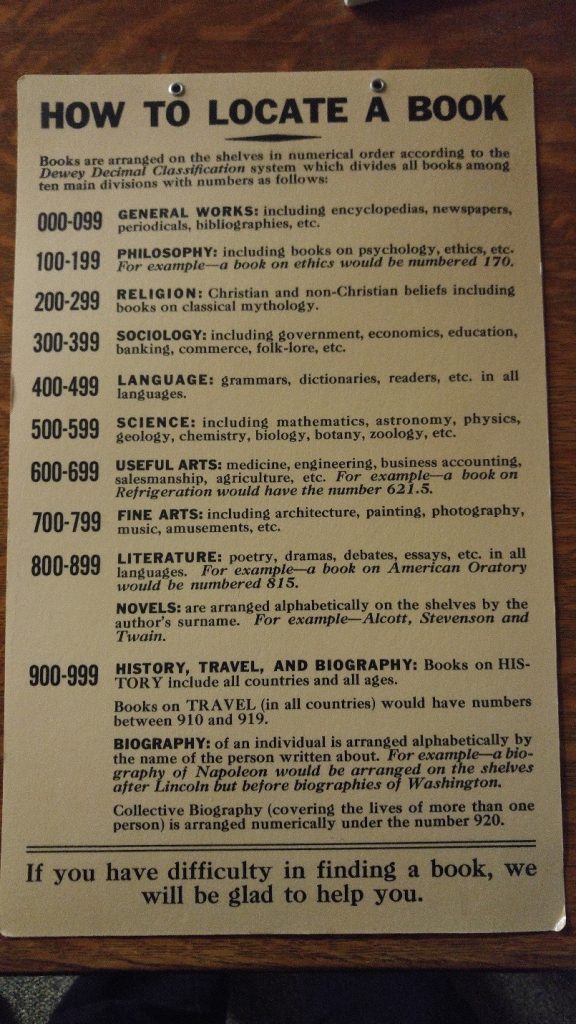
Each century is broken down into decades representing different subsets of the century’s main subject. In the 500’s, Natural Sciences and Mathematics, Mathematics is 510-519, Astronomy is 520-529, Physics is 530-539, Chemistry is 540-549, and so forth.
Each decade is broken down into years. Under the Subject of Astronomy, Celestial Mechanics is 521. Celestial bodies is 523. And here comes the decimal part of the classification. Our solar system can be found under 523.2; Planets of our solar system are classed at 523.41-523.48, with the exception of earth, which is 525.
Once we get into a year in Dewey, the numbers after the decimal allow us to sub-divide the subject into increasingly more specific aspects. 523.8 is stars, and Supernovas are classed in 523.84465.
The Dewey portion of the call number deals specifically with subject. Following that is a “cutter,” which tends to organize materials by author, so that materials on a specific subject will be grouped together, sub-organized by the author’s last name, then by the title of the book. And so we use the Dewey Decimal Classification System to bring like materials together, which increases the likelihood that if you find one book on your subject, you will find others shelved nearby.
With all of these elements of organization, it’s important to bring the whole call number with you to the stacks when you’re looking for a book. With almost 2500 books classed in the 520’s on Astronomy, you can find your book much quicker if you know the whole call number.
Navigating the Stacks
Finally, we offer a map of the 3rd floor stacks to help you estimate where each century starts. But if you get stuck, find a Librarian. We’ll be happy to help.

–Michael Ingram, Technical Services & Systems Librarian