According to the International Federation of Library Associations and Institutions, there are around 2.8 million libraries worldwide. Most of those (2.2 million) are school libraries, over 410,000 are public libraries, and a whopping 85,623 are academic libraries, like those found here at High Point University.
Globally, libraries serve essential functions in promoting same access to information for the communities they serve. Libraries themselves, as physical spaces, provide places for this information to be discovered, accessed and used. Sometimes, the libraries themselves are historical preservations, their design a reflection of the regions in which they were (and are) situated. If you look around the web for the so-called “best” libraries, you will see both relics of the past and ultramodern, architectural marvels. Why do you think that is? Will we look at contemporary libraries with the same awe we hold for the libraries of old?
As you browse this blog post, think about what these libraries, as spaces, represent. Could you see a library like this within the United States? What would it mean for the American people, and how might it change to reflect us and serve our needs?
Bibliotheca Alexindrina
The Bibliotheca Alexindrina was built in commemoration of what is arguably the most famous library in history–the Library of Alexandria.
The Bibliotheca Alexindrina is an excellent example of what a large modern library can contain. In addition to space for 8 million books, it is home to special libraries (including one for the blind and visually impaired) museums, art galleries, a planetarium, and more!
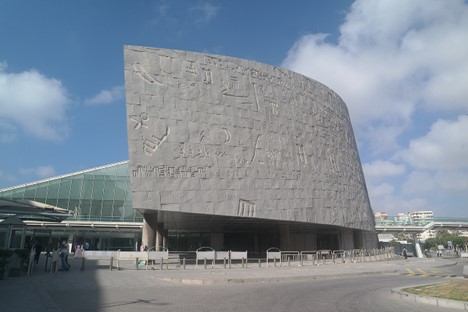
The outside of the Bibliotheca Alexandrina is a sweeping stone circular structure, the inside of which showcases high, clear windows letting in lots of natural light.

The inside is functional and organized, dominated by straight lines and practical furniture in light-colored wood.
Contrary to popular belief, the original Library of Alexandria didn’t exactly burn down in one major, cataclysmic fire. Instead, the library declined over many centuries due to neglect. Part of the already-despairing building was accidentally burned in 48 BC by Caeser’s troops, limping on until an invasion around 270 AD that likely destroyed the rest.
Take a virtual tour here: https://www.bibalex.org/en/Page/BA_Virtual_Tour_Project
Stuttgart Library
The central library for the city of Stuttgart in Germany was located in Wilhelm Palace from 1965-2011.
In 2011, the library left its nearly-200 year old palace home for something no less jaw-dropping: the Stadtbibliothek am Mailänder Platz.
From the outside, the Stuttgart Library looks like any brutalist, concrete square one might see in an American city. But inside, it is a breathtaking, Escher-like space, awash in white, the books like colorful dots along the walls.
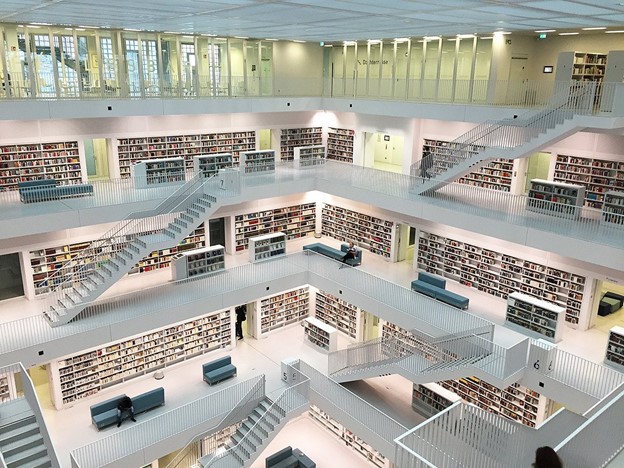
Despite its otherworldly looks, the library serves its city in ways which would be familiar to most any American public library user. Its website lists that books, DVDs, CDs, and magazines are available, tells you how to get a card, and lets you know the checkout periods for items.
Theological Hall Library, Strahoy Monastery
Finally, we have the “Theological Hall” in the Strahov Monastery in the Czech Republic. Built in 1679, the library is older than the formation of our very country!
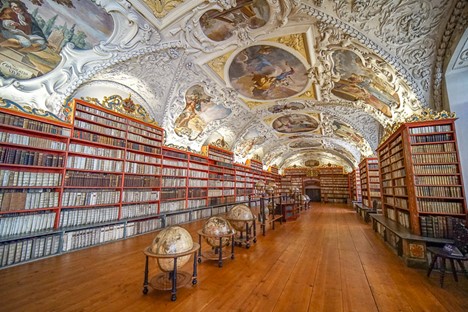
Featuring ceiling frescoes by Siard Nosecký and Anton Maulbertsch.
The library has over 200,000 books, most of which are between 200 to 500 years old. For an entry fee of roughly 7 US dollars, the public can visit the library which is open 7 days a week.
-Blog post by Allison Cruise, Wanek Center Librarian
Sources:
(https://librarymap.ifla.org/)
(https://en.wikipedia.org/wiki/Bibliotheca_Alexandrina)
(https://en.wikipedia.org/wiki/Library_of_Alexandria)
(https://en.wikipedia.org/wiki/Stadtbibliothek_Stuttgart)
(https://en.wikipedia.org/wiki/Strahov_Monastery)
https://czechbyjane.com/wp-content/uploads/2020/12/DSC08095.jpg
