In honor of the new semester, HPU Libraries has two new Reading Challenges. Complete either challenge, and you can enter your name into a drawing to win some free HPU merch!
Challenge One: The Tortured Poets Department Reading Challenge
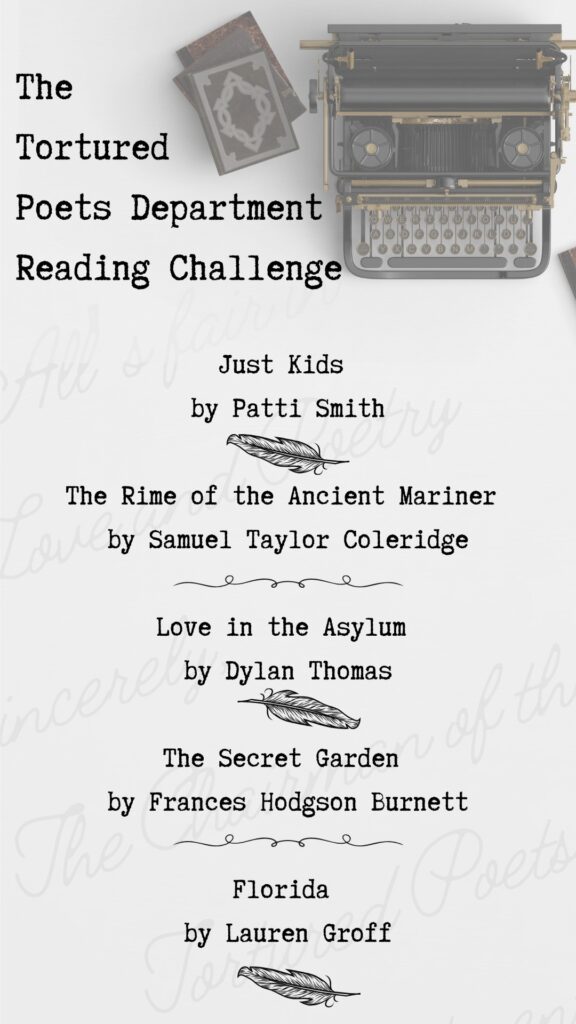 Taylor Swift’s latest album The Tortured Poets Department has shattered records across the Billboard charts. In addition to being the most pre-saved album in Spotify’s history, it was also the most streamed album in a single day upon its release. It also boasts being the first album in Spotify’s history to get to one billion streams in a week.
Swift is known for her lyrics, which frequently include references to classic literature. On theme with the album’s title, several songs reference famous poems and poets, including “The Albatross” which refers to the bird in Samuel Taylor Coleridge’s “The Rime of the Ancient Mariner.” There are also multiple references to poets Patti Smith and Dylan Thomas, the latter of whose poem “Love in the Asylum” fits in perfectly with the motif of madness tying Swift’s album together.
There are also direct references to The Secret Garden by Frances Hodgson Burnett in the song “I Hate it Here” from the album’s anthology. Swift sings, “I hate it here so I will go to/secret gardens in my mind/People need a key to get to/The only one is mine/I read about it in a book when I was a precocious child.” These lyrics tie together a through line of the album: Swift feeling overwhelmed by the many eyes on her at all times and her need to find an escape, whether in the form of a book, a man, or a trip to Florida.
Collaborators on the album also contributed their own literary references. Florence Welch, of Florence and the Machine, stated that she drew on concepts from her favorite collection of short stories, Florida by Lauren Groff, while helping Swift pen the lyrics of their song. “When @TaylorSwift asked me to feature on ‘Florida!!!’ I immediately thought of one of my favourite short story collections by Lauren Groff. Full of ghosts and swamps and storms,” Welch wrote on Instagram.
Challenge Two: The Poetic Justice Reading Challenge
 Swift isn’t the only poet on the Billboard charts. Kendrick Lamar is known for his unique lyricism and infusing his music with statements about political and social justice. Lamar’s song “The Blacker the Berry” takes its name from the book, The Blacker the Berry, by Wallace Thurman. The song tackles issues of police brutality and racism while also contemplating Lamar’s African heritage and pondering his place amongst it all.
Lamar is known by his fans for his elusive personal life. Andreas Hale, a contributor for Medium, writes, “In an era when success doesn’t exist unless you post the futile fruits of your labor on social media, Kendrick Lamar’s has mastered the complexities of the disappearing act.” Lamar’s fans have taken note of this and between his evasiveness and many pointed lyrics in his 2015 album To Pimp a Butterfly, a strong association has formed between the singer and the protagonist of Ralph Ellison’s novel Invisible Man.
In addition to referencing Ellison’s Invisible Man, Lamar’s 2015 song “King Kunta” references Alex Haley’s Novel Roots, the story of an enslaved man from Africa and his descendants in the United States. The song also draws allusions to Chinua Achebe’s novel Things Fall Apart which depicts pre-colonial life in Nigeria and examines the impacts on the community following the arrival of European missionaries to the region.
Between the two poets, Swift and Lamar provide commentary on an array of social and emotional issues and draw from a variety of classic literature, providing a collection of literature to suit every taste and experience.
-Blog post by Kelly Jones, Wanek Center & Health Sciences Librarian