
Update, October 2026: High Point University now provides every student with premium access to ChatGPT and Claude through Microsoft Copilot premium, at no extra cost. See HPU’s AI tools for students.
It is fair to say that AI has become a staple of casual and technological conversations today, and has changed the way we access and consume information. Apple Intelligence is set to release in only a couple short months and other new AI platforms are appearing frequently, each of which is offering vastly different functionalities. With this in mind, it is imperative for us to think about how we use AI in both our academic and personal lives. While some claim that AI will revolutionize the way we live and work, others are more apprehensive about the ramifications of increased AI usage. This HPU librarian has a positive, yet reserved attitude towards AI, especially when it comes to using this technology to conduct academic research. In this blog post, we will explore several AI platforms that have positive applications in academic research. We will also discuss some considerations that users should acknowledge when thinking about integrating AI into their work. Finally, we will offer some helpful resources available at HPU Libraries and online that can help you to make informed decisions about how to use AI tools when conducting academic research. It is significant to note that, since there are many different AI platforms that all have very different functions, it is imperative that you do your research on the strengths and weaknesses of each AI platform you want to use prior to using it to conduct research.
ChatGPT
There is very little doubt in this librarian’s mind that ChatGPT is the most commonly used AI platform today. ChatGPT is a generative AI platform developed by OpenAI that answers user-generated questions by searching the internet and pulling data according to potential patterns it perceives. ChatGPT offers a free version and a paid version with more advanced features. HPU students have premium access to ChatGPT through Microsoft Copilot premium, provided by the university. The examples in this post, written in 2024, use the free version. ChatGPT is very easy to use, which makes it a go-to platform for anyone interested in using AI to conduct any kind of task. Craig Federighi, Senior Vice President of Software Engineering at Apple Computer, recently showed how AI can be seamlessly integrated into daily living to increase our quality of life and productivity. Mr. Federighi also announced that the latest version of Siri will be integrating ChatGPT 4.0 to provide users with a larger knowledge base for more accurate answers to any question we may have (Apple, 2024.)
ChatGPT has many applications that researchers may find helpful when conducting research. ChatGPT can be helpful for brainstorming research topics, thinking of keywords to use when searching for resources on these topics, planning your approach to researching your topic, focusing broader topics into more specific topics and even generating bibliographies of research materials that support your research when you are struggling to find materials.
Figure 1
Keyword Generation in ChatGPT
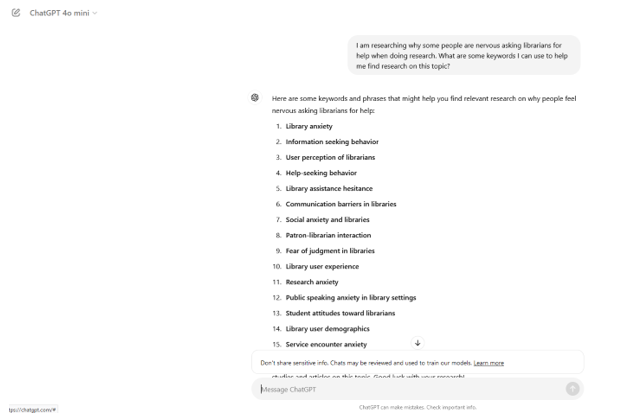
OpenAI. (2024). ChatGPT (Sept. 23 version) [Large language model]. https://chat.openai.com/chat
While all of this sounds like it is too good to be true, ChatGPT also has its fair share of shortcomings that users need to consider when using the software to conduct research. Ray (2023) expresses that some of these shortcomings include the inability to fact-check or provide current information due to an outdated knowledge base; the provision of potentially biased, imaginary, false or misleading information; a lack of contextual awareness; and negative impacts on the environment. For researchers who are not as confident in their research skills, it can be very easy to become dependent on AI software when doing research, which may make it difficult to improve research skills in the future. This librarian recommends using AI software as a supplemental support to your existing research skills. Knowing these strengths and weaknesses of this or any research tool is imperative when using it to conduct research or making any kind of informed decisions.
Consensus
The Consensus AI tool is another AI search tool that is simple to use and very helpful for academic research. Consensus (n.d.) describes their product as:
“An academic search engine, powered by AI, but grounded in scientific research. We use language models (LLMs) and purpose-built search technology (Vector search) to surface the most relevant papers. We synthesize both topic-level and paper-level insights. Everything is connected to real research papers.”
Using Consensus, researchers can ask questions in natural language (ex. do video games cause violent behavior?) and the AI will search for academic and scientific content written by professional researchers. Finally, as its name suggests, it will generate a synthesized communal consensus based on the data it finds on your topic. This summary provided by Consensus is powered by GPT-4 (Consensus, n.d.b) Researchers can then look at a generated list of sources to find materials from rigorous and highly cited journals, as well as see different research study types, such as randomized controlled trials, systematic reviews, observational studies, and more. A wide range of filters is also available to assist researchers in obtaining the exact results they need.
Figure 2
Consensus Search for “Does Listening to Music Reduce Anxiety?”
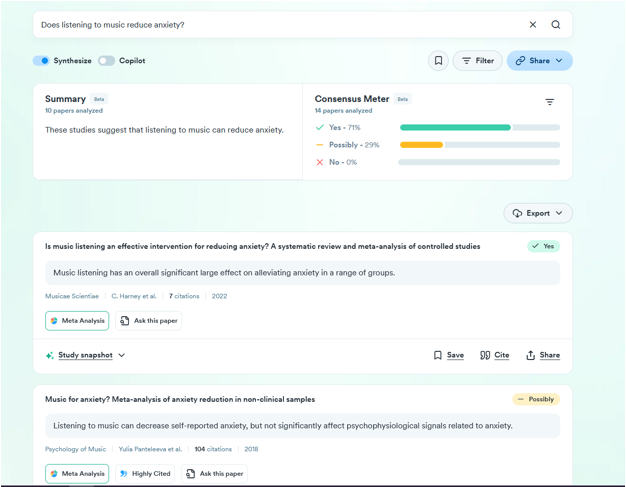
Consensus (2024). Consensus (Sept. 24th version). https://consensus.app/search/
Consensus has a free version as well as paid versions that give users access to different features based on which version they are subscribing to, such as unlimited GPT-4 summaries, unlimited access to Consensus Copilot, unlimited bookmarks and lists, and more (Consensus, n.d.a). While this tool offers very useful features when it comes to research, it is still critical that users be aware of what this software can’t do. Consensus is, at its core, a large language model (LLM), like ChatGPT (Consensus, n.d.). Knowing this, researchers can expect to encounter some of the same shortcomings as they would with ChatGPT and other LLM-based AI. Despite these shortcomings, Consensus is still a very helpful guide to finding information on your research topic.
ResearchRabbit
The final AI tool up for discussion is a tool called ResearchRabbit. ResearchRabbit is an AI tool that is particularly helpful for researchers conducting literature reviews. ResearchRabbit is a free-to-use tool that allows you to put search terms into its database, choose relevant articles from a list provided by the tool, and then see similar articles that are like the results you have chosen, all placed in an easy-to-read chart.
Figure 3
ResearchRabbit Search for “AI and Academic Libraries”
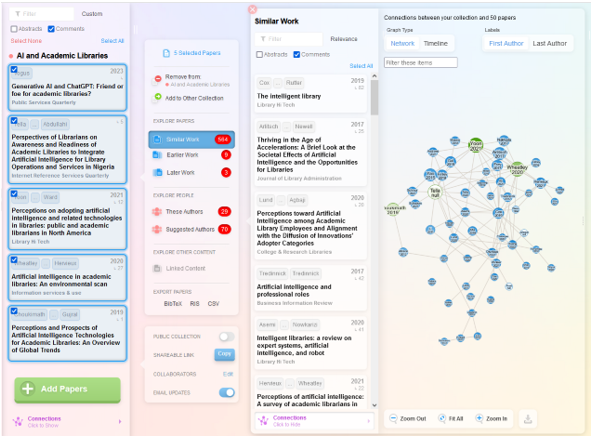
ResearchRabbit (2024). ResearchRabbit (Sept. 29th Version). https://www.researchrabbit.ai/
Once you have these results, you can manipulate the data to find more similar results based on your topic, create a chronological timeline of the research on around your topic, identify prominent authors who have written on your topic, and more. You can even select articles you are interested in and ask ResearchRabbit to create the same visual aid as before; If you ever need to go back to your original chart, ResearchRabbit makes it easy to do so.
As with the other AI platforms discussed in this blog, ResearchRabbit is not without its flaws. ResearchRabbit can be a lot to take in when you’re first getting started; it will take users quite a bit of time and experience with this platform to take full advantage of all its features (Cole & Boutet, 2023.) ResearchRabbit also does not give you a way to save a search to look at later, and the exploration is limited to a linear pathway, which forces the user to remember the branching pathways of citations and authors they have already seen (Cole & Boutet, 2023). If you are willing to put in the time and energy to learning the in’s and out’s of this software, ResearchRabbit can be a very powerful tool to assist you when completing literature reviews or when you are just looking for more sources to complete your research.
Library Resources on AI
As noted earlier in this discussion, if you are interested in using AI to increase productivity or to have a little extra help when conducting research, we highly recommend researching the AI platform of your choosing before you use it. HPU Libraries has quite a few books on ChatGPT that new users may find helpful; a few standout titles include “ChatGPT for beginners: features, foundations, and applications,” “Rise of Generative AI and ChatGPT”, and Applied generative AI for beginners : practical knowledge on diffusion models, ChatGPT, and other LLMs. These texts can give beginning users a much better understanding of generative AI and LLM-based AI, such as ChatGPT and Consensus. For more information on ResearchRabbit, why not check out some of our library databases; users may wish to consider using general databases such as ProQuest Central or computer science databases such as Computer Science Database via NC Live or the Computer Science Database provided by Gale OneFile. The application of AI has implications across many disciplines, such as Health Sciences, Education, Business, and more (Ray, 2023). Users looking for information on the application of AI across these and other disciplines should check out our research guides for books, journals, and other sources of information on this topic. Finally, please refer to the reference section of this blog for more helpful resources on all the AI tools mentioned in this blog. For assistance with citing AI, please refer to this guide provided by Harvard University, or this guide by Brown University.
As always, for any and all other questions you have about using AI for your research, just ask a librarian!
-Blog post by Bryan Nicholls, Evening Librarian
References
Apple. (2024, June 10). WWDC 2024—June 10 [Video]. YouTube. https://www.youtube.com/live/RXeOiIDNNek?si=Z7ZH4R0j9vtbcL84
Cole, V., & Boutet, M. (2023.) Product: ResearchRabbit. Journal of the Canadian Health Libraries Association 44(2), 43-47. https://doi.org/10.29173/jchla29699
Consensus (2024). Consensus search for “Does listening to music reduce anxiety?” [Screenshot] Consensus. https://consensus.app/search/
Consensus (n.d.a). Affordable plans for intuitive & reliable research. Consensus NLP. https://consensus.app/home/pricing/?synthesize=on&copilot=on
Consensus (n.d.b). How it works & Consensus FAQs. Consensus NLP. https://consensus.app/home/blog/welcome-to-consensus/
Gwynedd Mercy University (n.d.). Researcher using AI [Image]. Gwynedd Mercy University. https://www.gmercyu.edu/academics/learn/become-artificial-intelligence-engineer
OpenAI (2024). Keyword generation in ChatGPT [screenshot]. OpenAI. https://chat.openai.com/chat
Ray, P. P. (2023). CHATGPT: A comprehensive review on background, applications, key challenges, bias, ethics, limitations and future scope. Internet of Things and Cyber-Physical Systems, 3, 121–154. https://doi.org/10.1016/j.iotcps.2023.04.003
ResearchRabbit (2024). ResearchRabbit search for “AI and academic libraries.” [Screenshot]. ResearchRabbit. https://www.researchrabbit.ai/