Special Collections Spotlight: Manipulus curatorum, A Manual for the Care of Souls
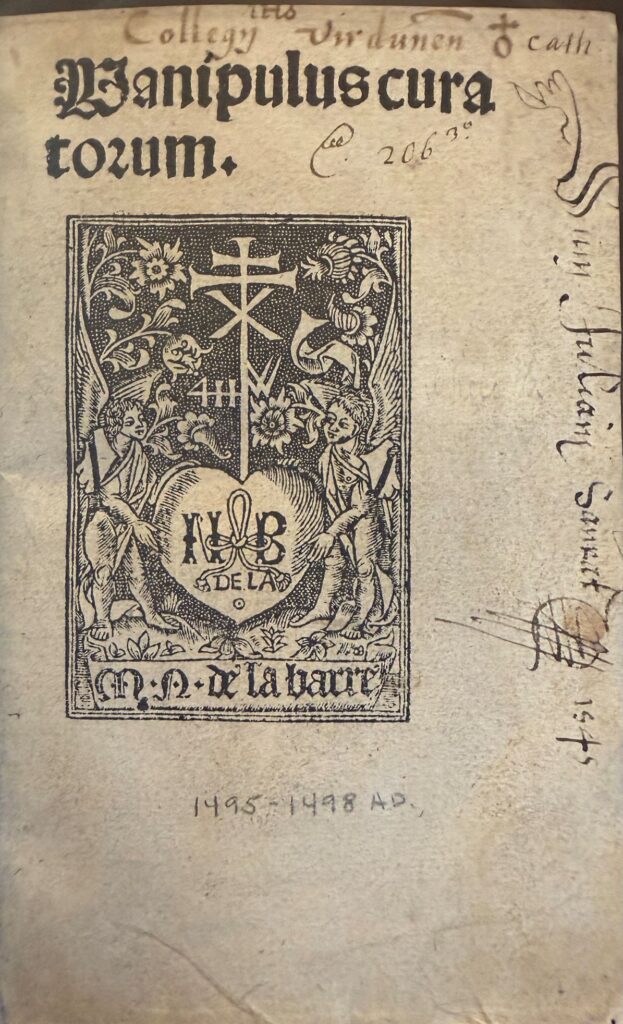
This volume is the oldest book in High Point University Libraries’ collection. Donated anonymously in 2025, this copy of Manipulus curatorum was printed in Paris around 1497, placing it within the incunable period, the first half-century of European printing with movable type. The volume offers a remarkable window into medieval religious practice, the early book trade, and the evidence that books accumulate through centuries of ownership and use.
The Latin title Manipulus curatorum is generally translated as Handbook for Curates. Guido de Monte Rochen composed the work in 1333 as a practical guide for parish priests responsible for the spiritual care of their communities. Its intended readers included recently ordained clergy and priests who lacked extensive university training. By bringing together theology, canon law, and pastoral instruction, Guido created a manageable reference work for the performance of everyday clerical duties. The text became one of the most influential pastoral manuals of the later Middle Ages, circulating widely in manuscript before being reproduced in numerous printed editions.
The handbook is divided into three principal sections. The first discusses the meaning and administration of the sacraments, including baptism, confirmation, the Eucharist, holy orders, extreme unction, and marriage. The second concentrates on penance, confession, contrition, and satisfaction, reflecting the central importance of confession in medieval parish life. The final section summarizes essential Christian teachings, including the articles of faith, the Lord’s Prayer, and the Ten Commandments. Rather than presenting abstract theology alone, the book was designed to help priests address the practical questions and situations they encountered while serving their parishioners.
Printed around 1497, HPU’s copy belongs to a transformative period in the history of the book. Early printers often modeled their products on familiar manuscripts, and this volume retains many features associated with medieval scribal culture. Its dense Gothic type, extensive use of abbreviations, decorated initials, compact page design, and woodcut devices would have appeared familiar to readers accustomed to handwritten books. At the same time, printing made it possible to reproduce pastoral instruction more efficiently and consistently for a broader clerical audience.
The book’s present binding is considerably later than the printed text. It is bound in dark half leather, with leather covering the spine and corners and blue cloth covering the boards. Gilt rules separate the leather from the cloth, while five raised bands divide the spine into six compartments. A gilt-lettered label identifies the volume as Manipulus curatorum. Although this is not the book’s original binding, it represents an important chapter in its material history, showing that a later owner valued the volume enough to have it rebound for continued preservation and use.

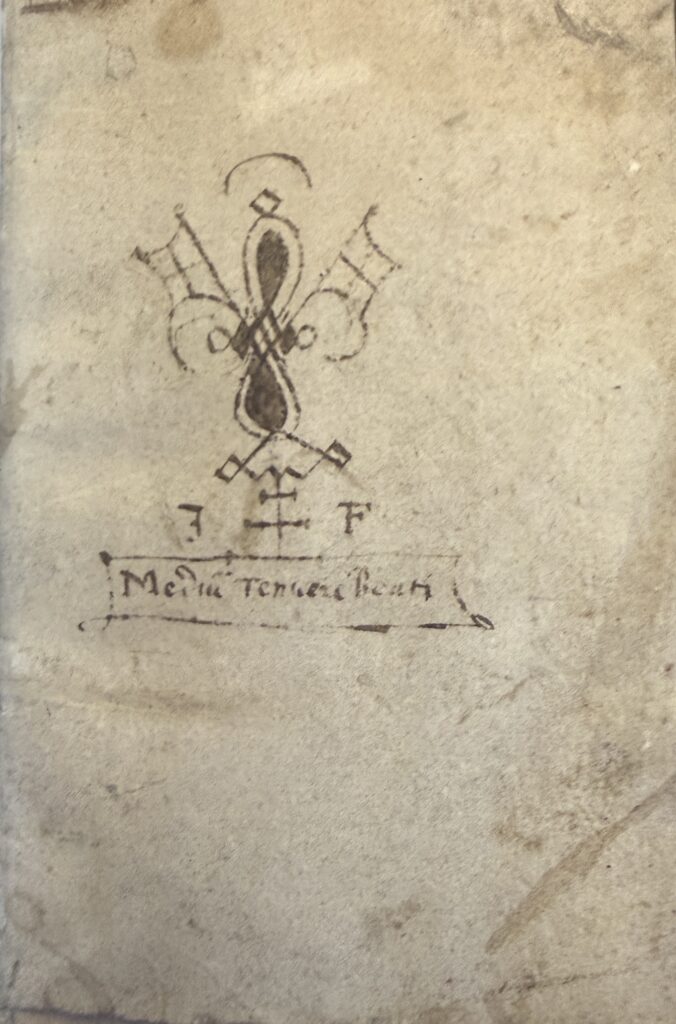
Perhaps the most compelling evidence of that history appears inside. The preliminary leaves and title page contain handwritten inscriptions, monograms, pen flourishes, ownership marks, and other annotations left by earlier readers. These traces remind us that the book was not created as a museum object. It was handled, read, marked, transferred between owners, rebound, and preserved for more than five centuries.
As both a text and a physical artifact, Manipulus curatorum supports the study of medieval religion, incunable printing, typography, bookbinding, provenance, and the early European book trade. Its anonymous donation has given HPU students and researchers the opportunity to encounter this history not simply through a modern description or digital image, but through a surviving object printed during the earliest decades of European print culture.
Blog post by Gerald Ward, Assistant Director, Head of Archives & Special Collections
References
Black, W. E. (2012). Review of Guido of Monte Rochen: Handbook for curates: A late medieval manual on pastoral ministry, translated by A. T. Thayer, with an introduction by K. J. Lualdi. The Medieval Review, 12(06).
Guido de Monte Rochen. (ca. 1497). Manipulus curatorum [Rare book]. High Point University Libraries, Special Collections.
Guido de Monte Rochen. (2011). Handbook for curates: A late medieval manual on pastoral ministry (A. T. Thayer, Trans.; K. J. Lualdi, Intro.). Catholic University of America Press.