
Special Collections Spotlight: Charles Dickens’s A Christmas Carol
Charles Dickens’s A Christmas Carol has become so familiar that it can be easy to forget how new and carefully designed it once was. High Point University Libraries’ copy is a third edition, published by Chapman and Hall in 1843, the same year as the first edition. Its early date, original suite of illustrations by John Leech, and handsome later binding make it both a landmark of Victorian literature and a compelling object in the history of publishing.
Dickens wrote A Christmas Carol in roughly six weeks during the autumn of 1843. He had considered publishing a pamphlet about child labor and poverty, but decided that a story might reach readers more powerfully. The result combines the pleasures of a Christmas ghost story with a sustained concern for poverty, isolation, generosity, and social responsibility. Through Ebenezer Scrooge’s encounters with the Ghosts of Christmas Past, Present, and Yet to Come, Dickens turns a supernatural tale into an argument for recognizing one’s obligations to other people (Evans, 2022).
The first edition appeared on December 19, 1843, in a print run of 6,000 copies and sold out by Christmas Eve. Chapman and Hall quickly issued second and third editions before the end of the year, evidence of the story’s extraordinary reception (Library of Congress, 2015). HPU’s third edition therefore belongs to the earliest wave of publication, before the story had become the cultural institution it is today.

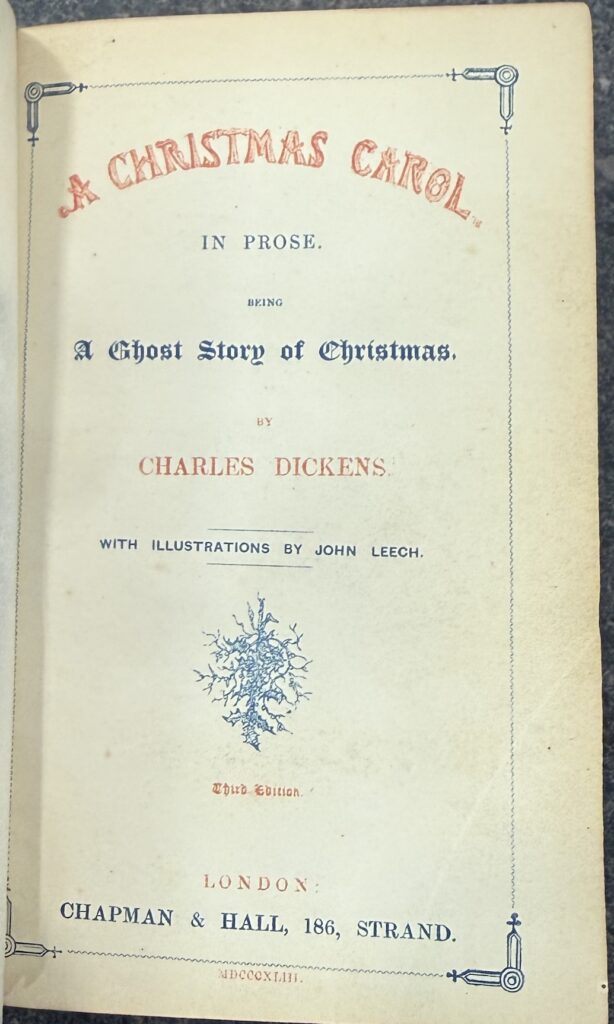
Dickens was deeply involved in the appearance of the book. Working with illustrator John Leech, he included four full-page hand-colored etched plates and four black-and-white wood engravings. These images helped establish the visual identities of Scrooge, the spirits, the Cratchit family, and the crowded scenes of Christmas celebration. HPU’s copy retains these illustrations, including the hand-colored frontispiece and the memorable image of the Ghost of Christmas Present. The title page, printed in red, blue, and black, reinforces the sense that Dickens wanted the book to feel festive, gift-worthy, and visually distinctive rather than merely inexpensive reading (Library of Congress, 2015).
The volume contains 166 numbered pages, followed by advertisements for other works by Dickens. Those advertisements are easy to overlook, but they place A Christmas Carol within the commercial world of Victorian publishing. Titles such as Martin Chuzzlewit, American Notes, Barnaby Rudge, and The Old Curiosity Shop remind us that Dickens was already a major literary brand, and that publishers actively encouraged readers who enjoyed one work to seek out the others.

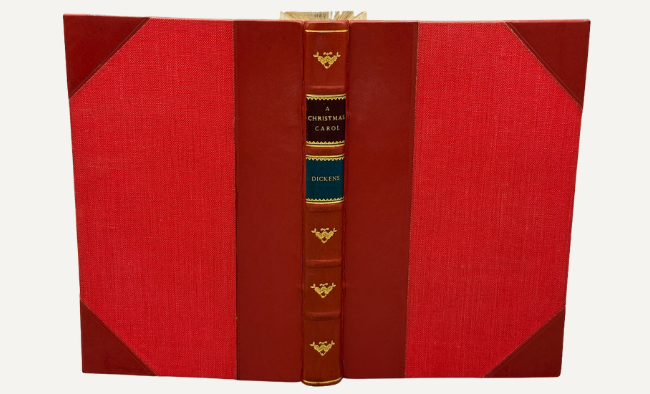
HPU’s copy is preserved in a later half red leather binding, with leather covering the spine and corners and red cloth over the boards. Five raised bands divide the spine into six compartments, several decorated with gilt floral ornaments. Contrasting leather labels identify the title and author, while marbled endpapers complete the design. The binding is not original to the book, but it records a later stage in the volume’s life, when an owner chose to preserve and present it as a valued collectible.
This copy offers more than an opportunity to read a familiar story. It allows students and researchers to encounter A Christmas Carol as an early Victorian book, with its colored illustrations, typography, advertisements, and later evidence of collecting and rebinding. Seen in this form, the work becomes both a literary classic and a material object whose design helped shape the way generations of readers have imagined Christmas.
Blog post by Gerald Ward, Assistant Director, Head of Archives & Special Collections
References
Charles Dickens Museum. (n.d.). First edition of “A Christmas Carol.” https://dickensmuseum.com/en-de/blogs/explore/first-edition-of-a-christmas-carol
Dickens, C. (1843). A Christmas carol in prose: Being a ghost story of Christmas (3rd ed.). Chapman and Hall.
Evans, J. (2022, July 5). 10 surprising facts about Charles Dickens! Charles Dickens Museum. https://dickensmuseum.com/blogs/charles-dickens-museum/10-surprising-facts-about-charles-dickens
Library of Congress. (2015, December 17). Highlighting the holidays: A tale of two publishings. https://blogs.loc.gov/loc/2015/12/highlighting-the-holidays-a-tale-of-two-publishings/