Special Collections Spotlight: Daniel Defoe’s A Journal of the Plague Year
Published anonymously in 1722, A Journal of the Plague Year reconstructs London during the Great Plague of 1665 with such immediacy that readers have long debated where history ends and fiction begins. High Point University Libraries’ copy is a first edition, printed in London for E. Nutt, J. Roberts, A. Dodd, and J. Graves. Its importance extends beyond the text itself: the volume is preserved in a fine later binding and carries the bookplate of the noted American collector A. Edward Newton.

The title page does not name Daniel Defoe. Instead, it presents the work as the observations of “a Citizen who continued all the while in London,” and the final page is signed only “H. F.” Defoe was about five years old during the plague, so the narrative could not have been his adult eyewitness account. The narrator may have been inspired in part by Defoe’s uncle Henry Foe, although no journal or manuscript by Henry is known to survive. Defoe’s authorship was not publicly proposed until later in the eighteenth century, and scholars have continued to examine the book’s unusual mixture of documentary evidence and imaginative reconstruction (Greenberg, 2021).
H. F., presented as a London saddler, chooses to remain in the city as the disease spreads. He describes deserted streets, shuttered houses, mass burials, disrupted trade, religious fervor, fear, questionable remedies, and the difficult choice between flight and remaining at home. Defoe strengthens the impression of eyewitness reporting by naming streets and neighborhoods, reproducing mortality statistics, and recounting the experiences of particular families and individuals. The result resists a simple label. It can be read as novel, memoir, journalism, social history, or some combination of all four.
The first edition was issued in octavo and contains 287 numbered pages followed by a final unnumbered page. It ends with a brief verse in which H. F. recalls the plague that “swept an Hundred Thousand Souls away,” followed by an ornamental printer’s device and the word Finis. The edition was originally issued with a half-title, although preliminary leaves do not survive in every copy (Folger Shakespeare Library, n.d.). These physical details help distinguish individual copies and remind us that even books from the same edition can develop different histories over three centuries of use.
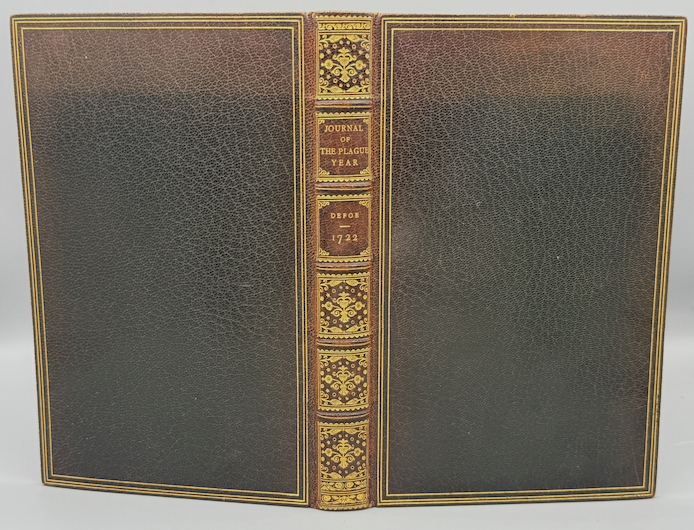
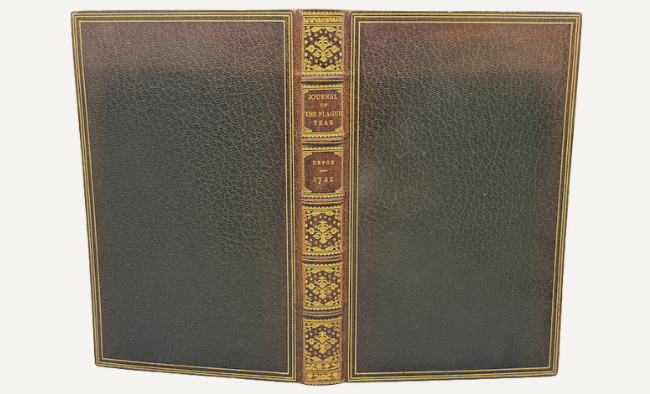
HPU’s copy is housed in a handsome later binding of full dark green morocco. Triple gilt fillets frame the boards, while raised bands divide the spine into compartments filled with intricate gilt floral tooling. Two contrasting leather labels identify the title, author, and publication date. Elaborately gilt inner turn-ins surround marbled endpapers. The binding is far more luxurious than the restrained typography of the original text, reflecting the status the book acquired among later collectors.
That collecting history is especially visible on the front pastedown, which bears the distinctive 1909 bookplate of A. Edward Newton and identifies his library at Oak Knoll. Newton was one of the best-known American bibliophiles of the early twentieth century. Through books and essays about collecting, he helped popularize the pleasures of rare books among a broad reading public. His library was particularly strong in English and American literature, making his ownership of this first edition a meaningful part of the volume’s provenance (Boston Athenaeum, n.d.; Post, 2005).

HPU’s copy can therefore be read on several levels at once. It is a first edition of a work that challenges the boundaries between fiction and historical record; it is a finely rebound object shaped by later ideas of rarity and value; and it is a book with a documented place in the library of an important American collector. More than three centuries after its publication, A Journal of the Plague Year still shows how print can preserve not only the facts of a public crisis, but also its fear, uncertainty, rumor, and lived experience.
Blog post by Gerald Ward, Assistant Director, Head of Archives & Special Collections
References
Boston Athenaeum. (n.d.). Bookplate of A. Edward Newton [Bookplate]. Boston Athenaeum Digital Collections. https://cdm.bostonathenaeum.org/digital/collection/p16057coll22/id/240/
Defoe, D. (1722). A journal of the plague year: Being observations or memorials, of the most remarkable occurrences, as well publick as private, which happened in London during the last great visitation in 1665. E. Nutt, J. Roberts, A. Dodd, and J. Graves.
Folger Shakespeare Library. (n.d.). A journal of the plague year [Catalog record]. Folger Shakespeare Library. https://catalog.folger.edu/record/844099
Greenberg, S. J. (2021, January 7). Defoe and the plague year. Circulating Now from the Historical Collections of the National Library of Medicine. https://circulatingnow.nlm.nih.gov/2021/01/07/defoe-and-the-plague-year/
Post, J. B. (2005). A. Edward Newton and Oak Knoll. Tredyffrin Easttown History Quarterly, 42(1), 27–28. https://www.tehistory.org/hqda/html/v42/v42n1p027.html