
Special Collections Spotlight: Sir Walter Scott’s Letters on Demonology and Witchcraft
Sir Walter Scott’s Letters on Demonology and Witchcraft brings together two things that make rare books especially engaging: an unusual text and a binding that interprets it. Published in London by John Murray in 1830, this first edition surveys centuries of belief in witches, demons, ghosts, fairies, apparitions, and other supernatural phenomena. HPU’s copy is made even more distinctive by a lavish later Kelliegram binding whose pictorial decoration turns the exterior of the book into an introduction to the subject within.

Scott presents the work as ten letters addressed to his son-in-law, literary executor, and future biographer, John Gibson Lockhart. Lockhart suggested the project while Scott was recovering from a stroke in 1830, hoping that a short contribution to Murray’s popular Family Library would be less demanding than the author’s other work. The subject, however, was hardly incidental to Scott. Folklore, witchcraft, criminal trials, and supernatural traditions had interested him since childhood, and his library at Abbotsford contained extensive material on these subjects. He completed the manuscript within several months, and the book appeared on September 14, 1830 (University of Edinburgh Library, n.d.).
Across the ten letters, Scott traces explanations of supernatural experience from the ancient world through the Middle Ages, the Reformation, the European witch trials, and his own time. He recounts stories of apparitions, fairies, elves, magicians, demonic possession, judicial persecution, and supposed witchcraft in Scotland, England, continental Europe, and colonial America. The engraved frontispiece depicts Edinburgh’s West Bow and the former home of Major Thomas Weir, whose sensational seventeenth-century confession and execution helped give the house a lasting reputation as a haunted place.

Scott was a master of Gothic atmosphere, but his treatment of the supernatural is often skeptical. He attributes many visions and apparitions to illness, heightened emotion, fraud, fear, or credulity, and he is sharply critical of the legal systems that accepted unreliable testimony and coerced confessions in witchcraft cases. The book therefore operates on two levels at once. It preserves a rich collection of eerie stories while also examining the historical conditions that made those stories believable. Later scholars have regarded it as an important precursor to the study of folklore, popular religion, and cultural belief, even though contemporary reviewers differed over its scholarly merits (University of Edinburgh Library, n.d.).
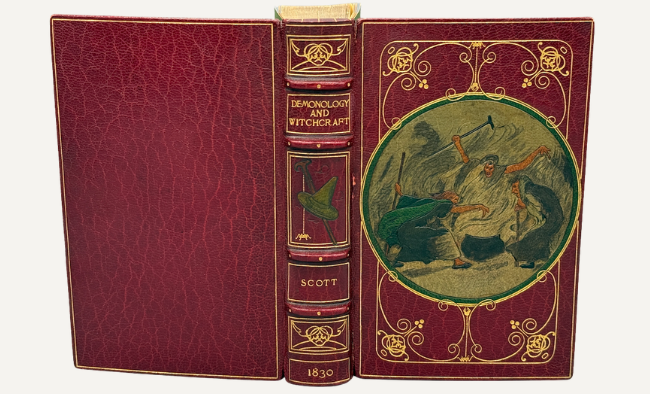
The binding of HPU’s copy gives the volume an entirely different kind of presence. Executed by Bayntun as a Kelliegram binding, it is covered in full red morocco with gilt rules and elaborate curvilinear ornament. A large multicolored pictorial panel on the front board depicts three witches gathered around a steaming cauldron. Five raised bands divide the spine, which is decorated with gilt lettering, floral ornament, and a small pictorial onlay of a witch’s hat. Green silk doublures, broad gilt-ruled leather turn-ins, and gilt edges complete the design, and the binder’s stamp appears along the lower turn-in.

Kelliegram bindings are especially associated with pictorial designs built from differently colored pieces of leather. In this case, the binding does more than protect or beautify the book. It interprets it. The witches, cauldron, hat, and gilt ornament translate Scott’s subject into a visual language that a reader encounters before opening the volume. The result also illustrates an important aspect of book history: later binders and collectors can profoundly reshape how an older text is presented and understood.
For teaching and research, this volume opens paths into literature, folklore, the history of witchcraft, skepticism, popular belief, illustration, collecting, and fine binding. Its text asks why people believed in the supernatural, while its later binding shows how subsequent readers chose to imagine and package those beliefs. Together, the two make this first edition a particularly rich example of the book as both text and artifact.
Blog post by Gerald Ward, Assistant Director, Head of Archives & Special Collections
References
George Bayntun. (n.d.). The bindery. Bayntun-Rivière. https://www.georgebayntun.com/the-bindery
Scott, W. (1830). Letters on demonology and witchcraft, addressed to J. G. Lockhart, Esq. John Murray.
University of Edinburgh Library. (n.d.). Letters on demonology and witchcraft. The Walter Scott Digital Archive. https://www.walterscott.lib.ed.ac.uk/works/prose/witchcraft.html