The Core Sequence
Mechanical engineering applies physics and mathematics to design, develop, build and test mechanical devices and systems. Courses build on one another: statics before dynamics, strength of materials before vibrations, and thermodynamics before heat transfer.
Program Contact
Dr. Brian Bernard, [email protected]
Mechanical Engineering Faculty
Dr. Brian Bernard is chair and associate professor of mechanical engineering, and Neil Petroff is an associate professor of mechanical engineering.
Key Mechanical Engineering Courses
- MME 1005: Introduction to Engineering Design. Hands-on design projects that teach the engineering design process from the first semester.
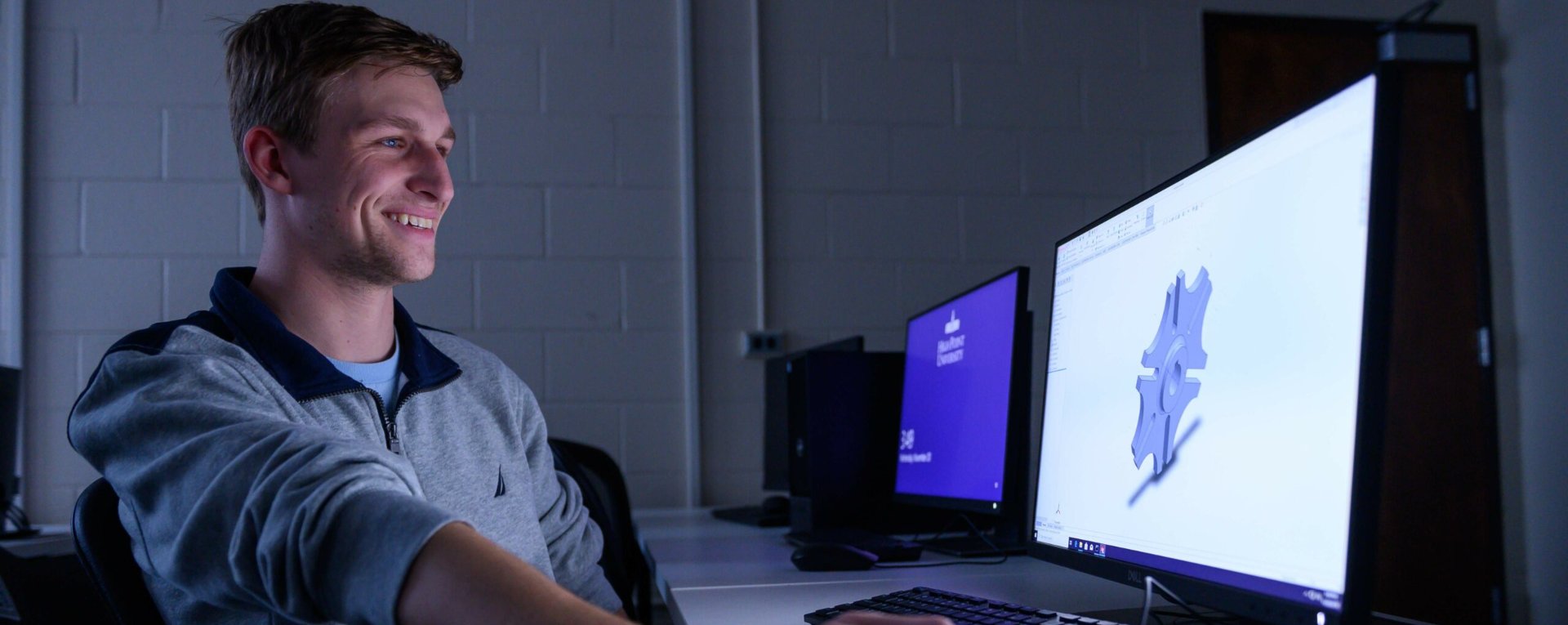
- MME 1010: Engineering Graphics. Technical sketching, engineering drawing and computer-aided design.
- MME 2100: Statics. Forces and moments on bodies at rest and the equilibrium of structures.
- MME 2200: Dynamics. The motion of particles and rigid bodies and the forces that cause it.
- MME 2300: Strength of Materials. Stress, strain and deformation in loaded structural members.
- MME 3100: Thermodynamics. Energy, heat and work in engineering systems.
- MME 3400: Vibrations. Analysis of vibrating mechanical systems and how to control them.
- MME 4300: Manufacturing Engineering. The processes and systems that turn designs into manufactured products.
See the full Mechanical Engineering course requirements.
B.S. in Mechanical Engineering Degree Requirements
The B.S. in Mechanical Engineering lists 79 credits of major requirements and 36 to 44 credits of University Core requirements.
Required courses include MME 1005 Introduction to Engineering Design, MME 1010 Engineering Graphics, MME 1015 Programming in MATLAB, MME 2100 Statics, MME 2200 Dynamics, MME 2300 Strength of Materials, MME 3100 Thermodynamics, MME 3150 Heat Transfer, MME 3200 Fluid Mechanics, MME 3300 Control of Mechanical Systems, MME 3400 Vibrations, MME 4100 Design and Analysis of Machine Components and MME 4300 Manufacturing Engineering. Students also take four semesters of engineering mathematics, General Chemistry, PHY 2020 Fundamentals of Physics II and either Linear Algebra or Probability and Statistics for Engineers, and finish with a two-semester senior design project, MME 4900 and MME 4910.
From Blueprint to Mass Production
Mechanical engineers carry a design from concept to creation: blueprint, prototype, production. Applications range from the engines in cars, ships and aircraft to the turbines that generate electricity to wind and solar systems.
The scale runs in both directions. The same discipline covers the gears in a watch and the mechanisms in a prosthetic limb, so mechanical engineers work in medical devices as well as manufacturing.
The Webb School Makerspace
The Makerspace in the Webb School of Engineering is open to students 24/7, starting freshman year with Introduction to Engineering Design. Equipment includes 3D printers, a laser cutter, a computer-controlled router, a vacuum former, a PCB mill, saws, soldering stations and a computer-controlled sewing machine for building electronics into garments.
Makerspace Director Matt Eaton, an instructor in the Webb School, maintains the equipment and works one-on-one with students on their projects. Students use the space for freshman and senior design courses and for their own projects. Questions about the Makerspace can go to [email protected].
Engineering Students Who Went Before
Mechanical Engineering majors learn alongside Webb School of Engineering students who have already turned that preparation into jobs and internships. Sarah Freeman, an electrical engineering major, interned as a project leader with ASSA ABLOY. Luke Schooley, a computer engineering major, interned with Siemens Healthineers. Emily Lattanzio moved from computer engineering at HPU into embedded software work at STURDY Corporation.
“HPU helped me develop the life skills that are increasingly valuable in today’s technology-driven world.”
Freeman, electrical engineering major
The Princeton Review gives High Point University a 95 out of 99 rating for professor accessibility, based on its student surveys.
Mechanical Engineering course requirements are listed in the HPU undergraduate bulletin. The Office of Career and Professional Development helps engineering students find internships, and the U.S. Bureau of Labor Statistics describes the work of mechanical engineers. Explore all programs in the Webb School of Engineering.
Explore Mechanical Engineering at High Point University
See how mechanical engineering at HPU is accredited and where Webb School graduates go next.
Accreditation & Awards Careers & Student Organizations
Questions about the program? Email Dr. Brian Bernard at [email protected].