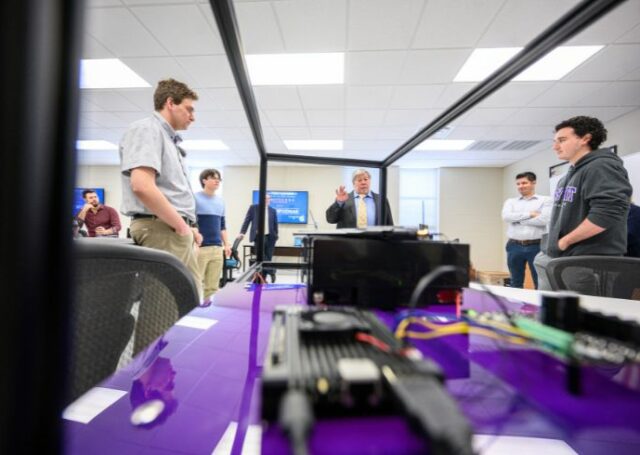
The Bachelor of Science in Mechanical Engineering is a comprehensive undergraduate program designed to equip students with a strong foundation in engineering principles and practical skills. This program integrates theory with hands-on experience, preparing graduates for a wide range of careers in various industries.
Contact Admissions
Contact Admissions
One University Parkway High Point, NC 27268


Mechanical engineering is the application of the principles and problem-solving techniques of engineering from design to manufacturing to the marketplace for any object. Mechanical engineers analyze their work using the principles of motion, energy, and force—ensuring that designs function safely, efficiently, and reliably, all at a competitive cost.
Mechanical engineering is one of the broadest engineering fields. Mechanical engineers design and oversee the manufacture of many products ranging from medical devices to new batteries.
Mechanical engineers design power-producing machines, such as electric generators, internal combustion engines, and steam and gas turbines, as well as power-using machines, such as refrigeration and air-conditioning systems.
Mechanical engineers design other machines inside buildings, such as elevators and escalators. They also design material-handling systems, such as conveyor systems and automated transfer stations.
A mechanical engineer is a master of machines, applying the principles of physics and mathematics to design, develop, build, and test a vast array of mechanical devices and systems. Their work touches almost every aspect of our lives, from the engines in our vehicles to the intricate workings of medical implants.
Mechanical Engineers:
- Design and build the machines of tomorrow. Handling everything from concept to creation, handling things from blueprint to prototype to mass production, mechanical engineers are innovators.
- Work in diverse application. Mechanical engineers are behind the engines that drive our cars, ships, and airplanes. They design turbines that generate electricity, and even develop cutting-edge renewable energy technologies like wind and solar power.
- Shape our lives. From the tiny gears in a watch to the complex mechanisms in prosthetic limbs, mechanical engineers create devices that improve our health, comfort, and everyday experiences. They work on everything from medical equipment to household appliances, constantly pushing the boundaries of innovation.
Reasons to graduate in mechanical engineering:
- Exciting and diverse field: Mechanical engineering touches almost every aspect of our lives, from cars and airplanes to medical devices and prosthetics. You’ll have the opportunity to work on challenging projects that directly impact society.
- Strong job market: Mechanical engineers are in high demand across various industries, with a projected job growth of 4% in the US through 2028. This translates to great employment opportunities and competitive salaries.
- Versatile skillset: Your mechanical engineering degree will equip you with a valuable skillset, including problem-solving, analytical thinking, design, and project management. These skills are transferable to various industries and open doors to diverse career paths.
- Personal satisfaction: If you enjoy tinkering with machines, solving puzzles, and building things, mechanical engineering can be a very rewarding career. Seeing your designs come to life and make a difference can be incredibly fulfilling.
- High earning potential: Mechanical engineers generally enjoy a higher salary than the average professional. The median annual wage for mechanical engineers in the US is $91,570, with experienced professionals earning significantly more.
- Engineering Design
- Engineering Graphics
- MATLAB
- Engineering Ethics
- Statics
- Dynamics
- Strength of Materials
- Thermodynamics
- Fluid Mechanics
- Control of Mechanical Systems
- Vibrations
- Heat Transfer
- Design and Analysis of Machine Components
- Manufacturing Engineering
Course Requirements 2024/2025
Bachelor of Science in Mechanical Engineering
Bachelor of Science in Mechanical Engineering
| Course Requirements | Credits |
|---|---|
| Major Requirements | 79 |
| University Core Requirements | 36-44 |
| Electives | 5-13 |
| Total | 128 |
Requirements for B.S. in Mechanical Engineering
Requirements for B.S. in Mechanical Engineering
| Course | Course Title | Credits |
|---|---|---|
| CHM 1010/11 | General Chemistry/Lab | 4 |
| MME 1005 | Introduction to Engineering Design | 3 |
| MME1010 | Engineering Graphics | 2 |
| MME 1015 | Programming in MATLAB | 2 |
| MME 2100 | Statistics | 4 |
| MME 2200 | Dynamics | 4 |
| MME 2300 | Strength of Materials | 4 |
| MME 3100 | Thermodynamics | 4 |
| MME 3200 | Fluid Mechanics | 4 |
| MME 3300 | Control of Mechanical Systems | 4 |
| MME 3400 | Vibrations | 4 |
| MME 3150 | Heat Transfer | 4 |
| MME 4100 | Design and Analysis of Machine Components | 4 |
| MME 4300 | Manufacturing Engineering | 4 |
| MME 4900 | Senior Design Project I | 2 |
| MME 4910 | Senior Design Project II | 2 |
| MTH 1415 | Mathematics for Engineering I | 4 |
| MTH 1425 | Mathematics for Engineering II | 4 |
| MTH 2050 | Mathematical Methods for Engineering and Physics I | 4 |
| MTH 2150 | Mathematical Methods for Engineering and Physics II | 4 |
| PHY 2020 | Fundamentals of Physics II | 4 |
| Select One Of: | ||
| MTH 2310 | Linear Algebra | 4 |
| STS 3005 | Probability and Statistics for Engineers | 4 |
| Course Descriptions | ||
| Gen Ed Core Requirements | #rowspan# |
|---|---|
| Intellectual Discovery | (4 credits) |
| First Year Writing | (4 credits) |
| Foreign Language | (4 credits) |
| Ethical Reasoning and Religious Traditions | (4 credits) |
| Natural Sciences (PHY 2010 Fundamentals of Physics I) | (4 credits) |
| Social Sciences (ECO 2050 Principles of Microeconomics) | (4 credits) |
| Arts | (4 credits) |
| Humanities | (4 credits) |
| Quantitative Reasoning (MTH 1415 Mathematics for Engineering I) | (4 credits) |
| The American Context | (4 credits) |
| Integrative Course | (4 credits) |
| Diversity Course | (4 credits) |
| Experiential Learning | (4 credits) |
ABET, the accreditation agency, requires the following:
The curriculum requirements specify subject areas appropriate to engineering but do not prescribe specific courses. The program curriculum must provide adequate content for each area, consistent with the student outcomes and program educational objectives, to ensure that students are prepared to enter the practice of engineering. The curriculum must include:
- a minimum of 30 semester credit hours (or equivalent) of a combination of college-level mathematics and basic sciences with experimental experience appropriate to the program.
- a minimum of 45 semester credit hours (or equivalent) of engineering topics appropriate to the program, consisting of engineering and computer sciences and engineering design, and utilizing modern engineering tools.
- a broad education component that complements the technical content of the curriculum and is consistent with the program educational objectives.
- a culminating major engineering design experience that
- incorporates appropriate engineering standards and multiple constraints
- is based on the knowledge and skills acquired in earlier course work.
In preparation for professional practice, the curriculum must include:
- principles of engineering, basic science, and mathematics (including multivariate calculus and differential equations);
- applications of these topics to modeling, analysis, design, and realization of physical systems, components or processes;
- coverage of both thermal and mechanical systems; and
- in-depth coverage of either thermal or mechanical systems.
| Mechanical Engineering | |
|---|---|
| Freshman year | |
| Fall | Spring |
| MTH 1415 Mathematics for Engineers I (4) | MTH1425 Mathematics for Engineers II (4) |
| MME 1005 Introduction to Engineering Design (3) | CHM1010/11 General Chemistry (and lab) (4) |
| MME1010 Engineering Graphics (2) | MME1015 Programming in MATLAB (2) |
| Intellectual Discovery (4) | MME2014 Engineering Ethics (3) |
| First Year writing (4) | Foreign Language core (4) |
| President's seminar (1) | |
| 18 credits | 17 credits |
| Sophomore Year | |
| Fall | Spring |
| PHY2010 Fundamentals of Physics I (4) | PHY2020 Fundamentals of Physics II (4) |
| MTH2050 Mathematical Methods for Engineering and Physics I (4) | MTH2150 Mathematical Methods for Engineering and Physics II (4) |
| MME 2100 Statics (4) | MME 2200 Dynamics (4) |
| The American Context (4) | Religion/ethics core (4) |
| 16 credits | 16 credits |
| Junior Year | |
| Fall | Spring |
| MME 3100 Thermodynamics (4) | STS3005 Probability and Statistics for Engineers (4) or MTH2310 Linear Algebra (4) |
| MME 3200 Fluid Mechanics (4) | MME 2300 Strength of Materials (4) |
| MME 3300 Control of Mechanical Systems (4) | MME 3150 Heat Transfer (4) |
| ECO2050 Principles of Microeconomics (4) - counts as social science core | Arts core (4) |
| 16 credits | 16 credits |
| Senior Year | |
| Fall | Spring |
| MME 4900 Senior Design Project I (2) | MME 4910 Senior Design Project II (2) |
| MME 4100 Design and Analysis of Machine Components (4) | MME3400 Vibrations (4) |
| MME 4300 Manufacturing Engineering (4) | Elective (4) |
| Humanities core (4) | Integrative course (4) |
| 14 credits | 14 credits |
| TOTAL: 131 credits |
Program Goals & Objectives
Program Goals
Three to five years after graduation, the graduates of Mechanical Engineering at HPU will:
- Be employed or be pursuing graduate degrees in their disciplines or in a closely related field.
- Be progressing toward professional licensure.
- Be continuing to develop their knowledge, sense of ethics, and skills in engineering through means such as professional societies, engineering conferences, mentorship opportunities, and formal or informal courses.
- Be fully contributing, and actively adding value, to their businesses or academic organizations, and developing as professionals.
Program Objectives
Prepare graduates for a career as a professional mechatronic engineer. Within 3-5 years of graduation, students will be able to:
- Attain increased responsibility beyond their entry-level position within mechatronic Engineering or related employment, while recognizing global and societal matters.
- Become ambassadors for engineering and improve the quality of life in the communities they serve, through collaboration, innovation, and effective communication.
- Successfully progress within graduate degree programs in Mechatronic Engineering, progress toward other professional degrees or professional engineering licenses, and/or continue lifelong learning in a broad range of fields to advance their careers.
- Successfully serve the profession by acting in a professional and ethical matter.
Student Outcomes of the Program
Skills students will possess at the time of graduation include:
- an ability to identify, formulate, and solve complex engineering problems by applying principles of engineering, science, and mathematics
- an ability to apply engineering design to produce solutions that meet specified needs with consideration of public health, safety, and welfare, as well as global, cultural, social, environmental, and economic factors
- an ability to communicate effectively with a range of audiences
- an ability to recognize ethical and professional responsibilities in engineering situations and make informed judgments, which must consider the impact of engineering solutions in global, economic, environmental, and societal contexts
- an ability to function effectively on a team whose members together provide leadership, create a collaborative and inclusive environment, establish goals, plan tasks, and meet objectives
- an ability to develop and conduct appropriate experimentation, analyze and interpret data, and use engineering judgment to draw conclusions
- an ability to acquire and apply new knowledge as needed, using appropriate learning strategies.