HPU Students Present Original Research and Creative Works at 14th Annual Symposium
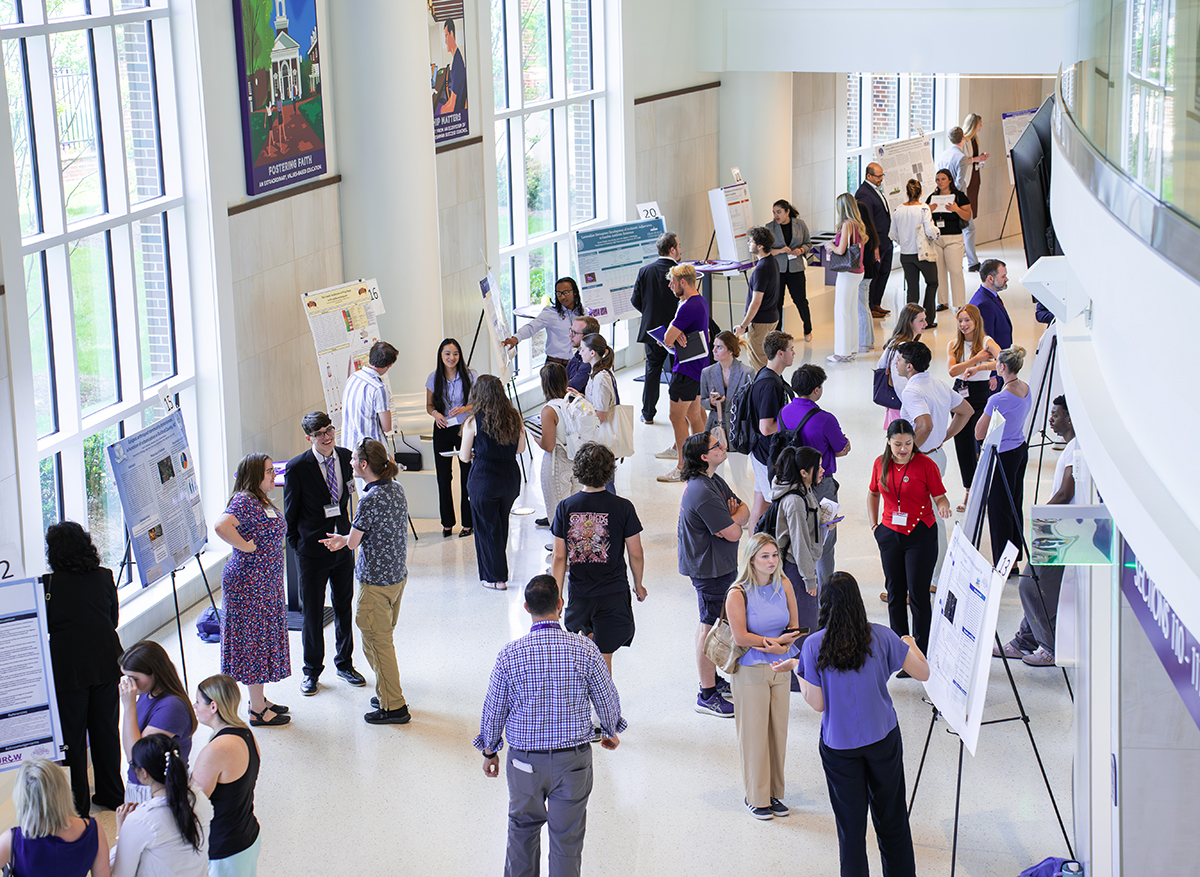
High Point University students shared the results of their original research projects at the university’s 14th annual Undergraduate Research and Creativity Symposium, known as High-PURCS.
HIGH POINT, N.C., April 22, 2026 – High Point University shared the results of their original research projects at the university’s 14th annual Undergraduate Research and Creativity Symposium, known as High-PURCS. The day-long event took place on April 14 in the Nido and Mariana Qubein Arena and Conference Center.
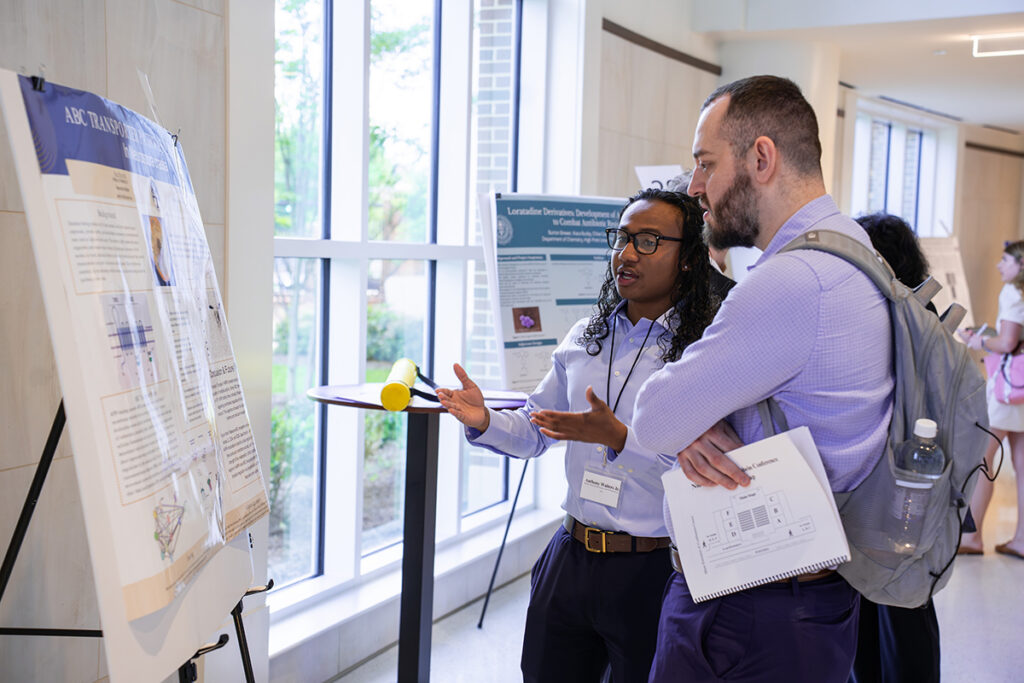
More than 410 undergraduate students teamed up with 88 faculty mentors to create 260 presentations across 40 different disciplines in HPU’s academic schools, including graduate schools. Poster displays highlighting their fact-finding investigations filled the arena’s concourse during the event, which also included oral presentations, technical exhibits, art, music and dance performances.

High-PURCS allows students to conduct year- and semester-long extracurricular research projects and share their results on campus with other students, faculty and staff. It also gives students an authentic venue to build and showcase their professional skills, said Dr. Joanne Altman, director of HPU’s Office of Undergraduate Research and Creative Works.
“This is the professional side of students’ academic life. They’re able to take what they’re learning and demonstrate it professionally,” Altman said. “When they do that, they’re able to show employers that they have those skills that employers are looking for: critical thinking, problem solving and communication. When students have something like a presentation or performance here and they put it on their resume, it’s concrete evidence they’ve developed those skills. When you compare those students in a pool for career or graduate school with those who simply get their degrees or diplomas, the students who have these professional skills are going to be more competitive. We’re building their confidence. They’re learning to promote and sell themselves, and they’re putting everything they’ve learned into practice.”
HPU provides unique, early opportunities for students to conduct research and foster an incredible sense of pride “to celebrate the power of curiosity, the discipline of scholarship and the remarkable things that happen when talented students are given the encouragement, mentorship, resources and space to pursue ideas,” said Dr. Daniel Erb, HPU’s provost. He credited Altman’s leadership for growing what began as a modest showcase into a signature academic event that reflects the best of what the university stands for.
“High-PURCS spans the fields from the sciences to the humanities, from business to the arts,” Erb said. “It’s a testament to the fact that rigorous, high caliber scholarship is not confined to any single classroom, studio or laboratory. It is alive across the entire campus at High Point University.”
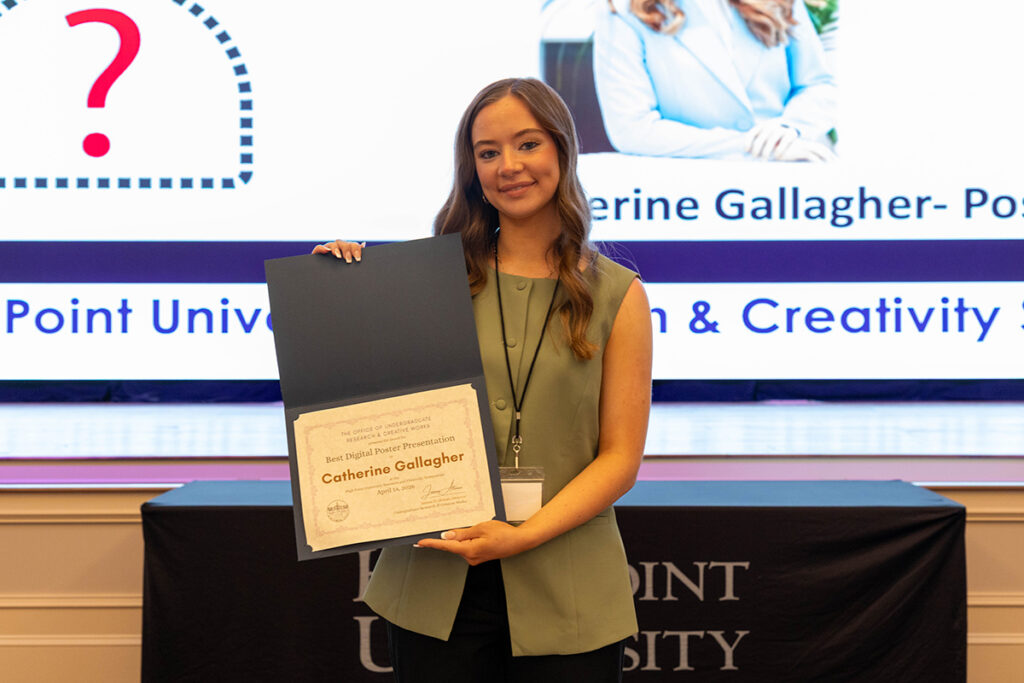
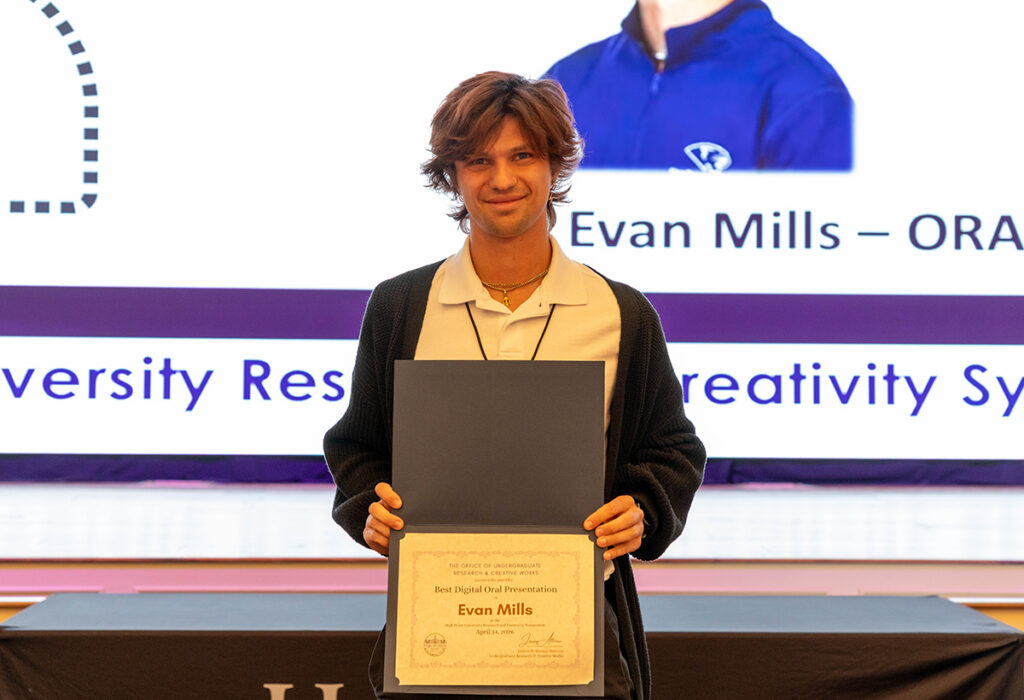
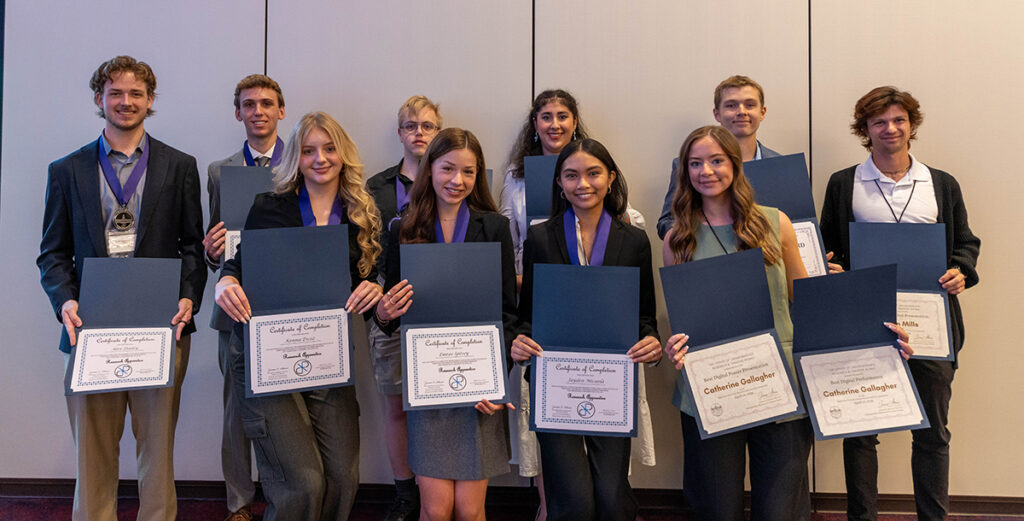
Catherine Gallagher, a senior pursuing a dual major in psychology and dance, was awarded for best digital poster presentation and best performance. The best oral presentation award was presented to Evan Mills, a senior biology and pre-veterinary major from Westminster, Colorado.
“Participating in High-PURCS since my freshman year has boosted my confidence as a public speaker and taught me how to ask questions at research conferences, and create some new research questions for different projects,” said Gallagher, who is from Chicago, Illinois. “I hope to be an academic researcher for my career. I’m going on to a research coordinator position at Harvard Medical School’s McLean Hospital, and this has been great practice for me.”
The 2025-26 Scholarly Interdisciplinary Research Grant (SIRG) was awarded to Mason Wolford, a junior entrepreneurship major from Plain City, Ohio. He recently placed second at the 16th annual HPU Business Plan Competition, earning $8,000 in start-up funds.
Eight students who completed HPU’s Research Rookies Program as freshmen or first-semester sophomores were promoted as Research Apprentices. Those students included Beyza Aksoy, Angel Bell, Alex Dailey, Trip Donaldson, Kenna Escoz, Jayden Michaela, Sam Pate and Emree Spivey.
Gaining Lab Experience
Having conducted research for four years provided experience with many different lab techniques, said Imogen Irons, a senior biochemistry major.
“I want to pursue a Ph.D., so it’s helping me gain lab time and the skills for doing that,” said Irons, who is from Alpharetta, Georgia.
Macie Fox, a senior neuroscience major, said working in the lab since her sophomore year with Dr. Kelsey Kean, assistant professor of chemistry, has built her interest in research.
“I never have a bad day in the lab, even when everything goes wrong,” said Fox, who is from Bertram, Texas. “This semester for me was rewarding scientifically. I got to develop my project and make it my own, which I think set me up to be more confident and comfortable going into grad school. I’m going to start my biomedical neuroscience Ph.D. in the fall, so I definitely feel prepared due to the work I’ve done with Dr. Kean.”
Caitlin Michaelis, a freshman biochemistry major, was one of the students who presented research related to antibiotic resistance in Staphylococcus aureus, particularly MRSA.
“Research was really effective with problem-solving skills,” said Michaelis, who is from Auburn, Maine. “This was my first semester doing research, and it’s a learning curve, but it’s a great way to get started in learning about new things. There were a lot of things in our research I could apply to my classes that I didn’t necessarily put together at first.”
Aubrey Fessler, a sophomore biology major, presented research related to how MRSA forms bacterial biofilms on medical equipment and causes hospital-acquired infections.
“Probably the most important thing we learned was to be very flexible because we’ve run into a lot of roadblocks this semester, so students were adjusting and thinking outside the box,” said Fessler, who is from Brea, California. “Generally, this sort of thinking has been very helpful with my other classes, too. I realized that if something was missing, it’s not the end of the world, and I can brainstorm and think of something else. I’m planning on going for my Ph.D. after undergrad now, probably in biology or biophysics, because I’m enjoying this so much.”
Three students said it was an invaluable experience for them to work in a Wanek School of Natural Sciences lab with Dr. Bill Kochen, professor and founding chair of neuroscience, to investigate the effects of dehydration and creatine on mild Traumatic Brain Injury (mTBI), also known as concussions.
Before a fight, martial artists and other combat athletes often dehydrate themselves to quickly lose weight. Shortly after weigh-ins, these athletes regularly suffer concussions during their matches. In addition, many athletes include creatine supplements in their training to boost performance. Kochen’s research with his students explores whether dehydration or creatine use before injury can change how a concussion affects an athlete.
“I definitely learned a lot, especially in the data analysis side,” said Isabella Frankovic, a sophomore from Ellicott City, Maryland, majoring in neurobiology and chemistry. “This whole process has helped me get my REU (Research Experience for Undergraduates) this summer. I’ll be heading to Indiana University at the start of the Neuroscience Institute doing Alzheimer’s research. Because of this research, I was able to have the skills to move into doing other research working with mice at Indiana University. This has really built the base for me to be successful moving forward into other research opportunities.”
Alexandra Shutters, a junior neuroscience major who worked in Kochen’s lab with Frankovic, said this research experience helped her understand the design of a study.
“This last cohort we did, I actually got to make and design the entire spreadsheet,” said Shutters, who is from La Plata, Maryland. “I was able to gain better organizational skills and take charge while making sure I was a reliable team member. It also helped prepare me for higher education. Going forward, I plan to get a Ph.D. after undergraduate academia and so this helped prepare me.”
Burton Brewer, a junior chemistry major, said conducting organic chemistry research starting with his freshman year helped prepare him for higher level chemistry classes and gave him an advantage.
“All this research I’ve done has allowed me to go to multiple professional conferences,” said Brewer, who is from Columbia, South Carolina. “I also was able to create posters, which is hard to do because you have to compile the information in a way that other people can understand. Nowhere else could I get this kind of research experience, which is why I came to High Point University. It helped me know I love synthesis chemistry, which leads me into knowing I want to work at a laboratory or something related because I love making chemicals and compounds. If I had never done research, I would never have known. It’s easy to get passionate about it when you just enjoy it.”
Working in a large laboratory setting was a new experience for Nelia Kelleher, a freshman biology major who presented findings from SEA-PHAGES, a year-long undergraduate research program supported by the nonprofit medical research organization Science Education Alliance at Howard Hughes Medical Institute. Students in SEA-PHAGES (Science Education Alliance-Phage Hunters Advancing Genomics and Evolutionary Science) conduct research that includes digging through soil to identify new bacteriophages, commonly known as phages, which are viruses that infect bacteria.
“I was learning the ropes of working in a big lab with a lot of collaborators working on multiple projects, and I really liked the environment and getting exposed to research,” said Kelleher, who is from Forest Hill, Maryland.
Learning to Adapt on the Fly
Jacqueline Perry, a senior business major with dual minors in healthcare management and video game design, gave an oral presentation titled “Split-Second Decisions: The Effect of Virtual Reality Environments on Fine Motor Skills.” She plans to go into medical teleconsulting and wanted to conduct a study to replicate decision-making in a high-stress environment, such as an operating room. Her study involved observing the behaviors of more than 20 participants.
“It’s a good way to learn, and I think it’s just going to make me more empathetic in my actual career,” said Perry, who is from Rochester, New York.
“I learned how to design a study, how to execute trials and how to operate these devices, and I’m learning how to present,” said Kat Karwoski, a junior psychology major and Spanish minor who is from Pittsburgh, Pennsylvania. “I’m happy I did research this year because next fall I have an internship in Winston-Salem that’s research based. I think this will help tremendously with that.”
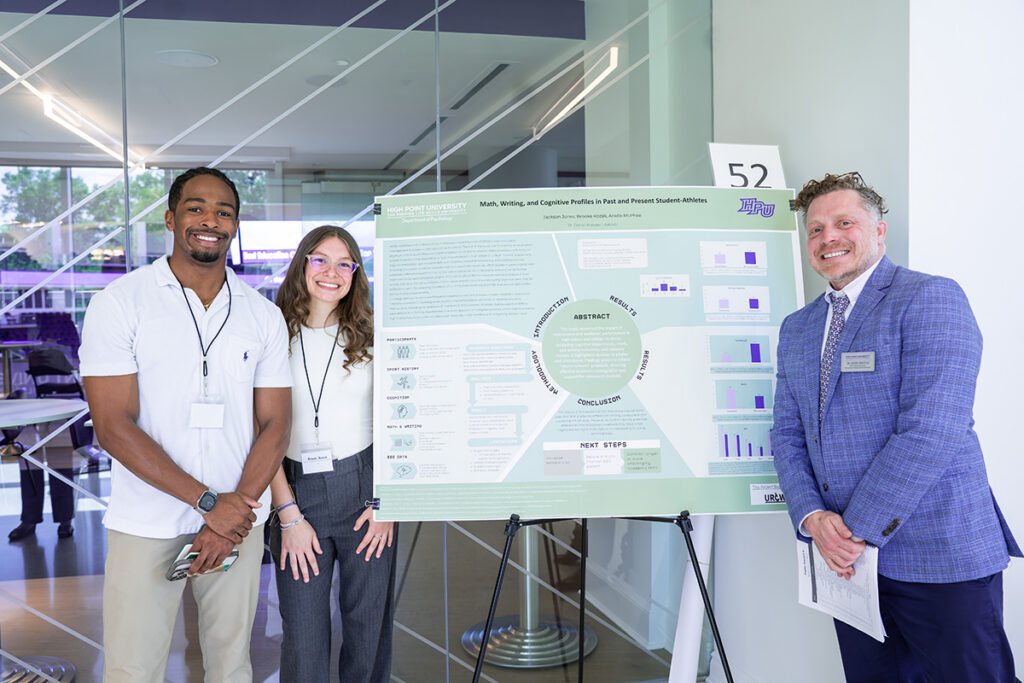
Two of the devices Karwoski and her research team member Sophie MacDonald, a senior psychology major on the pre-professional physical therapy track, used were the electroencephalogram (EEG) and heart rate variability monitor to measure the impact of athletics on cognitive and academic skills. They studied athletes on intramural, club and NCAA Division I teams to measure how their sports history impacted their brainwaves.
“My biggest takeaway would probably be learning how to be adaptable,” said MacDonald, who is from Staten Island, New York. “I had a few instances where one of the devices would just go out in the middle of research. I had to learn to go with the flow and work with that to figure out what was missing and what to do in terms of data. I think throughout this process I learned it’s not always going to go perfect, and you need to figure out how to work through that. It was informative and something I know will be beneficial and useful in the future.”
Amaris Jenkins, a senior game design major, presented a game titled “Recompile” that tells the story of a girl whose best friend puts her within a computer program to save her but finds that faults in the game are destroying her from within.
“My project has two voice actors, so directing them on the script that I wrote and recording and editing that audio gave me skills I can take with me,” said Jenkins, who is from North Plainfield, New Jersey.
“Technically this was coursework, but it allowed me to gain insight into the game design process as a whole,” said Mark Metcalf, a senior with dual majors in game design and computer design, who is from Advance, North Carolina.