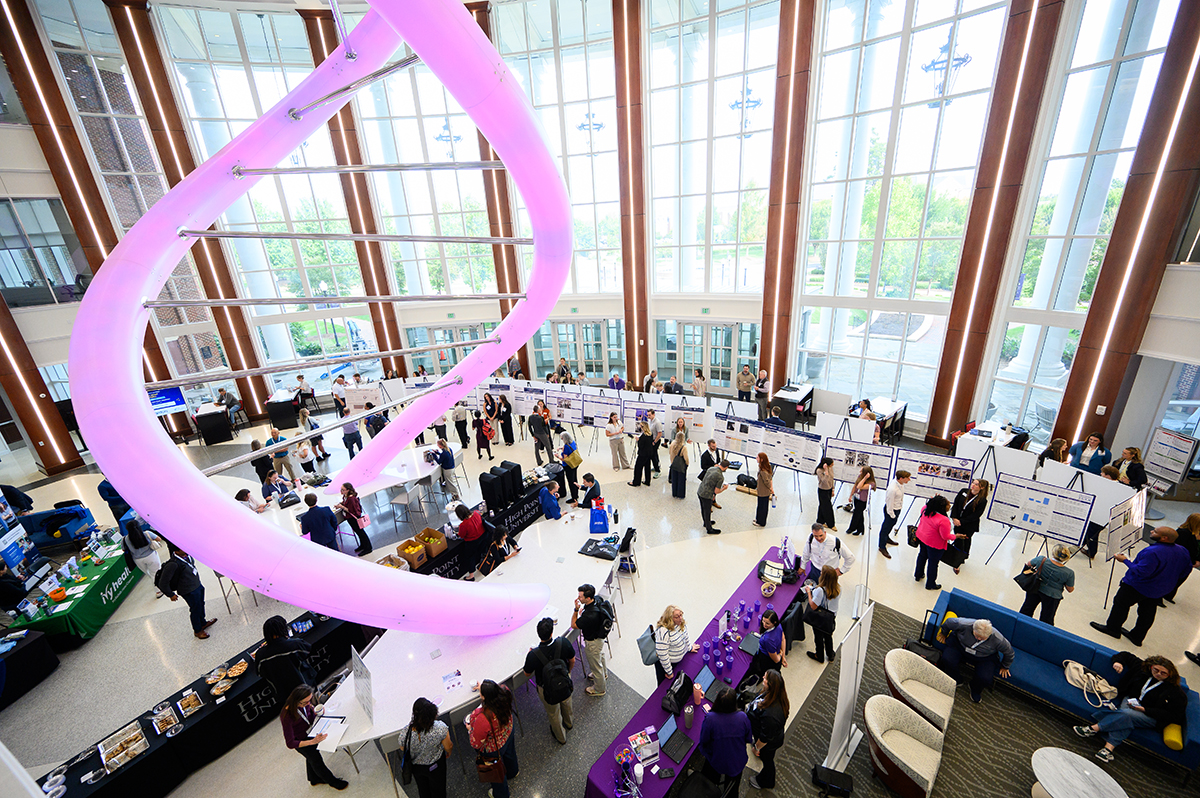
Sixty-two High Point University physical therapy students presented their research at the American Physical Therapy Association of North Carolina annual conference on Oct. 9 and 10, which HPU hosted in the Congdon School of Health Sciences.
HIGH POINT, N.C., Oct. 23, 2026 – High Point University students, faculty and staff frequently conduct, publish and share research and creative works in a variety of ways.
Below is a recap of recent research and innovative initiatives.
HPU Hosts American Physical Therapy Association of North Carolina
Sixty-two HPU physical therapy students presented their research at the American Physical Therapy Association of North Carolina (APTANC) annual conference on Oct. 9 and 10. This year’s conference was hosted at HPU in the Congdon School of Health Sciences. The two-day conference included 14 faculty mentors, 21 poster presentations and three educational sessions.
“This is the sixth year in a row that High Point University had the most students presenting at this state conference, which is impressive because there are 10 Doctor of Physical Therapy programs in the state and 12 physical therapist assistant programs in the state,” said Dr. Lance Mabry, assistant professor of physical therapy.
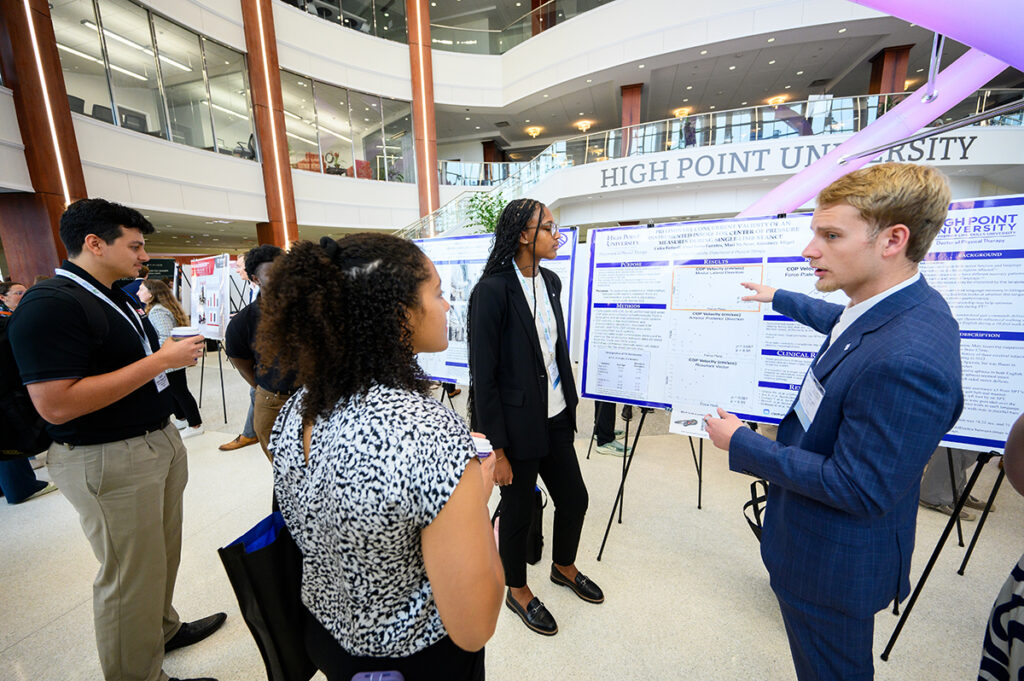
Colin Bottorff, a second-year DPT student, presented his research on chronic ankle instability, focused on people who tend to have balance impairments and repeatedly roll their ankles.
“We’re looking at insoles we can put in our patients’ shoes that will track the data, so we can send patients out to do their everyday activities. Later, we can check that data to see how our treatments are working,” said Bottorff, who is from Knox, Indiana.
Bottorff said it is important to be able to measure patients who have chronic ankle instability and know treatments are helping while they go about their lives without them having to come into a lab for further testing.
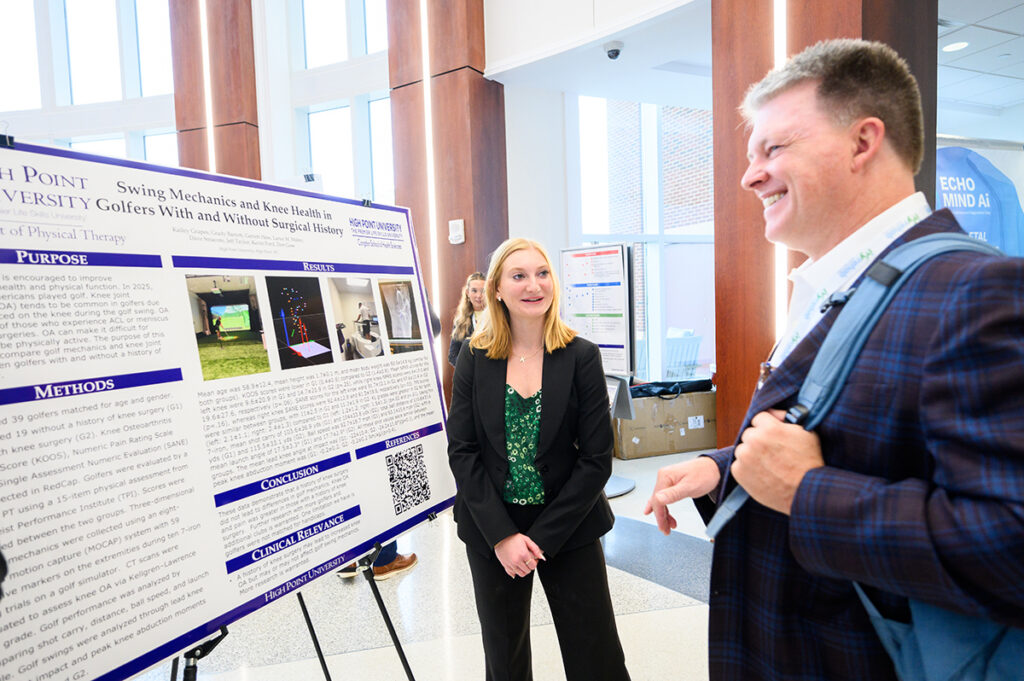
Kailey Grapes, a junior exercise science major on the pre-PT track, was conducting research on the effects of knee surgery on golf swing biomechanics and knee osteoarthritis as part of HPU’s Summer Research Fellows (SuRF) program. The program pairs undergraduate students with health science researchers and allows many students to get published in peer-reviewed journals.
Grapes said her SuRF research helped to prove the swings of golfers who have had knee surgery can return to normal with the same speed, power and other biomechanics. However, they may have more arthritis, which is common after any surgery.
“We found that the knee surgery had no effect on the golf swing, but we think that the golfers had compensated with other parts of the swing because the power was the same,” said Grapes, who is from Fort Worth, Texas. “With knee arthritis, obviously after surgery there’s more osteoarthritis, and those were our findings.”
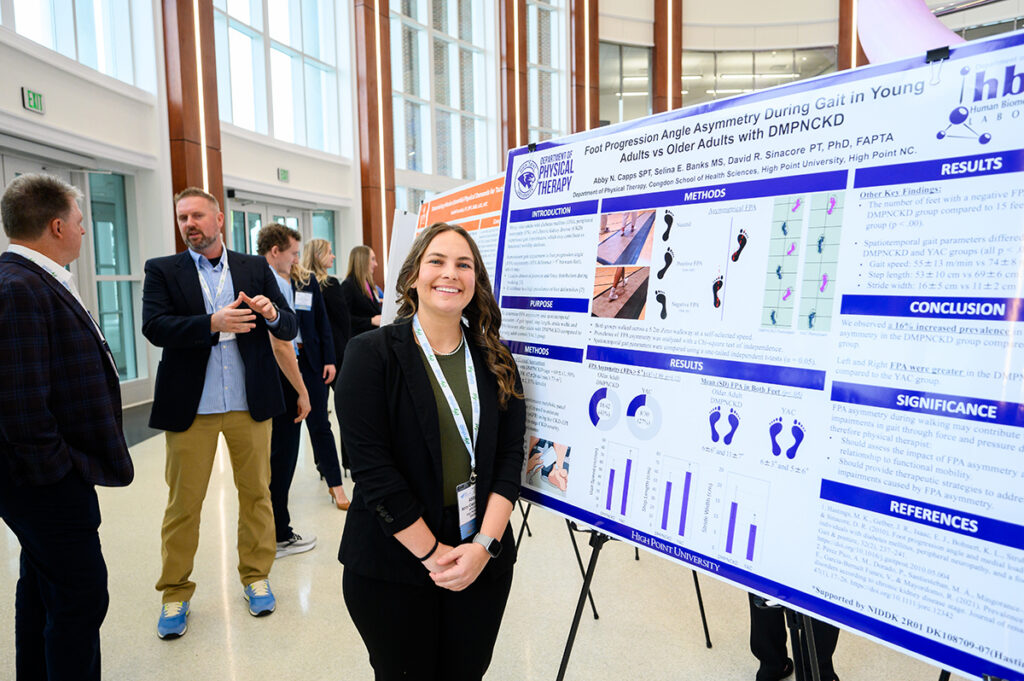
Abby Capps, a first-year DPT student, presented research she has worked on in the lab with Dr. David Sinacore, professor of physical therapy, as part of his five-year, $3.9 million grant from the National Institutes of Health (NIH). Sinacore is studying the feet of individuals who have diabetes and peripheral neuropathy because one complication they develop is progressive chronic kidney disease.
Patients with the worst chronic kidney disease (Stage 5 CKD) also have the highest rates of amputation in the U.S., so Sinacore’s lab is researching ways to identify them early to prevent amputation.
“The patient population we were looking at have chronic kidney disease, and they also have been diagnosed with diabetes and peripheral neuropathy, so they have all three in combination,” said Capps, who is from Elgin, South Carolina. “A complication may arise with blood flow and circulation, leading to ulcers of the feet. Peripheral neuropathy may prevent the patient from feeling that spot on the foot, and that can lead to an infection and possibly amputation if it goes unchecked.”
Researchers looked at the foot progression angle of patients when walking (whether the foot is toeing in or out). They also considered asymmetry, whether one foot is greater than the other. The findings showed CKD patients had a 16% increase in asymmetry, compared to a younger population. Researchers are also looking at force distribution and the role of bone deformities as a way to predict whether one foot is at more odds for ulcers, possibly leading to amputation.
“If we have more of that awareness beforehand going in, we can bring awareness and hopefully prevent them from having to get a leg or foot amputated,” Capps said.
Faculty Collaborate at AI Summit
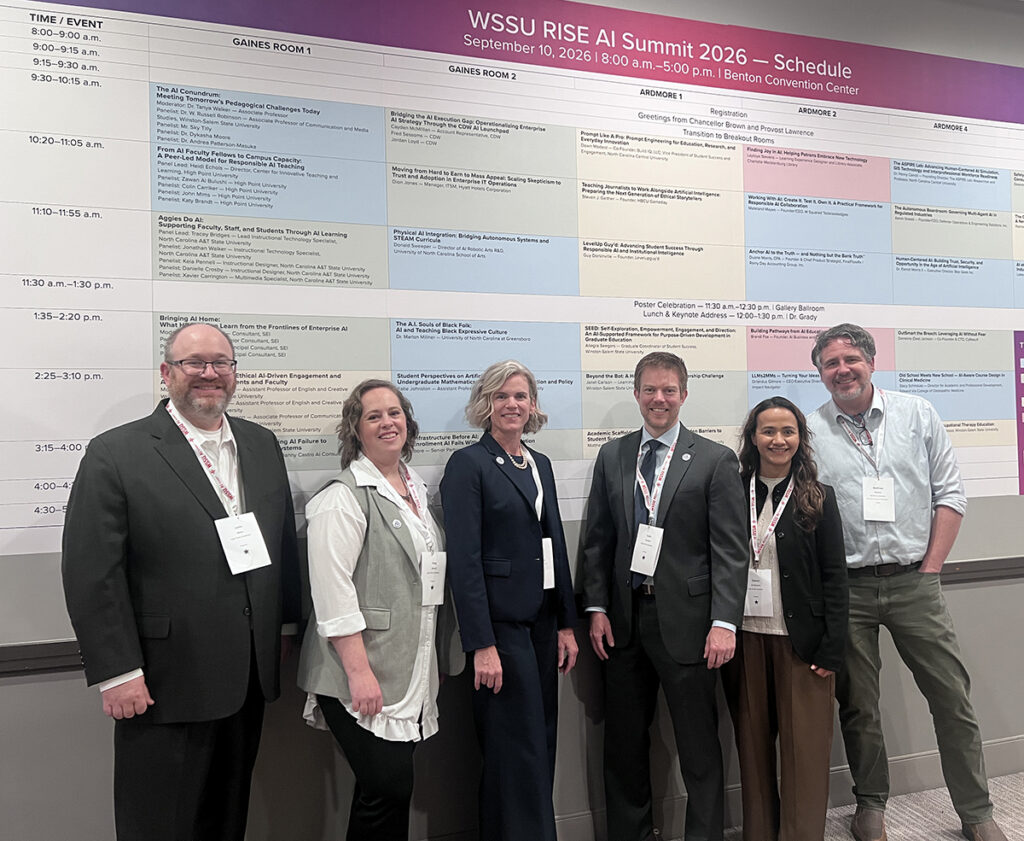
Six HPU faculty members shared their expertise about artificial intelligence with other educators at the inaugural RISE AI Summit.
Dr. Matthew Brophy, Dr. Zawan Al Bulushi, John Mims and Heidi Echols, director of HPU’s Center for Innovative Teaching and Learning (CITL), were among the faculty presenters at the Sept. 10 summit at Winston-Salem State University in Winston-Salem, North Carolina. AI Faculty Fellows Katy Brandt and Dr. Colin Carriker also participated.
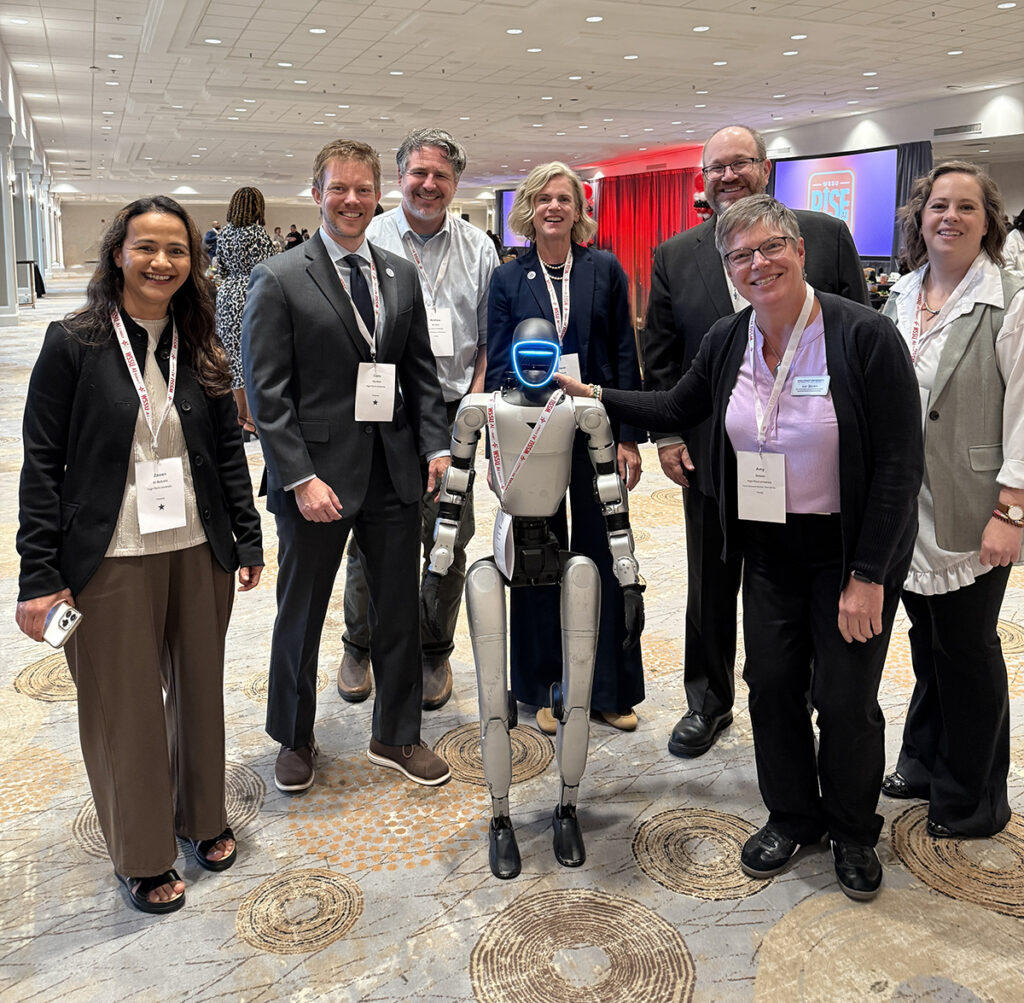
“The Winston-Salem State University RISE AI Summit created an energizing space for learning, connection and collaboration,” Echols said. “I’m grateful for the opportunity to present with HPU colleagues and to spend time with so many people committed to supporting innovation and student success.”
Colleges have a duty to help students overcome educational barriers and support learning, said Brophy, associate professor of philosophy and chair of the HBS AI Committee. The inaugural RISE Summit exemplified how Piedmont universities can band together around a shared challenge, he said.
“We’ve seen a big shift in the relationship between academia and AI in a very short amount of time,” said Mims, chair of the Department of Strategic Communication and professor of the practice. “We went from ‘How do we keep our students from using AI?’ to ‘How can we, as educators, use AI to make ourselves better teachers and how can we help our students use AI in an ethical way to enhance their learning?’ It was exciting to be part of the RISE AI Summit, where we could explore with other institutions how we can all use this exciting technology to enhance education.”
Seeing a humanoid robot and a robotic dog in action during the summit made AI feel real, said Bulushi, an assistant professor and faculty development specialist for AI in education.
HPU’s AI initiatives and programs are housed under CITL. The approach is structured, faculty-centered and aligned with preparing students for a workforce increasingly shaped by AI. The CITL currently operates out of Congdon Hall but will be housed inside the John and Lorraine Charman Library when the $100 million library opens in 2027.
Last spring, HPU launched its AI Faculty Fellows Program through CITL. Six faculty members from different disciplines serve as disciplinary liaisons, peer mentors and faculty development leaders who translate emerging AI technologies into practical teaching applications.
“The RISE AI Summit moved beyond asking whether AI belongs in higher education and instead engaged with the more important question of how we use it thoughtfully, responsibly and effectively,” said Carriker, an AI faculty fellow. “Connecting with colleagues from across the region created a valuable exchange of ideas about how we prepare for a rapidly changing professional landscape.”
Brandt, another AI faculty fellow, left the AI Summit feeling energized and optimistic.
“Hearing how faculty are adapting their teaching to support students for the realities of an evolving professional world was both inspiring and reassuring,” she said. “It was wonderful to see so many creative approaches to embracing change rather than resisting it.”
HPU Honors Student Research Rookies
Twenty-four HPU students who conducted research alongside faculty mentors last year as Research Rookies during their freshman or sophomore year were recently honored as Research Apprentices with certificates and medals.
“We are recognizing students who have spent a year working diligently at being new, young scholars,” said Dr. Joanne Altman, professor of psychology and director of Undergraduate Research and Creative Works. “The goal of the program is to be able to connect the students with faculty mentors and have some basic skills they can then bring to the table. They showed us their dedication, fortitude and determination.”
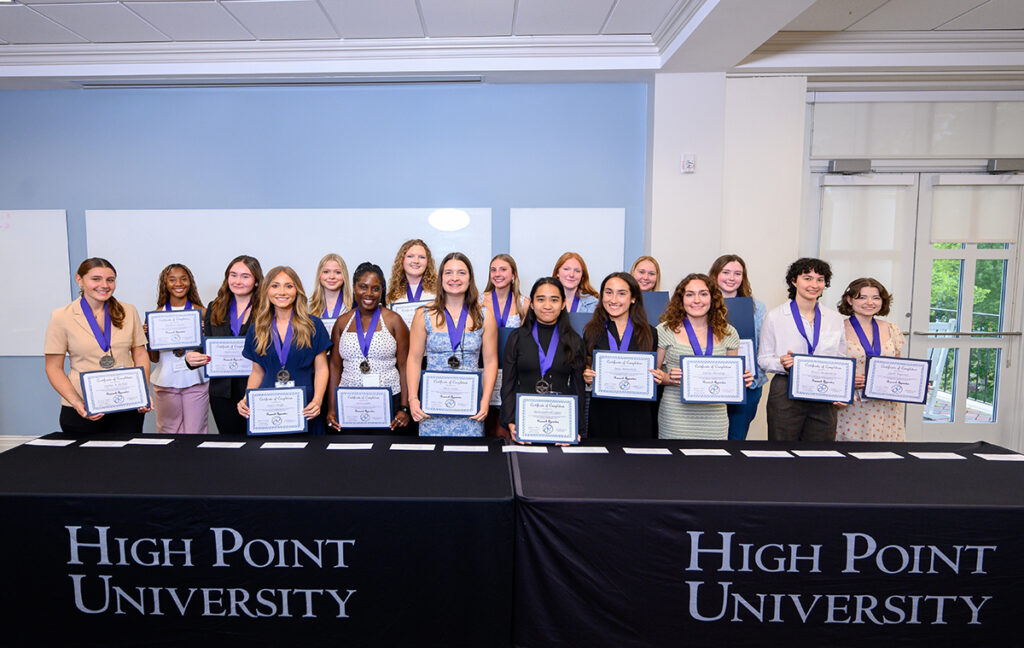
Several faculty mentors attended the ceremony to cheer on students from a variety of majors. Each student shared their research experience and future goals, many of which include the medical or legal fields. Several students said participating in research sharpened their critical thinking skills.
“Research Rookies has empowered me with an understanding of research and a supportive community that will help to advance my knowledge and experience throughout my undergraduate years,” said Annabelle Cloud, a sophomore from Southbury, Connecticut, who is double majoring in political science and mathematical economics with plans to attend law school after graduation.
“The best thing I got out of Research Rookies was my connection to my research lab and learning to discern information,” said Nelia Kelleher, a sophomore biology major and French minor on the pre-med track from the Washington, D.C.-Baltimore area. “The Research Rookies program was beneficial to me in learning more about the process of research and research opportunities we have here at HPU.”
Other students awarded as research apprentices were:
- Sophia Bellino, biochemistry major with biology minor
- Kaylee Brooks, health and wellness, and exercise science double major (pre-dental)
- Madyson Carter, psychology and criminal justice majors with forensic science minor (pre-law)
- Nyla Castro, political science major with criminal justice and legal studies minors (pre-law)
- Allison Dishman, mathematics major
- Aubrey Durham, chemistry major with biology minor (pre-dental)
- Kiora Gibbs, criminal justice major with legal studies minor (pre-law)
- Logan Hodge, pre-pharmacy major
- Alexa Irons, exercise science major with entrepreneurship minor
- Bethany Jenkins, pre-pharmacy major
- Kasen Kalafut, pre-nursing major
- Jacob Kimbro, biology/pre-med major with Spanish minor
- Raina Lassissi, biology major
- Rana Gabrielle Ligue, psychology major with statistics minor
- Julia Matachun, pre-pharmacy major
- Sophia Messerly, biochemistry major
- Caitlin Michaelis, biochemistry major with biology minor
- Scarlett Peabody, neuroscience and chemistry double major
- Veda Puri, biology major
- Eva Richardson, criminal justice and philosophy double major with forensic science and psychology minors
- Isabella Spencer, pre-nursing major
- Faith Wagoner, psychology and musical theater double major
Innovation Conference Empowers Nurse Leaders
Students in HPU’s Teresa B. Caine School of Nursing prepared for ongoing medical field changes during the 2026 Innovative Nursing Leadership Course Conference. The conference was titled “Nurses Leading the Future: Inspiring Career Pathways Through Innovation, AI (artificial intelligence) Competency and Emotional Intelligence.”
The Sept. 22 conference brought together healthcare executives, nurse leaders, AI innovators and educators to examine the future of nursing leadership and healthcare transformation. Students engaged directly with chief nursing officers, healthcare CEOs and nurse leaders to gain valuable insights into leadership, innovation, workforce development and organizational excellence.
“As artificial intelligence transforms healthcare, nursing education must evolve to develop AI literacy, ethical judgment, critical thinking, emotional intelligence and leadership,” said Dr. Lorrie Davis-Dick, an assistant professor who led the nursing leadership course. “The future nurse must be prepared not only to use emerging technologies, but to lead their responsible implementation.”
One conference highlight was the AI innovation experience led by Dr. Zawan Al Bulushi, faculty development specialist for AI in education in HPU’s Center for Teaching and Learning (CITL). During the presentation, students explored the responsible integration of AI, ethical decision-making, critical thinking and leadership in nursing practice.
Senior nursing students also gave career and professional development oral presentations, sharing ideas for integrating AI into nursing practice, healthcare innovation, entrepreneurship and business. Students received certificates recognizing competency development in AI, innovation, leadership and professional development.
Davis-Dick expressed appreciation to Dr. Racquel Ingram, founding dean of the Teresa B. Caine School of Nursing, for her vision and steadfast commitment to advancing nursing education. She also thanked conference moderator Natalie Hinson, a senior nursing major from High Point.
Faculty Shares Knowledge in Scientific Magazine
Dr. Matthew Sayre, a professor of anthropology and chair of the Department of Sociology and Anthropology, was recently interviewed for an article by “Science” magazine, one of the nation’s leading scientific publications.

The article, “High Culture: How psychoactive substances helped spur Andean civilization,” delved into the roles of mind-altering ritual activities among ancient Peruvians at Chavin de Huanter. During excavations in 2017 and 2018, tubular objects made of bird and mammal bone were recovered inside an underground gallery, which was used exclusively for ceremonies. Independent chemical and micro botanical analyses demonstrated the use of psychoactive plants in institutionalized rituals in the first millennium. This direct identification of psychoactive paraphernalia from pre-Hispanic Peru sheds light on the content and function of ritual at early monumental centers.
“The oldest use of these plants in this region of the world was acknowledged as a groundbreaking discovery by Science magazine,” Sayre said. “Our research is reaching audiences around the world. Many of the plants are now being explored for use in treating PTSD (post-traumatic stress disorder).”
Sayre and Dr. Silvana Rosenfeld, an associate professor of sociology and anthropology, also were among the co-authors of an article, “Psychoactive Drugs Found in Mysterious Temple May Have Helped Ancient Peruvians,” which was published in 2025 in the scientific journal PNAS and Science magazine.