As the world of education adapts to the sudden pivot to online education amidst the current public health crisis, academic librarians are now focusing primarily on helping students and faculty access the resources they need remotely. Initially this was quite a challenge, particularly with textbooks, many of which are either not available for library purchase or are prohibitively expensive. Fortunately, many publishers, aggregators and archives have stepped up by making previously paid-only content freely available, or by removing access limits on eBooks until the end of the semester.
This blog post will guide you through the publisher responses which have had the most impact. From eTextbooks to the National Emergency Library to classic literature to OERs, all students and faculty need to be aware of the sources in this list.
eTextbooks on VitalSource and Redshelf
 The most urgent need after classes moved online was, of course, remote access to textbooks–with many students leaving them on campus planning to return after Spring Break. Just as the need for eTextbooks became critical, two websites emerged with a lifeline, providing platforms for textbook publishers to offer titles in an online format. The first is called VitalSource. If you cannot locate your textbook there, you can also try Redshelf.
For publishers not working with either company, faculty can view information about their responses to COVID-19 by visiting individual publisher websites.
 National Emergency Library
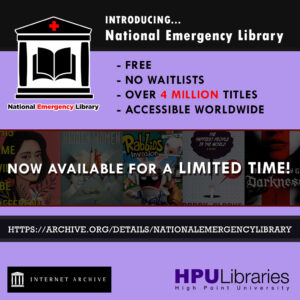
The Internet Archive has generously opened up simultaneous access to over 4 million titles published between 1920 and 2000. These books don’t generally have an e-version available anywhere else, and with libraries across the country closing their doors temporarily in response to COVID-19, the need for an alternative way to access these books was urgent.
You can borrow their books for up to two weeks and read them using their convenient browser reader or download them to Adobe Digital Editions.
This collection is not limited to books, however. You can also access videos, audio, software, and images. Notable sub-collections include American Libraries, LibriVox Audiobooks, Feature Films, and the Television Archive.
This website also hosts the Wayback Machine, which has a massive searchable collection of over 424 billion archived web pages dating all the way back to the 90s. Just drop in your favorite URL to see how the page has evolved over time.
ProQuest eBook Central
Major current eBook platforms like ProQuest eBook Central and EBSCO eBooks have made a similar change, switching all current library holdings with limited user access to unlimited until further notice. This means an eBook that previously only permitted one viewer at a time will now allow multiple students to view it simultaneously.

Duke Classics Collection
English majors, literature lovers, and students looking to alleviate boredom while stuck at home will be pleased to learn that Duke University opened up its collection of over 4,000 classic titles for simultaneous use on our popular eBook platform, OverDrive—and it doesn’t even expire at the end of the semester. In fact, we will have access to this wonderful collection for an entire year! So if you’re like me and have a running list of classic titles you’ve been meaning to read for years, now is the time. (After all, you can only watch so much Netflix!)
You already have an OverDrive account with your HPU username and password. You can use the in-browser reader, download their Libby app, or send the eBooks to your Kindle.
If classic eBooks aren’t your thing, try browsing our existing popular fiction collection as well as the audiobook collection also hosted on OverDrive. And if you find a book you really want to read but cannot access, you can use the built-in “recommend to library” feature to suggest that we purchase it.
Open Educational Resources Are ALWAYS Free
Believe it or not, there is an extensive array of books and learning resources freely available online even outside the context of a pandemic. These are called Open Educational Resources (OERs) and adopting course materials from these eliminates access barriers for students from the beginning.
OER Commons NCLive Open Textbooks
The OER Commons is NCLive’s effort to bring free, open textbooks to colleges and universities across North Carolina. The growing collection includes textbooks in over 30 of the most commonly taught subject areas.
This is a wonderful resource for public domain and open access eBook titles, and will be free even after the crisis abates. Just make an account and you can borrow up to ten eBooks at a time.
These are just the tip of the iceberg–check out our libguide on OERS for even more!
-Blog post by Leanne Jernigan, Wanek Center Librarian