
Smith Library Begins Transitioning Book Collection to Library of Congress Classification
Throughout the dynamic history of HPU Libraries, one thing has remained static: the books were always classified according to the Dewey Decimal System (DDC) developed by Melvil Dewey in 1876, which remained widely employed by academic libraries at the time Wrenn Memorial Library was completed in 1937. Over the years, however, Dewey has persisted more in public libraries while academic institutions have increasingly shifted to the more discipline-specific Library of Congress (LC) Classification system introduced in 1901. In fact, 81% of academic libraries currently use the LC system, and the rate of use of DDC continues to decrease at a rate of 1% per year (Lund et al., 2019).
Dewey vs LC
 Dewey is structured around nine “centuries” with numerical notation denoting subdivisions within these main disciplinary areas. While useful for collections with general works and broad treatments of subjects, it does not cover the full granularity of current academic disciplines, fields which have differentiated over time and need further distinction now haphazardly covered by the expansion of already-lengthy Dewey numbers. The 20 main classes of LC align much better with modern-day academia, with separate main classes for areas like political science, law, education, etc. Revisions to LC classes are done in collaboration with experts from relevant fields so that they stay up-to-date.
The differences in the flow of subject areas are evident from a side-by-side comparison of the overall structure of the collections. While both begin with general works, philosophy and religion, an LC collection then flows into history subjects rather than relegating those to the end of the collection, as with Dewey. LC then covers social sciences in greater depth, fine arts, language and literature, and ends with technology classes.
Dewey Decimal System
|
LC Classification
|
Why switch now?
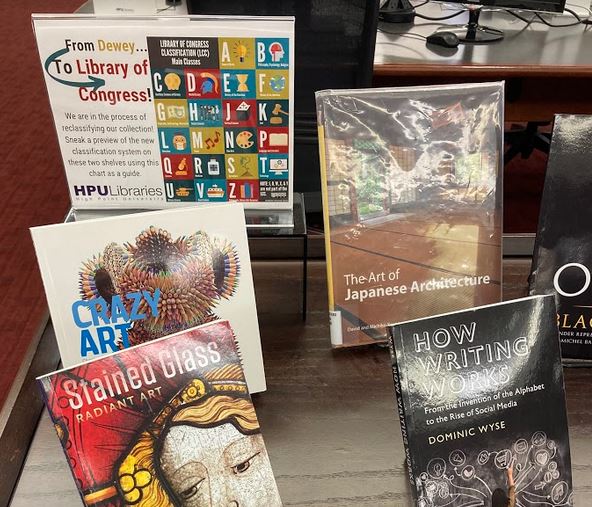
Although the nuanced subcategories and simplified notation system of LC has long been considered more suited to academic library collections than DDC, seldom do libraries have a good opportunity to make the switch without significantly disrupting access for patrons. HPU Libraries, however, now have the opportunity for a relatively seamless transition with the building of the new library facility on the horizon. So the decision was made in summer 2021 to begin building a “Current/Core Academic Collection” with all incoming new non-fiction classified into a separate collection organized by LC—a collection which will eventually grow into the approximately 60,000 volumes slated to move onto the shelves of the new library. The remainder of the collection (up to 100,000) volumes will remain in DDC as the “historical collection”; still searchable via the library catalog but physically accessed in the future via remote storage.
How will this affect library users?
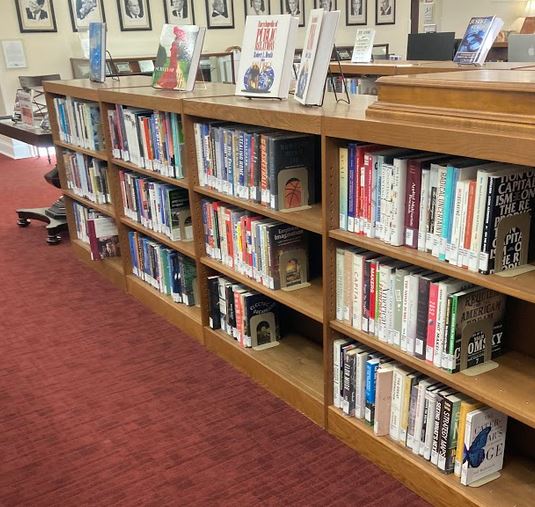
So what does this mean for HPU students and faculty today? For the next couple years, it will mean navigating a “split collection”—with the 3rd floor stacks being increasingly relieved of newer titles being re-classified and moved downstairs to our fast-growing “Current/Core Academic Collection.” The new collection, while small, is located on the right side of the main floor of the library (the side with the Powell room, ReaderSpace, and elevators) on the low shelving amongst the public computers and research stations.
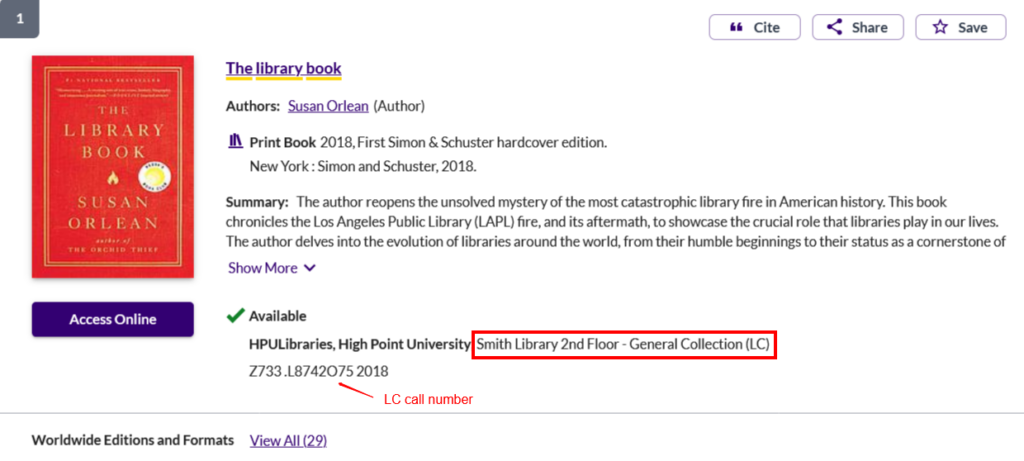
In the library catalog, these items have the shelving location “Smith Library 2nd Floor – General Collection (LC),” as shown in the following example:
How to Read an LC Call Number
The LC call number itself has 3 parts, generally represented on 3 lines. The first line classifies the book by subject using an alphanumeric string, beginning with one or two letters followed by a number and occasionally a decimal point subdividing the number. The next line, which we call the “Cutter,” uses another alphanumeric string to organize items within the same class number—usually by author’s last name, but occasionally by title or format. The final line contains the publication year.
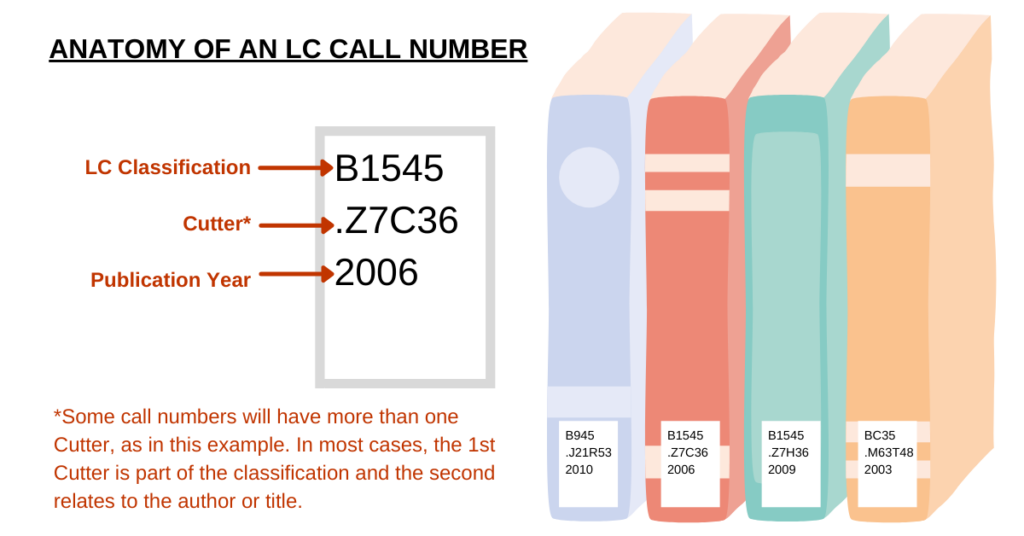
When reading LC call numbers to locate a book, first find the main class (B, for example, for philosophy, psychology and religion). Single letter class numbers will come before double letters and the associated numbers are then ordered chronologically (B945, for example, would come before B1545, and both of those would come before BC35).
Decimal numbers (if present) are read line-by-line (not chronologically) and so is the Cutter, a pattern likely more familiar since that is how Dewey Decimal numbers are ordered (BF724.55, for example, would come before BF724.6).
Of course, if you can’t find an item on the shelf, a librarian is always available to assist you in your search. Just ask for help at the desk.
-Blog post by Leanne Jernigan, Technical Services Librarian