
 During the early years of the college there were many choices that needed to be made. The school added literary societies, fraternities and sororities, athletic teams and then made other decisions such as changes to the curriculum. The faculty discussed setting up an honor roll and establishing an honor society for high-achieving students. At a faculty meeting in the fall of 1935, a committee was created to investigate the creation of an honor society and with that the establishment of an honor roll. It was not until the spring of 1936 that standards were established, and an honor society was created.
It can be difficult to see why this is so important, but honor was built into the early college social structure. Here is a note from the minutes of the Faculty Meeting on February 9th of 1926 where accruing honor allowed both men and women certain freedoms.
“The fallowing privileges will be granted to the present junior class. Whether these same privileges are given to the juniors of other years will depend upon the conduct of the class as sophomores.
- Juniors may go home on four weekends during the semester and may stay out until ten o’clock Sunday night.
- Juniors are allowed to go to town four times a week.
- Juniors do not have to get permission to go to town but must sign up properly.
- Juniors may use their own discretion in the matter of church attendance.
- Junior girls may, at the discretion of the dean of women, act as chaperones for young ladies who wish to go for a short auto ride in the afternoon.
- Junior girls may have one honor date a month.”
Women were allowed one date a month but needed permission from her parents. Also, women should date men who were honor students as well, referred to here as “honor dates”:
“Conditions to be fulfilled for honor dates: Any girl who has not been before any student council or reproved by any member of the faculty for one month may anytime during the next month have one date to-go out with a boyfriend. The nature of the date to be stated in permission from the parents.
These dates may be carried over from one month to the next. If these dates are with the college boys, they must be honor students also.”
The need to determine who were the better students was necessary as each year the faculty were asked to decide who were the “best all-around boy” and the “best all-around girl.” The following is from the minutes of the May 1927 Faculty Meeting:
“In order that honors may be distributed as much as possible among the students of the college, the point system as used by most colleges and universities has been adopted.
No student shall be allowed more than 100 honor points during any one semester of the school year. The administration of the system is to be in the hands of a permanent faculty committee which shall yearly consider the evaluation of points and shall act upon cases necessitating any exception to general regulations.”
Points were given for students who were involved in student government, athletics, or any club or organization, and higher points were given to students who served as officers in these organizations. In the year this was adopted the faculty selected J. Elwood Carroll as the best-all-around boy student and May Frazier was selected as best-all-around girl student. Their photos are included here.

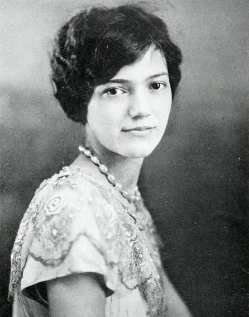
In 1928 the campus established an honor roll.
“February 15, 1928, Faculty Committee
The matter of graduating students with honors was referred to the Executive Committee.
It was moved and carried that the High Point College honor roll should be composed of students who are carrying 15 hours of class work who average “B” or over and who are in good standing in the institution.”
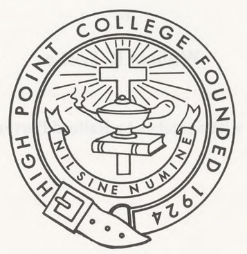 In the mid-1930s, an honor society was formed. This organization was created in 1934 and had its first inductees noted in the 1935 Zenith. While there is no description of why they adopted the name Lighted Lamp, the symbolism is not hard to decipher. The school had recently decided on a college seal, as seen here, that enclosed the Christian cross, a book, and a lamp of knowledge as symbols that demonstrated their resolve as a college. Also, it was not lost on them that the lamp of knowledge was the crown that stood at the apex of the Roberts Hall tower and still does so today.
It was the work of students and faculty who wanted a student organization that was made up of the top students at the college. Those selected had made the honor roll and had been awarded points as being active members of student government or student run organizations. In the 1935 Zenith, the new honor society was introduced, and you can see that it meshes well with how the campus determined honor: scholarship, character, service, and leadership.
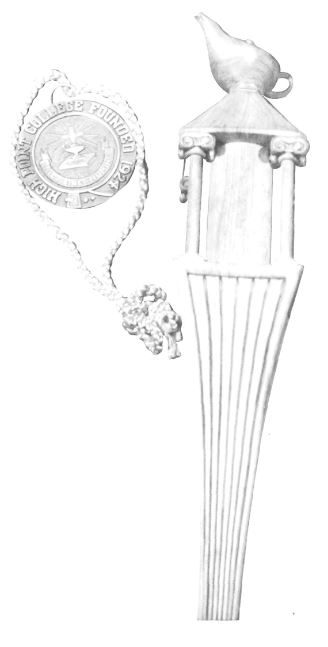 “The Lighted Lamp is a new honor society that was organized as a joint movement of the faculty and students to promote higher standards among the student body. The rules for the first tapping were made by a committee from the student government and the faculty, but the organization is now self-perpetuating.
The members are elected in the second semester of the junior year or of the senior year. Requirements for membership are:
- Scholarship—an average of B and no failures or conditions for five semesters
- Character—excellent.
- Service—outstanding
- Leadership—the candidate must have proved his ability as a leader.
Members are chosen from various student activities such as athletics, Christian organizations, student government, forensic group, publications, literary societies, and social groups.”
-Blog post by David Bryden, Director of Library Services