
Emotional Intelligence—EQ—is more than a trending concept. It anchors High Point University’s 2025–2035 Quality Enhancement Plan because research demonstrates that EQ supports academic success, personal well‑being, and long‑term workplace readiness. The QEP draws from established scholarly models to create a shared, research‑based foundation for this initiative.
How the QEP Defines Emotional Intelligence
The QEP begins with the widely accepted definition from Salovey and Mayer (1990), who describe EQ as “the ability to monitor one’s own and others’ feelings and emotions, to discriminate among them, and to use this information to guide one’s thinking and actions.”
Their later work (1999) further explains EQ as “the ability to recognize the meanings of emotions and their relationship, and to reason and problem‑solve on the basis of them toward self‑regulation.”
The field later expanded EQ to include how individuals manage social relationships. Goleman’s (1995, 1998) work frames EQ in terms of practical skills: self‑awareness, self‑regulation, motivation, empathy, and social skills—all of which can be developed.
Stein and Book (2011) add that EQ involves maintaining relationships, coping with challenges, and using emotional
information effectively.
The Four Core EQ Skills Highlighted in the QEP
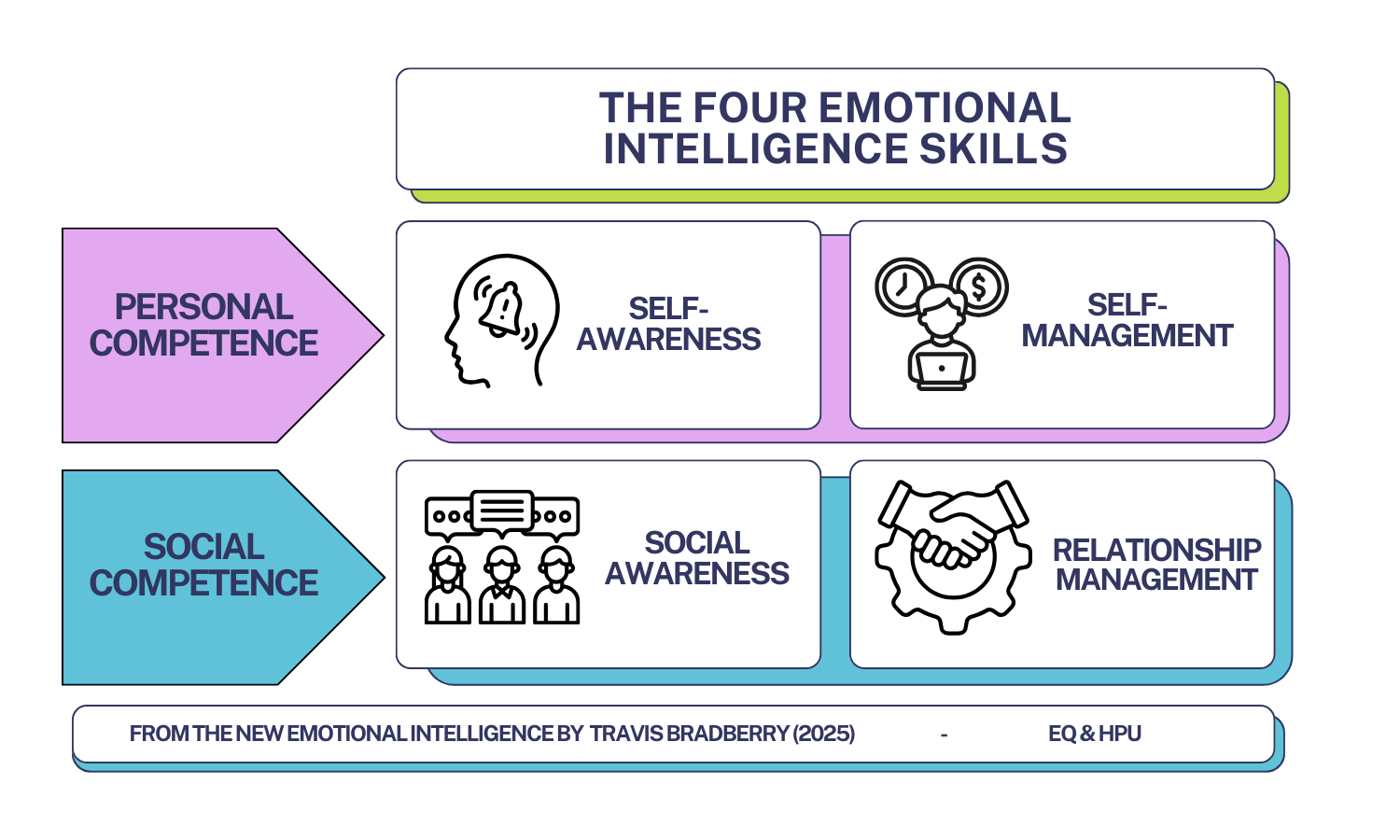
To simplify and unify these models, the QEP uses a four‑part framework from Bradberry (2025). These four skills serve as a clear foundation for campuswide understanding:
- Self‑Awareness: identifying what you feel and why
- Self‑Management: managing your emotional responses and behaviors
- Social Awareness: recognizing and understanding others’ emotions
- Relationship Management: using the previous three skills to sustain healthy interaction
Bradberry identifies self‑awareness as the “cornerstone” because the other competencies depend on it.
How EQ Works in Real Life
The QEP details multiple cognitive and behavioral capacities that fall under EQ, captured in Mayer and Salovey’s (1997) Four‑Branch Model:
- The ability to perceive and recognize emotions
- Using emotion to facilitate cognitive processes
- Understanding emotional complexity and change
- Managing one’s own emotions and the emotions of others
These abilities are not fixed traits—they develop over time through reflection, feedback, and social interaction.
Why EQ Matters for Students, Classrooms, and Careers
The QEP team outlines three primary areas influenced by EQ:
- Personal: EQ supports self‑esteem, resilience, motivation, and hope (Salovey & Mayer, 1990; Batool et al., 2014).
- Academic: EQ contributes to better stress management, organization, time management, GPA, and retention (Shulman, 1995; Mann & Kanoy, 2010; Parker et al., 2016).
- Professional: 71% of employers value EQ over IQ (CareerBuilder, 2011). 27–45% of job success is linked to EQ (Stein & Book, 2011).
EQ supports collaboration, leadership, adaptability, and positive client interactions, and is tied to greater promotion and salary outcomes (Brooks, 2024; Landry, 2019; Price, 2023; Wells, 2024).
These findings reinforce why EQ is the center of Intelligence That Connects—the long‑term QEP mission to help HPU students grow as learners, community members, and future professionals.