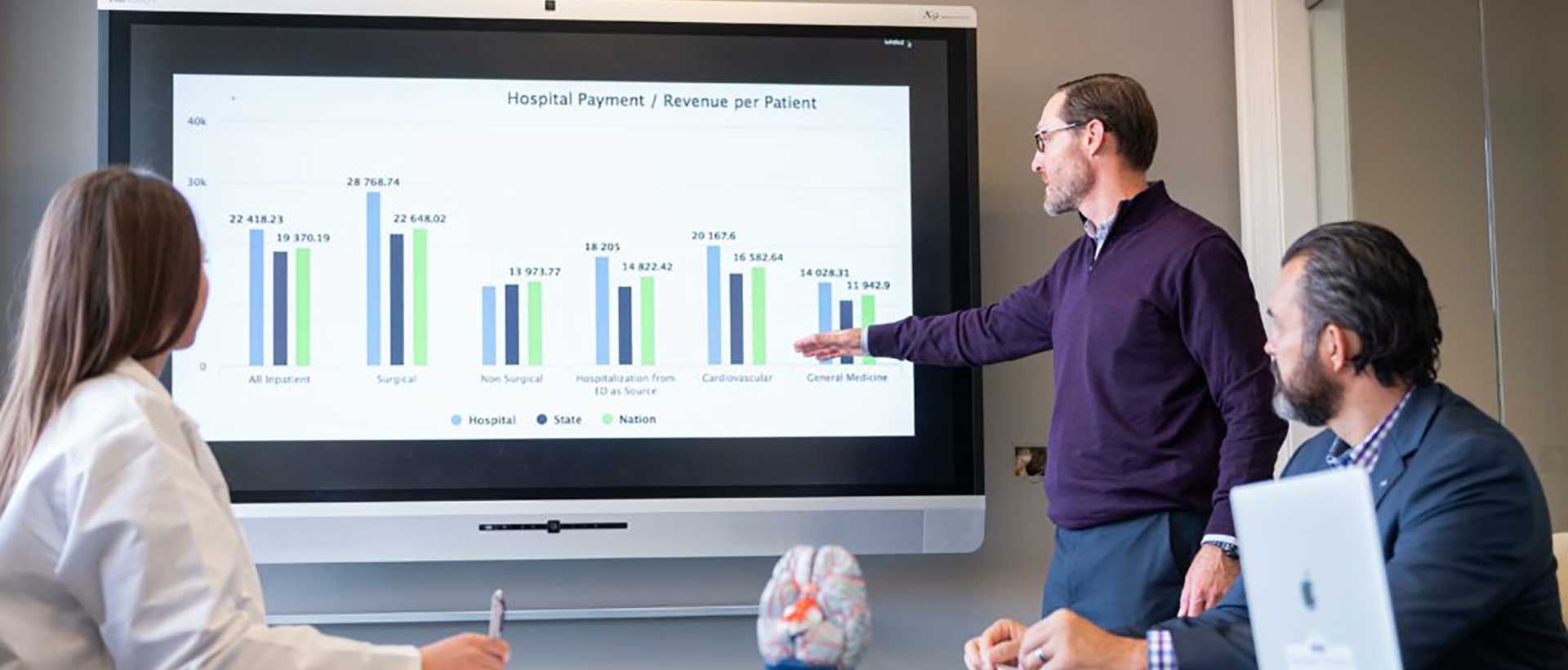
Learning That Reaches Past the Classroom
A healthcare administration degree is worth what your network and your judgment make of it. The HPU MHA program builds both on purpose. Students join national professional societies, sit in on state policy conversations, compare the U.S. system against a universal one, and work with alumni who finished the same program a few years earlier.
These partnerships give students a professional identity before graduation, not after it. Below is where those connections lead.
Where Our Students Connect

American College of Healthcare Executives (ACHE)
Every MHA student is encouraged to join ACHE as a Student Associate. Membership opens the door to career resources, mentoring and advising networks, local chapter events, webinars, publications and fellowship listings.
Program leadership also sponsors one to two students to attend the ACHE Congress on Healthcare Leadership when funding allows. That sponsorship exists for a reason. Congress puts students in the room with executives from across the country, and cost should not be what keeps them out of it.
ACHE Higher Education Network (HEN)
The MHA program is a member of the ACHE Higher Education Network, the group that ties healthcare management education programs directly to the profession.
The affiliation gives faculty access to professional development tools and resources built specifically for graduate health management education. For students, it means the competencies taught in class are the ones the profession is actually asking for.
About the Higher Education Network
North Carolina Healthcare Association (NCHA)
NCHA represents hospitals and health systems across the state, and its meetings are where North Carolina’s healthcare leaders work through policy and operations questions in real time.
Select MHA students have received complimentary registration to the NCHA Winter Meeting, giving them a seat at those conversations while they are still studying the concepts behind them.

Medical Group Management Association (MGMA)
Not every healthcare leadership career runs through a hospital. MGMA is the program’s route into physician practice management, ambulatory care and medical group operations.
Students gain awareness of industry benchmarking data, practice management resources, training, and the certification pathway through the American College of Medical Practice Executives (ACMPE). Management expertise matters across the full continuum of care, not only inside health systems.
National Council on Administrative Fellowships (NCAF)
As an NCAF program partner, HPU connects students to the national community that shapes how administrative fellowships are recruited and structured.
Students get a clearer view of how the process works, plus access to the National Administrative Fellowship Centralized Application Service (NAFCAS), virtual fellowship fairs and the NCAF fellowship directory. Administrative fellowships are competitive. Preparation is the part students can control.
Swedish Healthcare Academy
MHA students may take part in an optional international learning experience with the Swedish Healthcare Academy.
Studying a universal system next to the U.S. model sharpens how students think about access, quality, population health and the policy choices behind system design. Watching another country solve the same problems differently is hard to replicate in a textbook.
Support From Inside HPU
MHA Alumni Advisory Committee
The MHA Alumni Committee keeps alumni, current students, faculty and program staff in regular contact. Its work covers networking, mentoring and career conversations, plus the harder question of how to build community among students who are learning online, including more chances to meet in person.
The committee is also a candid feedback loop. Alumni say what the program got right and where current students need more support, and that shapes what the program does next.
Office of Career and Professional Development
MHA students work with HPU’s Office of Career and Professional Development whether they are on campus or fully remote. The office covers resume and cover letter development, interview preparation, professional branding, networking and career exploration, along with access to employer platforms such as Handshake.
The point is translation. Coursework, experiential learning and leadership competencies only count once a student can make an employer see them.