Disney’s Robin Hood 1973
By: Reagan Smith, Dexter Boldog, and Maggie Roche
Plot
Disney’s projection of Robin Hood is about a sly fox named Robin Hood who steals from the rich to give to the poor in his town called Nottingham. Nottingham is under the rule of King Richard, a full-grown lion who went on a Crusade away from England. England is now left under the rule of Richard’s brother, Prince John, a younger, cowardly lion. Prince John was taking a lot of taxes from the people; everyone in the town saw John as taking money from them for his own greed. He took so many taxes that the people of Nottingham could barely provide for themselves. Robin Hood and his friend, a bear named Little John, would disguise themselves to get the money that Prince John collected and give it back to the people. Prince John was seen by the people as gullible and childish and who always fell for Robin Hood’s disguises and schemes. He was never prepared to fight back and get rid of him, plus John would constantly complain and whine about his mother liking Richard more than him. Disney portrayed John as an evil, greedy, gullible king. In the book, King John: An Underrated King, Graham E. Seel explains that “Robin Hood films produced over the course of the past one hundred years have frequently presented John either as the principle villain or an effeminate coward.”1 Because of films like this, people get an idea of John as a really poor king. However, history tells people that John was not taxing the people to gain personal wealth and fortune. King Richard was in fact the true king of England at this time. He did go on a Crusade during his reign, but he got captured and John had to pay Richard’s ransom. The only way to pay Richard’s ransom was to put heavy taxes on the people. It was truly Richard taking money from the people, not John.
King John’s Relationship with the Church
John’s relationship with the church in the movie, shows in great detail John’s accurate relationship with the church in the history books. In the movie, John never listened to the Friar of the church. He always took money from the church without hesitation and care. In the book, King John: An Underrated King, it explains that, “A key feature in John’s reign was his often fraught relationship with the church.” John was in a constant fight with the Pope. John needed an Archbishop of Canterbury in 1205 but in order to put an Archbishop in office, John needed the Pope’s approval. John put in his own choice and the Pope excommunicated him and all of England from the church. Later John repented to the Pope to get out of excommunication. However, his barons were plotting to get him off the throne. Civil war eventually broke out, John got captured, and he was forced to sign the Magna Carta. The Magna Carta said, “In the first place we have granted to God, and by his present charter confirmed for us and our heirs forever that the English church shall be free, and shall have her rights entire, and her liberties inviolate; and we will that be thus observed; which is apparent from this that the freedom of elections, which is reckoned most important and very essential to the English church, we, of our pure and unconstrained will, did grant, and did by our charter confirm and did obtain the ratification of the same of our lord, Pope Innocent III… before the quarrel arose between us and our barons.” This explains that the church was now free form the throne and had its own liberties for itself and for protection from the throne. John, in signing the Magna Carta, granted the church their liberties and rights separate from his power.
Prince John, His Perceptions, and Comparisons of King Richard
In Disney’s 1973 animated film Robin Hood, directed by Wolfgang Reitherman, Prince John was characterized as a young and childish lion, especially when compared to his older brother King Richard who is shown as stronger lion with a large and full mane. His main opponent, and the films protagonist, Robin Hood is portrayed as a sly and cunning fox. The film sets a clear “good versus evil” narrative where Robin Hood is seen as a savior for the people of Nottingham against Prince John’s tax-frenzy rulings and saying, “Rob the poor to feed the rich.”3 Throughout the film he is always shown surrounded by luxurious items and greedily hoarding bags of gold coins. He was shown to have no regard for religious figures and extended his taxing to the church. Furthermore, the townspeople in the film would often call him “Phony King John” not only because Prince John acted as King while his brother was off fighting in Crusades, but also, because they hailed King Richard to be much kinder and greater than John.

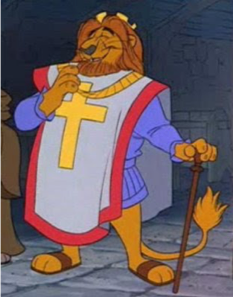
Prince John (left) compared with King Richard (right)
The film’s characterization of King Richard as great is questionable because he only spent six months of his ten years as King in England.4 However, the movie townspeople are shown as supportive of Richard being away fighting in the “great crusades” as emphasized by Little John, Robin Hood’s sidekick.
The film also conveniently does not mention that part of the reason the taxes are raised is due to the ransom John must pay to release his brother who was captured during the crusades. However, this detail might not be necessary as the aristocrats, not the townspeople who are the focus of the film, at the time still despised these taxes and fines, and had them taken out through the Magna Carta:5
“All fines made with us unjustly and against the law of the land, and all amercements imposed unjustly and against the law of the land, shall be entirely remitted.”6
Overall, these knocks on Prince John in comparison to King Richard are most likely oversimplifications made to keep the storyline simple because it is simply an animated children’s film. Reaching more for Hollywood entertainment than historical accuracy is made easier by keeping with a simple evil greedy fake king versus good heroic townsman and archer Robin Hood. It also keeps in line with Disney’s theme of the will of the people overthrowing the tyrannical evil ruler or villain; even though, the only people really helped by the signing of the Magna Carta were the aristocrats while the regular townspeople where still very poor.
In terms of historical accuracy, we would give it a 3/5 because there were many oversimplifications, but they were generally accurate with the actual time period.
The Context of Side Characters
Robin Hood contains various characters with questionable historical origins. Little John, Friar Tuck, Maid Marian, the Sheriff, and Sir Hiss all serve a purpose in the movie, but what was their purpose in the course of in the earliest “Robin Hood” ballads and history?
Sir Hiss is Prince John’s side kick in the movie who tries to warn him numerous times about Robin Hood’s doings. He continuously fails to inform Prince John adding an element of comic relief to the film. Sir Hiss has no historical backing and must be original to the Disney adaptation of the fable.
The Sheriff of Nottingham serves as Robin’s chief antagonist. He is collecting the money for Prince John and was shown as ruthless in the case of caring for the poor. Scholars found a comparable line between him and Philip Mark, Sheriff of Nottinghamshire and Derbyshire from 1209 to 1224, but with other people possibly being comparable, it is thought that the real representative factor of the Sheriff is the corrupt authority against which Robin and his men are fighting. The identity of one particular individual is nearly irrelevant as The Sheriff of Nottingham’s general role is to play the chief villain facing Robin Hood.
Maid Marian and Robin Hood are pinned as the love story of the movie. Robin Hood wants to impress her and end the separation that is between them. Maid Marian is absent from many early ballads of the historical story, though. Scholars trace her origins back to an old French tradition of a shepherdess called Marion who had her own unrelated Robin.8 In the nineteenth century, this connection was made into a love story in the Robin Hood legend that is known today.
Friar Tuck is a portrayed as a loveable character who holds the town together. He, like Maid Marian, does not appear in the early “Robin Hood” ballads but is first present in the fifteenth century. For example, the “Moch,” in “Robin Hood and the Monk,” portrayed an early version of Friar Tuck.9 Ironically, as the Robin Hood stories become more and more firmly associated with the reign of King Richard, Tuck became an essential part of the story even though mendicant friars did not appear in England until well after Richard I’s reign.10 Friar Tuck is not a historically accurate person but plays a crucial part in the film.
Little John is Robin Hood’s side kick. He assists in distracting the aristocrats so Robin Hood can steal from the rich throughout the movie. The two do most things together. The friendship formed in some of the earliest “Robing Hood” ballads and stories.11
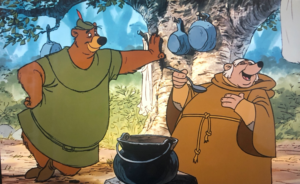
Scene from Disney’s Robin Hood depicting Friar Tuck and Little John interacting
Entertainment Value
Disney has struck gold again with its rendition of Robin Hood. The family-friendly animated classic depicts the historical story of Prince John’s taxes. Although exaggerated at times for effect, a heroic, at times comedic, adventure creates a jam-packed ninety minutes. Since the technology is not up to 2020 standards, at times the animation lacks. This children’s film may not be for everyone but is an easy watch with an entertainment value of 4/5.
Overall Ratings
Entertainment: 4/5
Historical Accuracy: 3/5
End Notes and Further Readings:
- Seel, G. E. (2012).King John: An underrated king. London: Anthem Press.
- White, Albert Beebe. (1915). Medieval Sourcebook: Magna Carta 1215. New York:
Harper and Brothers.
- Hood, Robin. “Wolfgang Reitherman.” Walt Disney Entertainment(1973).
- Meigs, Samantha A. and Lehmberg, Stanford E. “The People of the British Isles: From
Prehistoric Times to 1688”. Oxford University Press (June 2016)
- Hughes, Jane Frecknall, and Lynne Oats. “KING JOHN’S TAX INNOVATIONS –
EXTORTION, RESISTANCE, AND THE ESTABLISHMENT OF THE PRINCIPLE OF TAXATION BY CONSENT.” The Accounting Historians Journal, vol. 34, no. 2, 2007, pp. 75–107. JSTOR, www.jstor.org/stable/40698360. Accessed 18 Oct. 2020.
- Magna Carta, 1215. https://sourcebooks.fordham.edu/source/mcarta.asp.
- Rennison, Nick. Robin Hood: Myth, History, and Culture. Harpenden, Oldcastle Books,
October 2012.
- Ibid.
- Knight, Stephen and Ohlgren, Thomas. Robin Hood and the Monk. Kalamazoo,
Michigan, Medieval Institute Publications, 1997.
- Rennison, Robin Hood.
- Ibid.