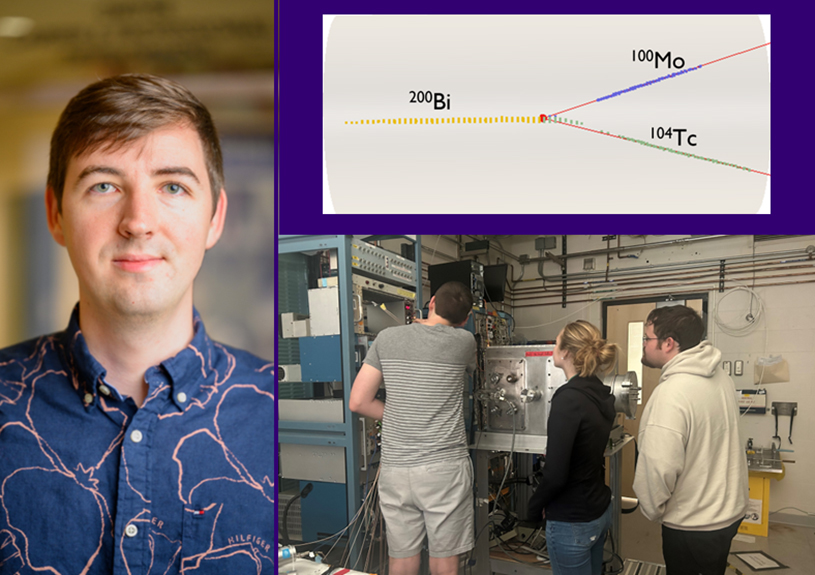
 Dr. Adam Anthony – My research focuses on nuclear physics, or studying the properties of the atomic nucleus. I primarily use a type of detector called a time projection chamber (or TPC) to study how nuclei split, a process called fission. A TPC acts as a large three-dimensional camera that allows us to take “pictures” of how individual nuclei travel through the detector and interact with each other. These experiments are all performed at accelerator facilities like Argonne National Lab and the Department of Energy’s Facility for Rare Isotope Beams. Students in my group have the opportunity to travel to these other facilities to perform experiments, run simulations to support the analysis and development of new experiments, design and assemble new detectors, and analyze the large data sets that arise from these experiments.
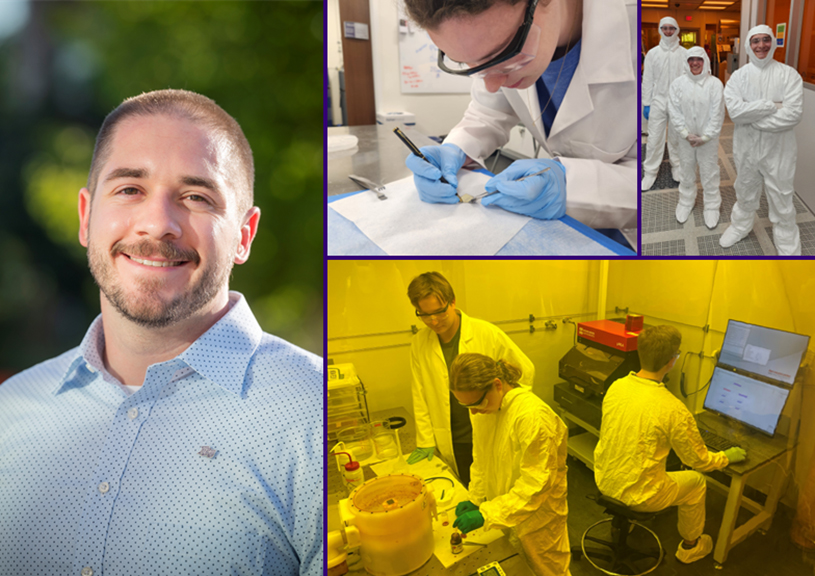 Dr. Jacob Brooks – The Brooks lab focuses primarily on designing, fabricating, and testing micropatterned surfaces in a variety of experimental environments and applications. Undergraduate researchers in our lab gain knowledge in physics, materials science, chemistry, and biology. They develop intellectual curiosity, creative problem-solving skills, and scientific independence, and may collaborate with other faculty and institutions. In the Brooks lab, undergraduate researchers learn microfabrication and analysis techniques like photolithography and advanced microscopy, respectively. Our interdisciplinary approach aims to create transformative biomedical and industrial technologies by integrating microfabrication, fluid dynamics, and rheology to understand and control biofilm-surface interactions.
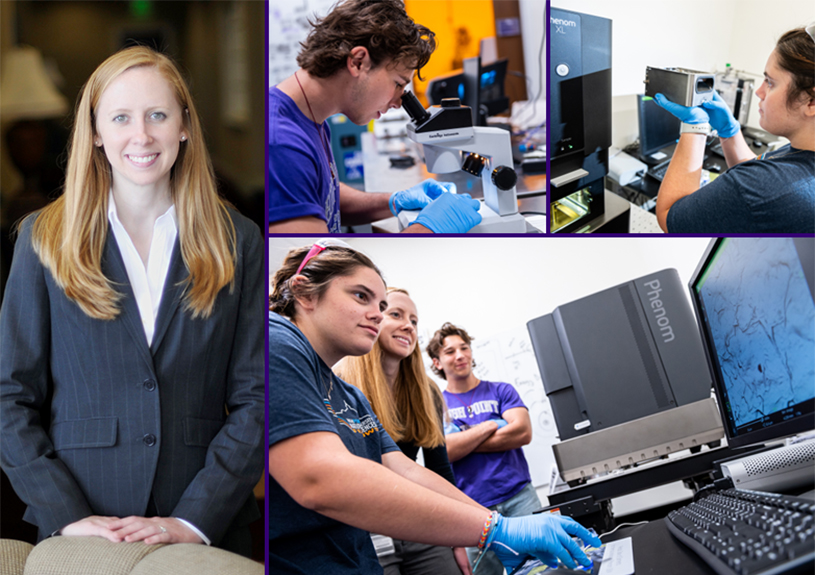 Dr. Briana Fiser – The Fiser Lab focuses primarily on the physics of biological systems and soft materials, including polymers, biomaterials, and complex fluids. To understand the fundamental properties and behaviors of these systems and materials under various conditions, the Fiser Lab applies nanoscale experimental techniques and computational modeling. Additionally, the lab seeks to uncover insights that can lead to innovative applications and the development of new technologies in fields like medicine, engineering, and materials science. Current projects are focused on exploring the prevention of bacterial growth on surfaces through surface patterning, a phenomenon employed by the lotus leaf and cicada wing, which have micron-sized structures that effectively prevent bacterial colonization through surface hydrophobicity or rupture. Such patterned surfaces show promise as a blueprint for developing new technologies to fight bacterial growth on surfaces used frequently in the field of human health, such as catheters, IVs, or cardiac stents.
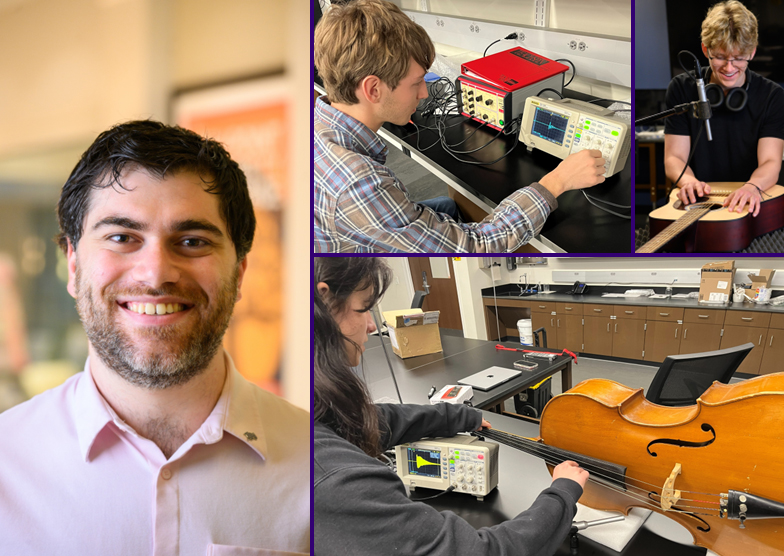 Dr. Eric Rokni – My research explores the interdisciplinary field of acoustics, with applications in both biomedical imaging and musical sound. In biomedical acoustics, my work has focused on understanding the origins of the Doppler ultrasound twinkling artifact, a phenomenon that can improve diagnostic imaging. In musical acoustics, I have investigated the occurrence of phantom partials in piano sound, a factor that contributes to the instrument’s unique and complex tonal quality. Future projects in the lab aim to expand these insights while also exploring new realms of acoustics.
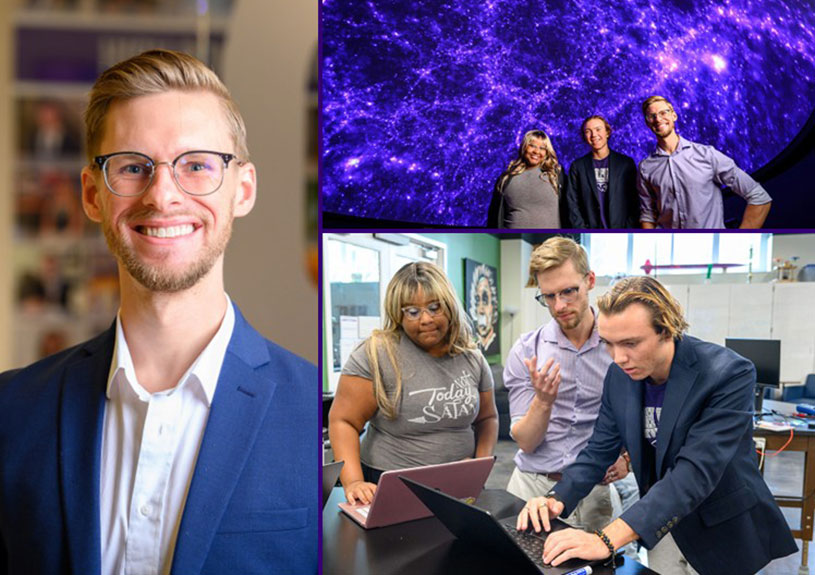 Dr. Alex Sobotka – Dr. Sobotka’s research group employs theoretical physics and computational modeling to better understand the nature of dark matter, dark energy, and the earliest epochs of our Universe. While successful in making many accurate predictions, the standard model of cosmology isn’t perfect. For example, measurements of the present-day expansion rate inferred from local probes like Type Ia supernovae are in tension with what we infer from observations of the Cosmic Microwave Background. This begs the question: how reliable is our standard model of cosmology? Are there models that make predictions that better match what we observe? Our group investigates alternative cosmological models and aims to develop new ways to test these models with observations. A major focus of our research is the study of small-scale structures such as dark matter subhalos, which are concentrations of dark matter that orbit within larger galaxies. These structures could be powerful laboratories for testing theories of dark matter and cosmological models that impact the formation of structure. More about the Sobotka Lab