Computer Science First, Security Second
The major is grounded in computer science. Students get the technical underpinnings before the security material, then move through information security basics into cryptography, operating systems, networks, penetration testing, malware and reverse engineering.
Foundational Courses
- MTH 1410: Calculus I. Limits, derivatives and integrals of functions of one variable.
- CSC 1710: Introduction to Programming. The fundamentals of writing correct, efficient programs in a high-level language.
- CSC 2342: Discrete Structures. The discrete mathematical structures that underpin computer science.
- CSC/MTH 3010: Cryptography. The mathematics of encryption and how cryptographic systems protect data.
- CSC 3460: Networking and Network Programming. Network technologies and network programming built on a layered model such as OSI.
- CSC 3810: Introduction to Information Security. Confidentiality, integrity and availability, common threats, and cryptographic tools such as encryption and hash functions.
- CSC 3940: System Security. Security of operating systems, networks and software, learned by building vulnerable systems and recreating attacks on them.
- CSC 4710: Software Engineering. A capstone in the software development life cycle with an object-oriented design focus.
Electives
- CSC 3820: Penetration Testing. Authorized testing of systems to find and exploit vulnerabilities before attackers do.
- CSC 4820: Reverse Engineering and Malware Analysis. Taking software apart to understand how it works and analyzing malicious code.
Review the full CSC course descriptions.
Classes average a 17-to-1 student-to-faculty ratio. Program contact: Dr. Michael Oudshoorn, [email protected].
The Cybersecurity Engineering Learning Facility
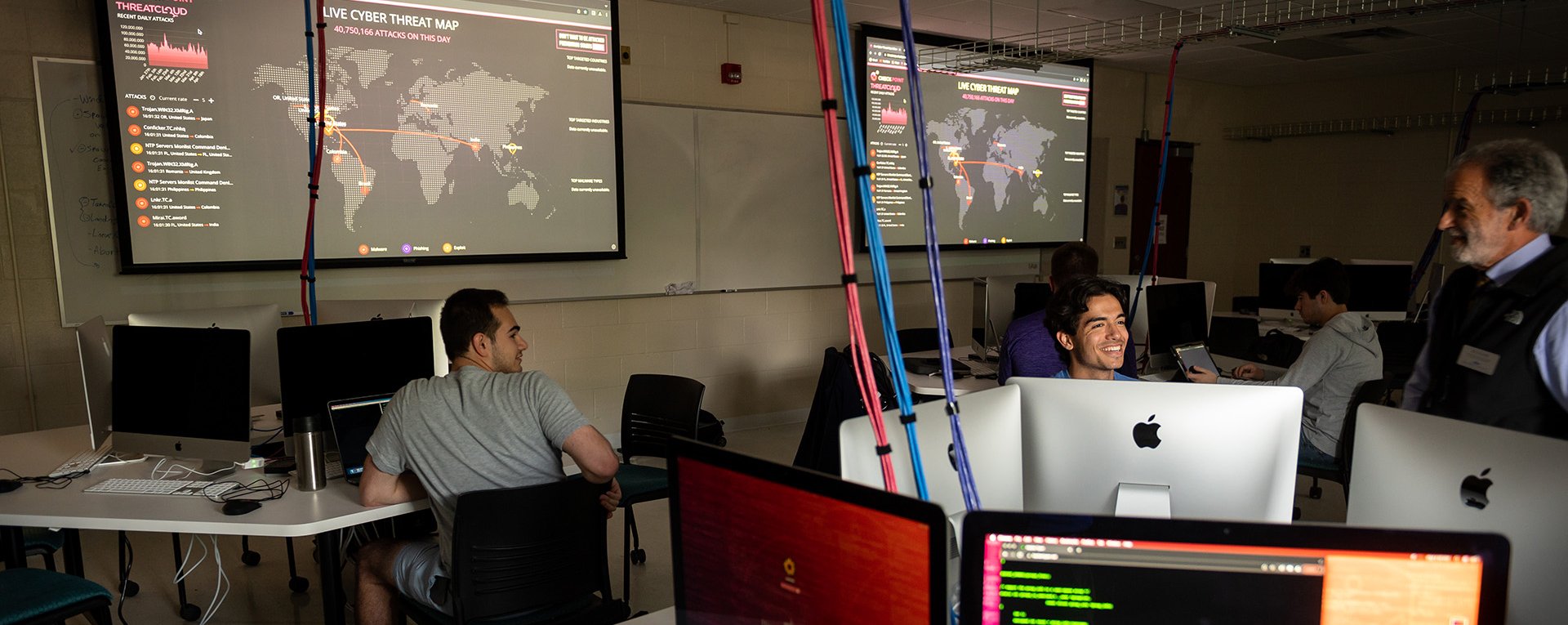
The CELF was built from the ground up as HPU’s hub for cybersecurity training, research, analysis and programming. It runs as an isolated environment, so students work hands-on with real cyber tools, live malware and networking equipment across a range of virtual machines without any of it touching a production network.
Inside it students defeat simulated cyberattacks. Outside it they compete in cyber competitions, take internships, and write scholarly articles on open problems in the field.
B.S. in Cybersecurity Degree Requirements
The B.S. in Cybersecurity requires 128 credits: 68 credits of major requirements, 36 to 44 credits of University Core requirements and 16 to 24 elective credits.
Beyond the foundational security courses, the major includes CSC 1720 Advanced Programming with Data Structures, CSC 2212 Database Systems, CSC 2410 Computer Systems, CSC 2710 Advanced Data Structures with Algorithm Development, CSC 4210 Operating Systems, ECE/PHL 2014 Engineering and Technology Ethics and STS 2910 Introduction to Statistical Analysis.
Inside the Cybersecurity Engineering Learning Facility
The CELF gives students an isolated environment for offense and defense work:
- 36 iMac workstations
- 10 Dell PowerEdge servers with AMD EPYC chipsets
- Networking lab pods with 4 switches, 4 routers and 2 wireless access points each
- More than 100 TB of storage on a private SAN
- A private cloud with more than 300 compute cores and 1.5 TB of RAM
- Dual 1 Gb Ethernet LANs, blue for defense and red for offense
- An isolated 1 Gbps internet connection
From Coursework to Cybersecurity Internships
Cybersecurity coursework at High Point University prepares students for the internships that start their careers. Spencer Day interned in cybersecurity at La-Z-Boy. Caitlin Black, a computer science major with a cybersecurity concentration, interned in the project management office at Old Dominion Freight Line. Jonathan Raz, who majored in computer science and minored in cybersecurity, worked as a risk management analyst intern at Exlibris.
“My HPU courses have provided me with important industry knowledge that allowed me to walk into the internship well-educated in cybersecurity so that I could hit the ground running from day one.”
Day, Cybersecurity Intern, La-Z-Boy
The Princeton Review gives High Point University a 95 out of 99 rating for professor accessibility, based on its student surveys.
Required courses and credits are in the HPU undergraduate bulletin. The Office of Career and Professional Development helps students prepare resumes and applications, and the U.S. Bureau of Labor Statistics describes the work of information security analysts. Cybersecurity is part of the Webb School of Engineering, alongside computer science.
Explore Cybersecurity at High Point University
See how HPU cybersecurity is accredited and where its graduates go next.
Careers & Student Organizations Accreditation & Awards
Questions about the program? Email Dr. Michael Oudshoorn at [email protected].