 In the past 50 years, there have been many efforts to reform schools, but reform efforts have not generated the level of improvement to prepare students to participate effectively in the new global economy or make responsible decisions as citizens in our nation (DuFour & Eaker, 1998; Eaker, DuFour & DuFour , 2002; DuFour and Marzano, 2011). These are complex times and there is an increased urgency to ensure that our students are able to perform at a level of productivity that will ensure our continued success as a state and nation.
The role of the school principal continues to become more challenging and immensely more complex. While traditional principals may have viewed their role as merely to manage the school and ensure smooth daily operations, the demands of 21st century principals require that they demonstrate the vision, courage, and skill to lead and promote effective learning communities where all students can reach their potential. Indeed, school leaders play a major role in developing a “professional community” of teachers who guide one another in improving instruction (The Wallace Foundation, 2011). School principals must be transformational leaders who require and achieve higher levels of performance from students, teaching staff, and themselves. To create a collaborative culture and collective capacity, principals must build, among all constituents, a common mission and vision, and common values and goals (DuFour and Eaker, 1998; DuFour and Marzano, 2011). To develop a guaranteed and viable curriculum, leaders in a Professional Learning Community (PLC) must have the instructional knowledge to understand what student should know and be able to do, as well as the best instructional practices to teach this content. Principals must have the knowledge and capacity to build relationships, forming connections between themselves and teachers, teachers and students, teachers and parents and among community constituents (Dufour and Marzano, 2011). Effective principals are data driven and insist on studying data and analyzing trends, gaps and insights. They must translate this data driven culture to teachers and students, motivating and encouraging the entire school community to focus on continuous improvement and the common mission and vision communicated in the schools’ goals (Boudett, City, & Murnane (2005). Although principals must be the lead learners in their schools, they must lead schools in a way that places learning for both students and teachers at the core (NAESP, 2008). Improved student learning can be accomplished through the principal’s efforts to build collective capacity through effective professional learning communities and their ability to drive continuous improvement through “interdependence, shared responsibility, and mutual accountability” (DuFour and Marzano, 2011, p. 67).
This new definition of school leaders is informed by standards, competencies and accountability measures (Green, 2010; Marzano, Waters & McNulty, 2005). Key components of the educational leadership program at High Point University are guided and informed by several initiatives: the North Carolina Standards for School Executives (NCDPI, 2006), the 21st Century skills (Partnership for 21st Century Skills, n.d.), the North Carolina Professional Code of Ethics (NCBOA, 1998), the research on implementing Professional Learning Communities and the impact of North Carolina’s Teacher Working Conditions Initiative. These same key components will guide, inform, and evaluate their practice as school executives when they enter the field.
The North Carolina Standards for School Executives (NCDPI, 2006), informed by national reports and research, identify the practices of leadership that impact student achievement. Among the many bodies of research instructive in the development of the standards were the Maryland Instructional Leadership Framework, the Wallace Foundation, the Mid-continental Regional Educational Laboratory (McREL), the Charlotte Advocates for Education, and the Southern Regional Education Board (NCDPI, 2006). The North Carolina Standards for School Executives (2006) identifies seven critical standards to guide and inform the work of principals and assistant principals. The standards are derived from a national research study on the principalship funded by the Wallace Foundation (Portlin, Schneider, DeArmond, Gundlach, 2003). The study suggests that the principal’s job is diagnosing the particular needs of their school, considering the human and material resources available, and determining the best strategies to meet those needs. The authors identify the need for leadership in “seven critical areas; instructional, cultural, managerial, human resources, strategic, external development, and micro-political” (Portin, et al, 2003, p. 1). These skills are applicable to schools of any type (elementary or secondary, public or private) and must occur in all areas, but can be facilitated through distributive teacher leadership or provided directly by principals. They form the basis of North Carolina’s Standards for School Executives.
The role of the school principal continues to become more challenging and immensely more complex. While traditional principals may have viewed their role as merely to manage the school and ensure smooth daily operations, the demands of 21st century principals require that they demonstrate the vision, courage, and skill to lead and promote effective learning communities where all students can reach their potential. School principals must be transformational leaders who require and achieve higher levels of performance from students, teaching staff, and themselves. To create a collaborative culture and collective capacity, principals must build, among all constituents, a common mission and vision, and common values and goals (DuFour and Eaker, 1998; DuFour and Marzano, 2011). To develop a guaranteed and viable curriculum, leaders in a Professional Learning Community (PLC) must have the instructional knowledge to understand what student should know and be able to do, as well as the best instructional practices to teach this content. Principals must have the knowledge and capacity to build relationships, forming connections between themselves and teachers, teachers and students, teachers and parents and among community constituents(Dufour and Marzano, 2011). Effective principals are data driven and insist on studying data and analyzing trends, gaps and insights. They must translate this data driven culture to teachers and students, motivating and encouraging the entire school community to focus on continuous improvement and the common mission and vision communicated in the schools’ goals (Boudett, City, & Murnane (2005). Today’s school leaders must be equipped with the knowledge and skills to improve teaching and learning in their schools in order to effectively prepare “future-ready” and globally competitive citizens”. School executives must be able to harness technology for engagement and achievement in their schools. In order to do this, they must encourage in themselves and others 21st century tools for collaboration, communication and creation (Schrum & Levin, 2009). High Point University’s Educational Leadership program subscribes to the 21st century framework (Partnership for 21st Century Skills, n.d.) in preparing administrators to lead 21st century schools. Through the course work at High Point University, candidates for the Master’s degree in Educational leadership will be provided the opportunity to build knowledge, skills, and dispositions to construct, with teachers, innovative support systems to assist students in mastering the multidimensional skills and abilities required of them as they graduate from high school ready to be competitive in a global economy. The alignment of 21st century skills with the university’s program ensures the infusion of skills such as distributive leadership, personal responsibility, self-direction, social responsibility and accountability for teachers and students as leaders promote these attributes in the schools in which they will lead (NC SBOE, 2006). High Point University’s goal is to provide administrators the tools to lead NC schools and provide a safe, caring, engaging, 21st century learning environment for students.
Finally, previous analyses using survey data demonstrate that “schools where leaders empower faculty, create safe school environments, and develop supportive and trusting environments in which teachers work are most successful in promoting student learning” (Hirsch & Church, 2009, p. 1). Ladd (2009) reports that together, the working conditions variables account for 10 to 15 percent of the explained variation in math and reading scores across schools, after controlling for individual and school level characteristics of schools. The North Carolina Working Conditions Survey is a tool developed to inform policy makers, and school administrators of students, teachers, and principals’ perceptions of teaching and learning factors affecting student learning. Developing strategies to use this tool to identify, initiate, and sustain change is a goal of the High Point University’s Master’s level Educational Leadership program.
The M.Ed. program in Educational Leadership at High Point University is committed to the preparation of experienced school executives to serve as educational leaders in 21st century schools. The program provides the foundations in the principles of school executive leadership and organizational management and law, strategies for creating positive school culture, developing teacher leadership, and using school data to improve student learning. Acknowledging the skills and dispositions that educators will need to operate in an increasingly challenging, fast-paced, demanding and ever-changing environment, the program embraces a vision that is focused on what educational leaders need to do to improve student learning outcomes to meet the challenges of today’s 21st century real-world environment.
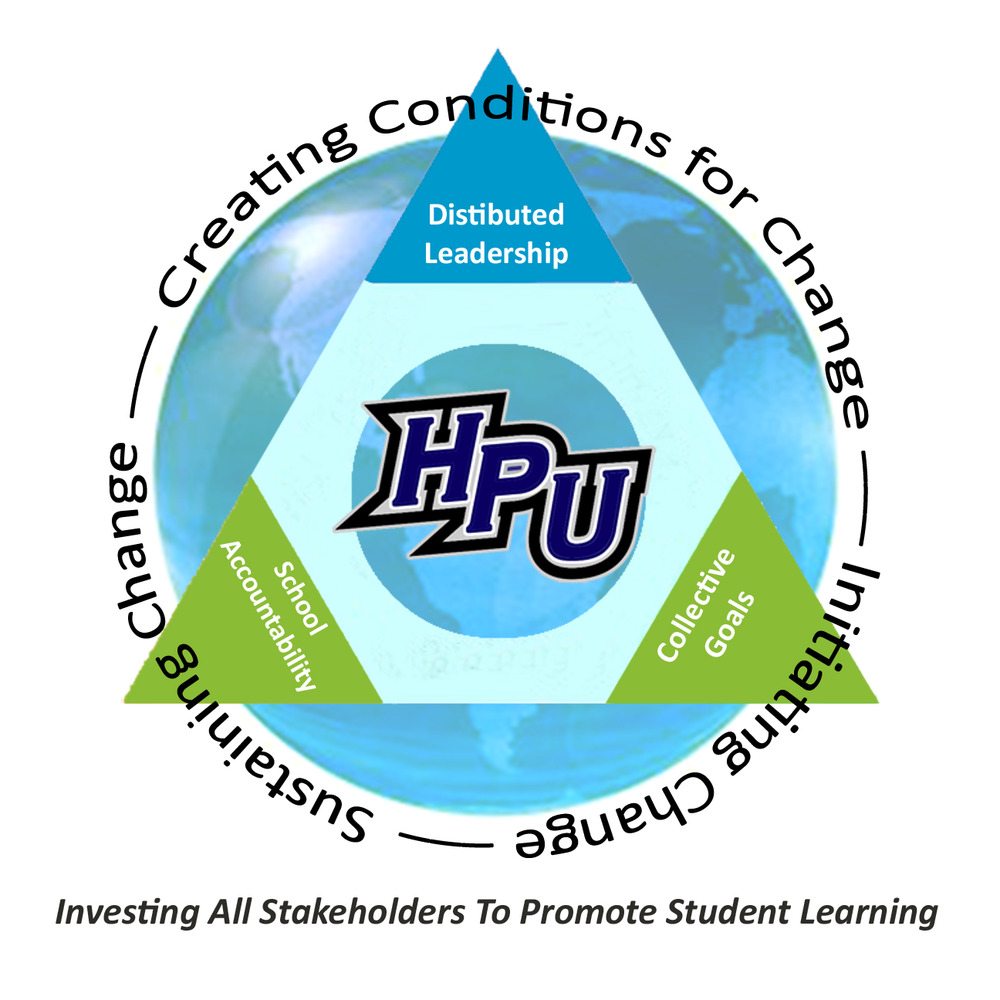
High Point University seeks to prepare school executives with the skills to lead others in accomplishing their school’s mission, establishing structures in which educators and students can lead, and improving leadership capacities of the staff and students. Indeed, school executives must be prepared to create conditions for change, as well as plan, implement and sustain change in their schools (Reeves, 2009). The “revisioned” program (2010) embraces a new vision of distributed leadership that prepares candidates with the knowledge, skills, and dispositions to create organized, purposeful, and collaborative school communities whereby all stakeholders are invested in diagnosing, learning and adapting quickly to improve student performance. The framework of the program chiefly serves to prepare school executives who are capable of “creating conditions of change” by building strong relationships with staff, students, and families; are invested in “implementing a shared vision for change” through professional learning communities whose members are committed to using data and research-based practices to improve classroom instruction and student learning and are capable of “sustaining change” by providing the structures needed for continuous school renewal.