
Devotional
Finding Purpose in our Pain
James has these words for the 12 tribes of Jewish Christians being driven out of Israel. In James 1:2-4, he writes:
“Consider it pure joy, my brothers and sisters, whenever you face trials of many kinds because you know that the testing of your faith produces perseverance. Let perseverance finish its work so that you may be mature and complete, not lacking anything.”
Think for a minute what almost every Jewish Christian must’ve felt. They were fearful, running for their lives, and they were scattered all over the place to escape the persecution of Christians that they heard was happening in Jerusalem.
James wrote this letter to encourage and remind them what true faith is because their trust in the Lord was lacking. The first idea James stressed to them is about trials. Now, imagine you are one of the people James is writing to, and while you are running for your life to escape some sort of persecution, James tells you to consider this as … pure joy?
I can only imagine someone trying to wrap their heads around that.
With Christians fleeing their homes and getting killed, the 12 tribes had good reason to be mad at God and doubt their faith. But James desperately reassured them that this hard time was neither a waste nor a coincidence. He reminded them that God was only testing them, and if they persevered, they would be ready for God to use them for something much more significant.
To understand what James means, consider what silversmiths do.
They test silver by putting it into a pot, heating it with fire, and at a specific extreme temperature, they look for the silver’s impurities rising to the surface. They then scoop out that top layer and repeat these steps over and over again until the silver is ‘tested’ or ‘pure.’
They know when the silver is complete or thoroughly ‘tested’ when they can look down and see their reflection in the silver. It’s so clear it’s like looking into a mirror. I find this to be a beautiful picture because it reminds me of how God tests us.
He wants us to be ‘complete.’ He tests us so that one day He can look down from above and see His own reflection within us.
So often, though, the farthest thing from our minds is seeking to understand God’s purposes in our pain. That seems so foreign to us. Contrary to James, most people are joyful when they escape trials.
So, how do we endure hardships with joy?
Let’s turn to Hebrews 12:2 for an answer. It says: “fixing our attention on Jesus, the pioneer and perfecter of the faith, who, in view of the joy set before Him, endured the cross, disregarding its shame, and has sat down at the right hand of the throne of God.”
Jesus endured the cross with joy, but that doesn’t mean He still didn’t experience pain, grief, or sorrow. That is just part of the human experience.
God doesn’t want to make us just happy; He wants to make us holy. Therefore, considering our hardships as joy does not mean we won’t experience pain. It means we have hope and trust in His process.
Our goal as Christ’s followers is to be more like Jesus, and if trials are what it takes to accomplish that, then we can ask God for the opportunity to experience His teachings and grow into the person He created us to be.
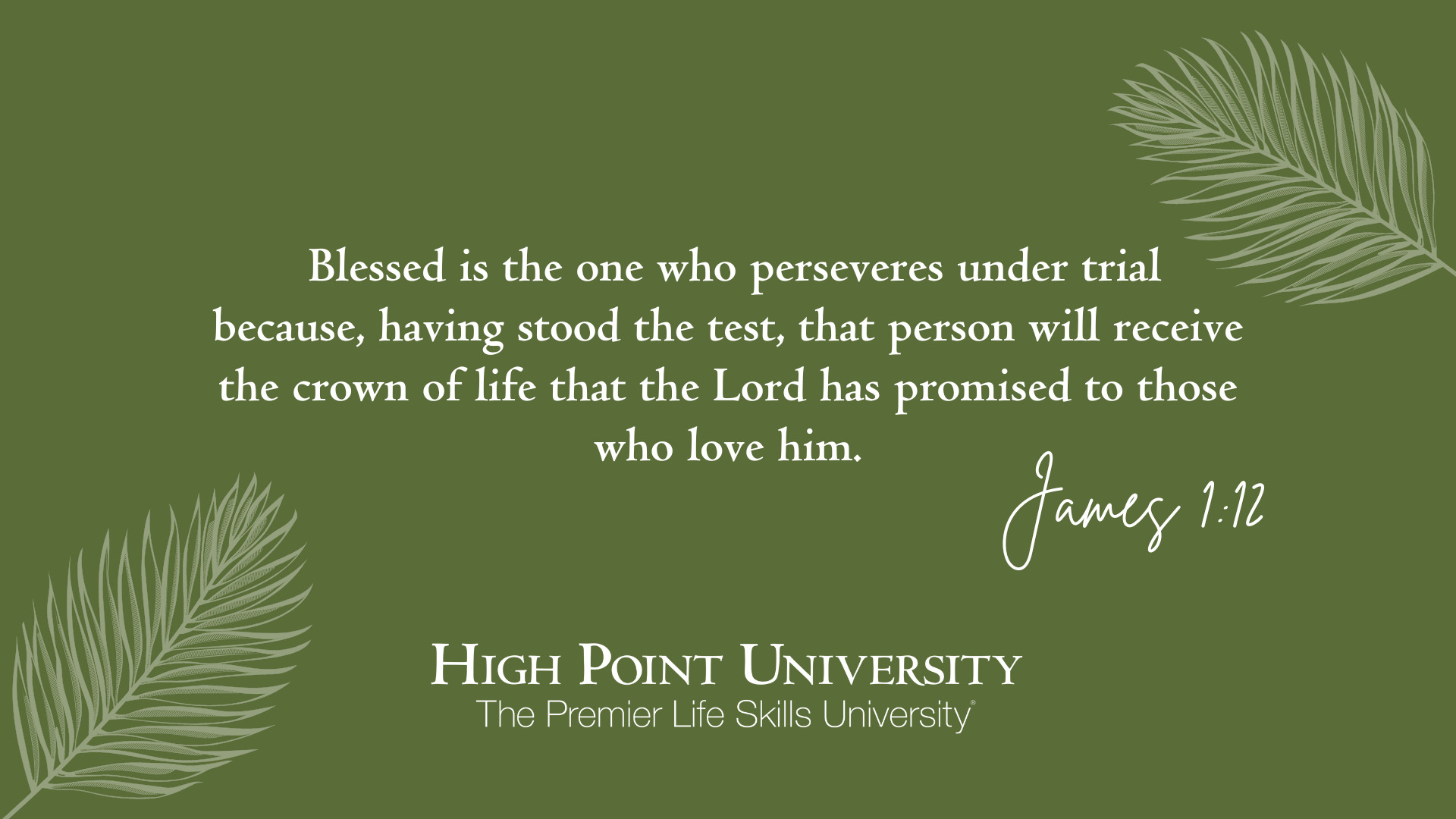
Know that the trials we all have and will undergo are unpredictable and unavoidable, but trust that they are intentional. James ties this all together in his letter to the 12 tribes when he says that if they persevere through this testing, they will receive what God has promised to those who love him –– the “crown of life.”
So, trust God to use your trials to purify you and help you become, in the words of James, “mature and complete, not lacking anything.”
During our season of Lent, think about a difficult time in your life where you became stronger, where you realized your potential, strengthened your faith, or discovered how your story could help others. Find peace and joy within this trial and thank God for this journey.
It led you to where you are today.

By Gabrielle Valkner, an HPU sophomore majoring in strategic communication with a minor in environmental science.