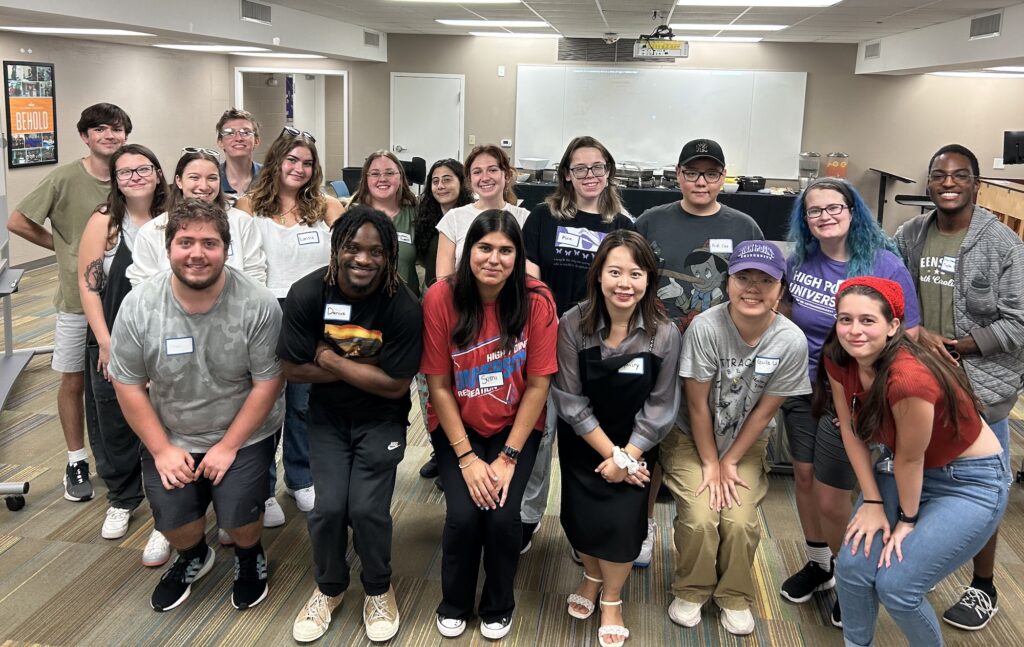
 HPU Interfaith United
Because of its religious heritage, High Point University prides itself on being a place of hospitality to people of all faith traditions. We are committed to not only providing space and support to multifaith development but also, interfaith engagement and service. Interfaith engagement is about creating bridges of understanding and empathy across lines of religious traditions.
Initiatives:
- Interfaith United is the student-led group, which leads efforts in bringing HPU’s student body together.
- Interfaith Dinner Club is a year-long interfaith dinning experience that introduces students to interfaith leadership concepts over the course of meals shared between people of different religious traditions.
- The Interfaith Partner Program is a one year student-employment cohort program providing interfaith education and engagement for students. Students interested in applying should contact Rev. Preston Davis, Minister to the University.
 Her name is Aqsa. She’s a senior at High Point University majoring in business administration, and she pronounces her first name this way –– she pronounces it this way — . Uh-k-sa.
She gets asked all the time how to pronounce her name, whether at HPU or her hometown of Thomasville, North Carolina.
She’s not bothered by it because her name is who she is.
Aqsa means to go very far, to be successful, and to reach great heights in Arabic. Having a name of Pakistani heritage among mostly Anglo names, makes her unique, she believes. Her Muslim heritage plays a large role in her everyday life.
Whether it’s from drinking water to starting a business, her religion provides a built-in instruction guide for the life that allows her to be successful.
Aqsa believes her purpose is to benefit society and spread truth through good actions. She does so by praying as much as possible. She praises God for giving her life, for a better world, for her family, and to ensure that everything turns out for the best.
Aqsa says she specifically feels holy during the month of Ramadan, which is the holy month of fasting. Ramadan happens at a different month every year revolving around the Islamic lunar calendar. Particularly, Aqsa enjoys “the food, family time, praying at night at the mosque, and being surrounded by community, everyone is focused on bettering their relationship with God.” This month allows her to look at life from a unique perspective and see how we usually take everything for granted in daily life.
She learned that from her parents.
Aqsa’s parents married each other in the Islamic Republic of Pakistan in 1985. A year later, her dad immigrated to the United States to escape poverty. He worked to get his citizenship and apply for a family visa. Meanwhile, he experienced various hardships including the language barrier, racism, and the struggles of providing for his family in Pakistan while working multiple below minimum wage jobs in America.

It was not until 1999 that his wife and children could immigrate to the U.S. as well.
However, once Aqsa’s mother immigrated, life still was not easy for her. She had to fully support three kids, while pregnant with Aqsa, not to mention navigate life in a new country on a minimal education level.
Due to the struggle her parents went through, Aqsa wishes to give back as much as possible. She wishes to give back to her parents for all they have done for her and help other families to have a sense of community in the United States.
For instance, she serves as a translator to others immigrating to America that do not speak English. She helps them navigate various activities such as going to the doctor or filling out documents. During the month of Ramadan, she donates to an orphanage to which her uncle introduced her.
One day, Aqsa hopes to work internationally to help less developed countries because she sees the disadvantages that people such as her parents go through and wants to be the change.
“My parents gave so much to me. I want to give back to help people in other countries.”
Because when she thinks about those people trying to make a way, she thinks of one thing — her parents.
 When she arrived in 2000, Dr. Nahed Eltantawy saw the United States as a place of opportunity. A year later, when 19 terrorists turned three planes into bombs and hit the Pentagon and the World Trade Center Dr. Eltantawy feared that her new home of opportunity might turn into a home of hate.
Prior to 9/11, Eltantawy proudly expressed her background to others and would enjoy striking up conversations with new people about Egypt. Then, after the terrorist attack, she began to fear publicly speaking about her background. To this day, she will not speak Arabic in the airport for fear of misunderstanding.
At Georgia State University, where she was seeking a doctorate in journalism, her peers supported her and kept asking, “Are you OK?”
Through all that, she practiced her religion and she continued to pray five times a day, as observant Muslims do. After 9/11, however, she did not simply want to become more pious. She wanted to become more informed about her faith. Eltantawy began to study her faith in a new way.
Eltantawy wanted to answer misguided questions such as “are Muslims terrorists?” and to defend her religion in the media and to the people.
Dr. Eltantawy grew up Muslim in Egypt, the middle daughter of an artist mother and a military doctor father. She experienced westernization due to her surroundings in the Catholic elementary and middle school and the British educational high school she attended.

This led her to attend the American University of Cairo and work in the Ministry of Economy. Two years later, she had a career shift and worked for a job in journalism without any experience in the field. She stayed there until she met her husband, Hesham Eltohami.
When her husband got a job as a networking engineer for a computer company, the two moved to Atlanta and Dr. Eltantawy went to Georgia State for a doctorate degree in journalism. Through the education, she received a student visa to stay in the United States.
After she graduated from Georgia State University with a degree, she came to HPU in 2008 to teach journalism. Eltantawy—now the Associate Dean of Journalism at the Nido R. Qubien School of Communication—identifies as a Suni Muslim, which is not simply a title but a way of life. Everything she does revolves around God’s will. For instance, “if I am on my way home, I might be on the phone with one of my children and I might say, “I am on my way home, I will see you in a little bit, Inshaa Allah (God willing),”” Eltantawy explains. It is ultimately God’s decision, not hers. She takes nothing for granted. Nothing is given.
She relies on God for everything. Her devotion began to grow when she was in high school as she started reading the Quran. Then, she expanded upon it even further when she moved to the U.S. and after 9/11 when there was increasing negativity around Islam.
To show her appreciation for God, Eltantawy prays five times a day, which is one of the Five Pillars of Islam. She prays in her office and at home with a prayer mat. Her religion has taught her how to treat others and has instilled values in her which she practices in her daily life.
Though Five Pillars such as Ramadan are practiced differently in Egypt, she and her family still find ways of observing the holy month here. In Egypt, Eltantawy is used to joining in on the Ramadan celebration with various members of the community as they all come together, and everyone is welcome to join.
In her experience of living in the U.S., Ramadan is a much quieter celebration. Her family will attend Mosque together and celebrate with the members of the Mosque. However, this past year she enjoyed the increased family time since they could not celebrate with others due to the pandemic.
She feels motivated by God, her immediate family, and the precious times she can see her relatives who live in Egypt.
 At a time where there were less than twelve Jewish students on campus, in the late 1990’s, Dr. Frederick Schneid made HPU’s Jewish Student Association Hillel affiliated.
The university’s tiny Jewish population was too small to be a Hillel. Yet, Dr. Schneid oversaw providing a place for the students to go for the High Holidays and arranging Birthright-Israel opportunities for the students.
Though he was the faculty advisor, he let the students run the programs because it was their experience.
Dr. Schneid’s experience was much different.
He grew up in Brooklyn, New York where he was enfolded into a large Jewish community. It was not until he attended graduate school in Indiana that he experienced not being in a population with other Jewish people. In graduate school, he was one of a very small number of Jewish students.
In 1994, Dr. Schneid began working at High Point University as a professor of European and military history. In addition to being a faculty advisor for Jewish students, he was director of the Honors program for ten years (200-2010) and is currently the Director of the Individualized Majors Program. He became the chair of the Department of History in 2010.
Every Friday, Dr. Schneid looks forward to coming home from work to honor the Sabbath (the day of rest). He enjoys this time of the week because it provides him with the opportunity to shut down his technology, reflect on his week, and spend time with his family.
He and his wife have one main rule, that his children must be home for the Sabbath dinner on Friday night.
Shabbat dinners are a weekly tradition in Dr. Schneid’s house. Each week, Dr. Schneid’s wife bakes challah breads for the family to enjoy, along with wine, and a candle lighting.
The Jewish holidays of Rosh Hashana Yom Kippur, and Passover are the most holy holidays of the year.
Specifically, Dr. Schneid enjoys Passover due to its historical significance. Each Passover goes something like this:
In the week before the holiday, the Schneids cleans out their pantry of food items that contain “Hametz”-food with yeast or flour that causes bread to rise.
This food is strictly prohibited for Passover.
They replace it with special Kosher for Passover food that substitutes matzo meal or potato meal for flour.
Then, he and his family have Passover Seders on the first two nights of Passover, which commemorates the enslavement of the Hebrews in Egypt and their Exodus.
This holiday allows Schneid’s passion for history to come through in a personal way as he happily celebrates with his family.
Today there are almost 200 Jewish students on campus. In Dr. Schneid’s 27 years at HPU, he has watched and helped the population to grow and blossom into what it is today, including the new Jewish Studies minor which will begin with the new 2021-2022 academic year.
Recognitions
In 2015, Interfaith Youth Core recognized High Point University as its Rookie of the Year recipient for unique programing and civic engagement.