What Students Take
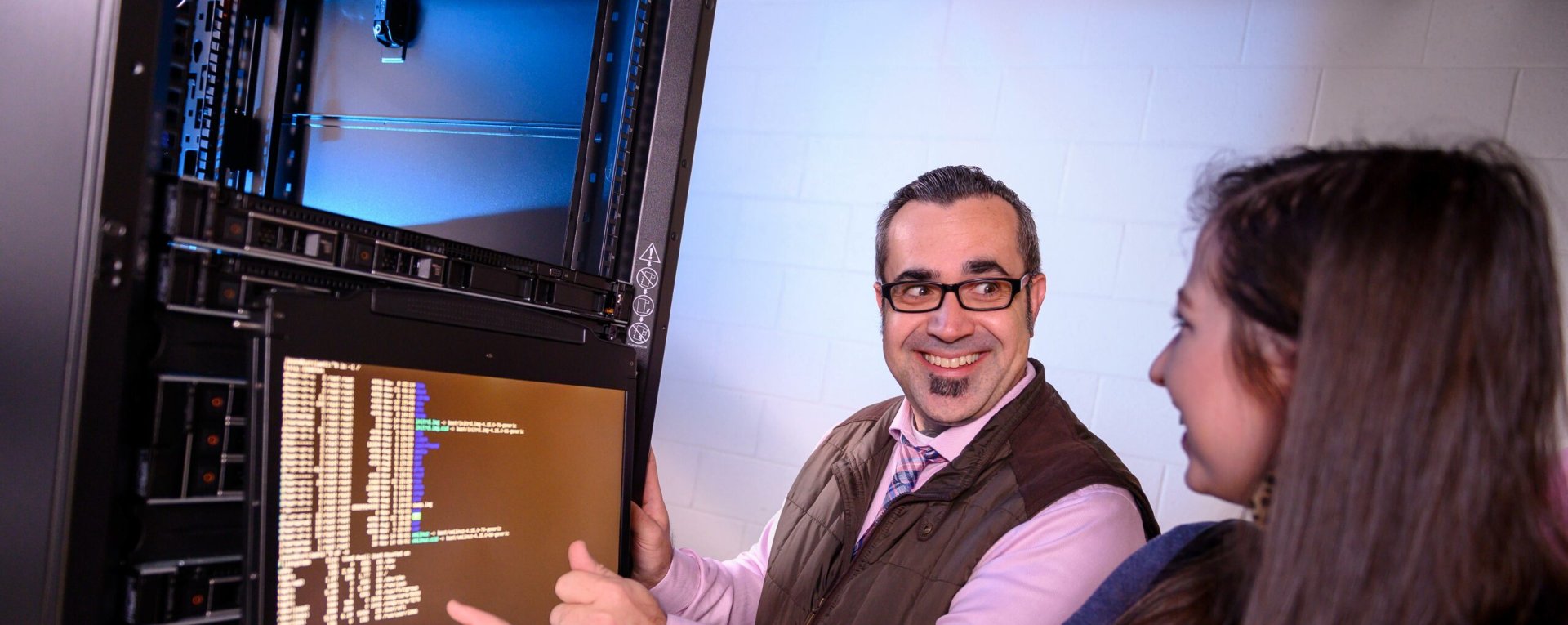
The degree covers collecting, shaping, storing, managing and analyzing data, and using AI for data-driven decisions. Students work on the university’s High Performance Computing Cluster rather than on laptops alone, and faculty teach toward discovering methods rather than presenting finished theory.
Key Courses
- CSC/STS 1600: Introduction to Data. Collecting, organizing and exploring data with modern tools.
- CSC 1720: Advanced Programming with Data Structures. Problem-solving strategies, algorithms and basic data structures in an object-oriented language such as C++.
- DSC 2110: Data Visualization. Designing charts and graphics that communicate what the data shows.
- CSC 2212: Database Systems. Relational design, SQL and NoSQL databases for web, mobile and cloud applications.
- CSC 2410: Computer Systems. Instruction set architecture, processors, memory and assembly language.
- CSC 2710: Advanced Data Structures with Algorithm Development. Algorithm design with graphs, trees and other advanced data structures.
- CSC 3250: Introduction to Artificial Intelligence. Building agents and systems that act intelligently in their environments.
- CSC 3270: Machine Learning. Algorithms that learn patterns from data to make predictions.
- DSC 4110: Data Management. Organizing, storing and maintaining large data sets for analysis.
- DSC 4900: Data Science Capstone. Applying AI, computational algorithms and machine learning to data from the student’s domain area.
Review the full CSC course descriptions.
Choosing Between AI & Data Science and Data Analytics
Artificial Intelligence and Data Science shares its programming, introductory data, calculus and statistics courses with the Data Analytics and Statistics major, including CSC/STS 1600, CSC 1720, DSC 2110 and STS 2910. This major adds a required domain area outside computing. Choose Data Analytics and Statistics instead if you want to stay inside statistics and math.
Classes average a 17-to-1 student-to-faculty ratio. Program contact: Dr. Michael Oudshoorn, [email protected].
Domain Areas in AI and Data Science
Students take coursework in a data-rich domain area of their own choosing, then apply AI, computational algorithms and machine learning to data from that discipline in the capstone. A graduate leaves able to talk to the people who own the data, not only to other data scientists.
Domain Areas
- Physics and astronomy
- Biology and neuroscience
- Chemistry and biochemistry
- Exercise science
- Economics
- Healthcare management
- Finance and accounting
Awards and Student Achievement
Ky Nguyen took third place for her paper presentation, “Optimized Three-Layer Hyperspectral Image Classification Model,” at the 2024 Mid-Southeast Regional Conference.
Research Access
Steve Wozniak, HPU’s Innovator in Residence, visits campus regularly to work with engineering students.
B.S. in Artificial Intelligence and Data Science Degree Requirements
The B.S. requires 128 credits: 74 credits of major requirements, 36 to 44 credits of University Core requirements and 10 to 18 elective credits.
Along with the key courses, the major includes CSC 1710 Introduction to Programming, CSC 2342 Discrete Structures, CSC 4710 Software Engineering, MTH 1410 Calculus I, MTH 2310 Linear Algebra, STS 2910 Introduction to Statistical Analysis and STS 3110 Intermediate Statistical Analysis. Students program in R, Python and C++.
Domain Area Requirements
Students select 12 credits from a single domain area, approved by their advisor. Sample courses include BIO 2001 and BIO 2002 Principles of Genetics, ECO 4150 Econometrics and PHY 2030 Modern Physics.
Data Science Minor
Students in other majors can add a 20-credit Data Science minor built on CSC/STS 1600 Introduction to Data, CSC 1710, CSC 1720 and CSC 2212 Database Systems.
Research and Presentation in Data Science
Data science students at High Point University present original work to outside audiences. Ky Nguyen placed third for a paper presentation at the Mid-Southeast Regional Conference in Gatlinburg, Tennessee. Jack Jaramillo, a finance and data science major, credits class presentations and faculty feedback with building the communication skills Jaramillo uses at Under Armour.
“Being able to communicate clearly and effectively. That’s something I could not do at all before college.”
Jaramillo, finance and data science major
Full requirements are in the HPU undergraduate bulletin. The U.S. Bureau of Labor Statistics describes the work of data scientists. Students can pair the major with mathematics or computer science in the Webb School of Engineering, and the Office of Career and Professional Development supports internship searches.
Across HPU, 99% of the Class of 2025 was employed or continuing their education within 180 days of graduation, measured by NACE standards.
Explore Artificial Intelligence and Data Science at High Point University
Artificial Intelligence and Data Science coursework at High Point University leads into data science, machine learning and analyst roles.
Careers & Student Organizations Accreditation & Awards
Questions about the program? Email Dr. Michael Oudshoorn at [email protected].