Semester Abroad
Charles Sturt University


The Department of Health & Human Performance strives to cultivate student development through an innovative curriculum and transformative learning experiences to develop future leaders in the field of exercise science as well as a variety of health science professions.
The mission of the Department of Health & Human Performance is to provide an extraordinary education through integrative student-centered teaching, research opportunities, and experiential learning related to human movement. The scope of education and scholarship ranges from the cellular to the psychosocial; the metabolic to the mechanical. We are committed to empowering students to pursue careers or graduate education in clinical professions, fitness, wellness, sports performance, public health, and research.
What is Health and Wellness?
Health is a structural, functional, and emotional state that is compatible with effective life as an individual and as a member of society. Wellness is an active process through which people become aware of, and make choices toward, a more successful existence. The academic focus of the program aligns with the pillars of lifestyle medicine across the lifespan including nutrition, physical activity, sleep, stress management, social connections, and avoidance of risky substances.
Computer Requirement Specs for Health and Wellness Majors
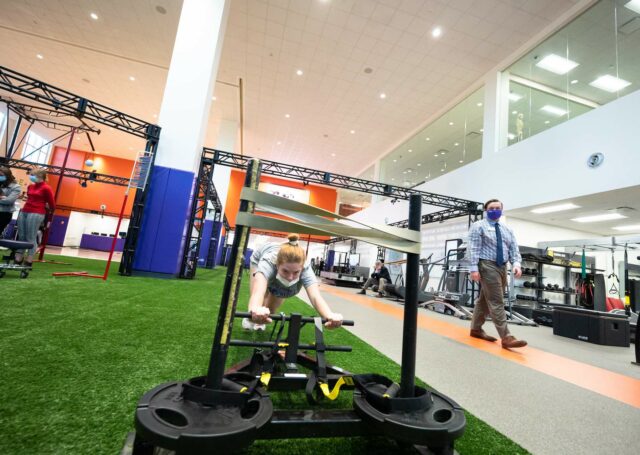
The Human Biomechanics & Physiology Laboratory consists of 13,500 square feet of awe-inspiring research, teaching, and clinical space. The centerpiece of the lab is our biomechanics area which consists of a large, open space surrounded by 24 motion capture cameras, featuring three force plates and an instrumented treadmill. In addition, the biomechanics area boasts truly unique functional motion-capture areas with a golf simulator, turf field, and wooden court surface. The physiology component of the lab includes an environmental chamber, wet lab, anti-gravity treadmills, metabolic carts, a wireless EMG for tracking muscle activity, and a DEXA scanner that measures bone density.
Exercise science majors have unique learning experiences in undergraduate research while receiving direct mentorship from faculty in exercise science and physical therapy. Students and faculty have presented peer-reviewed research at the American College of Sports Medicine and the American Heart Association annual conferences. A number of research projects have been published in the Journal of Applied Physiology, the Journal of Physiology and Biochemistry, and the British Journal of Sports Medicine.
In addition, the Congdon School of Health Sciences Summer Undergraduate Research Fellowship (CSHS-SuRF) program provides students the opportunity to work with a faculty mentor while conducting research in the Human Biomechanics and Physiology Laboratory.
| Degree Requirements | Credits |
|---|---|
| Core | 28 Credits |
| Elective Choice | 16 Credits |
| Total | 44 |
| Course | Course Title | Credits |
|---|---|---|
| ANA 2070 & 2071 | Human Anatomy w/ Lab | 3/1 |
| Core Courses: Foundation in lifestyle behaviors contributing to prevention, treatment, and reversal of chronic diseases within a cultural context. | ||
| PHYS 2060 & 2061 | Human Physiology w/ lab | 3/1 |
| HHP 1000 | Foundations in Lifestyle Medicine | 4 |
| HHP 1010 | Stress Management | 2 |
| HED 1200 | Nutrition & Healthy Living | 4 |
| HED 2100 | Prevention & Substance Abuse | 2 |
| HED 2200 | Human Sexuality & Relationship | 2 |
| HED 3100 | Contemporary Health | 2 |
| HHP 4400 | Health Behavior Change | 4 |
| HHP 4650 | Physical Activity Epidemiology | 4 |
| Electives Choices - 4 courses chosen from the elective pool to deepen understanding of specific lifestyle pillars, cultural contexts or related career applications. Listed alphabetically by dept. | ||
| HED 3300 | Aging & Life Choices | 4 |
| HHP 3100 | Research in Exercise Science | 4 |
| HHP 3200 | Exercise Testing and Prescription | 4 |
| HHP 3175 | Nutrition for the Health Science Professional | 4 |
| HHP 4200 | Exercise & Aging | 4 |
| HHP 4275 | Sports Nutrition | 4 |
| HHP 4425 | Culture of Healthcare | 4 |
| HHP 4475 | Culture of Fitness | 4 |
| HHP 4675 | Body and Identity | 4 |
| MGT 3600 | Introduction to Healthcare Management | 4 |
| MGT 3620 | Leading & Managing in Healthcare Organizations | 4 |
| MGT 3640 | Healthcare Delivery Systems & Policies | 4 |
| PEC 2130 | Healthy Living for the Elementary Child | 4 |
| PSY 3610 | Health Psychology | 4 |
| SOA 3030 | Health, Illness & Medicine | 4 |
| Internship | Internship | Variable Credit |
| Course Descriptions | Note: No more than two courses in the elective pool can double-count for fulfilling requirements in a declared Minor or Major. | |
Health and wellness coaches are healthcare professionals who assist patients in making lasting behavior changes that will improve their health and well-being by partnering with them to evoke motivation and develop skills to achieve their goals.
Health services managers plan, direct, and coordinate the business activities of healthcare providers
Health Informatics Specialists work with data such as patient records and other health information to optimize patient care.
Fitness and Wellness Coordinators develop and implement strategies and programs to promote health and well-being in the groups of people they serve which depending on the context could be employees, families, or community members.
Health education specialists work in hospitals, nonprofit organizations, and government agencies. Health educators develop programs to offer programs to teach about conditions affecting health and well-being.
Epidemiologists work in the private and public sectors to study patterns and causes of disease and injury.
