The B.A. in Middle Grades Education
Middle grades teachers work with students at a pivotal age, so the program pairs adolescent learning and interdisciplinary methods with deep content study in one subject. Students do fieldwork in local schools all four years.
The degree totals 128 credits, with 62 in the major and specialization.
Teaching Courses
- Educational Psychology (EDU 2100). How the social, psychological and physical development of K-12 students shapes learning.
- Students with Disabilities: Characteristics and Service Delivery Models (EDU 3100). Multi-tiered supports, IEPs, special education law and co-teaching in inclusive classrooms.
- Literacy in the Content Areas (EDU 3280). Helping students read and interpret content-area material, with a 15-hour practicum.
- Interdisciplinary Methods of Instruction for Middle Grades (EDU 4150). Planning interdisciplinary curricula for young adolescents across language arts, math, science and social studies.
- Methods of Instruction for Teaching Middle Grades and Secondary Subjects (EDU 4165). Standards-based instructional design, assessment and lesson planning for grades 6-12.
- Analyzing and Evaluating K-12 Assessment Data (EDU 4166). Rubric design, data literacy and value-added tools such as EVAAS.
- Instructional Technology (EDU 4110). Integrating technology into standards-based lessons and formative assessment.
- Discipline and Classroom Management Issues for Middle Grade and Secondary Teachers (EDU 4280). Positive classroom management for the social, physical and emotional needs of adolescents.
- Introduction to Student Teaching (EDU 4155). The first half of the supervised 16-week student teaching internship in grades 6-12. Degree-only students take Internship in Education (EDU 4811).
- Student Teaching Continuation (6th-12th Grade) (EDU 4255). Completion of the full-time 16-week internship under a cooperating teacher and university supervisor.
Discipline Specializations
Each student chooses one subject to teach:
- English language arts, with courses such as The Literary Imagination, Style, Children’s and Young Adult Literature and Literature for Young Adults (EDU 3251), a study of works read by children ages 10 to 13
- Mathematics
- Science
- Social studies
Students can add a minor, such as mathematics, history or special education, to strengthen their content preparation.
Licensure and Degree-Only Tracks
Students can finish on the licensure track, with 16 weeks of student teaching, the required licensure tests and the edTPA portfolio, or on a degree-only track that replaces student teaching with a four-credit internship and electives. Both total 128 credits. Students can also continue straight into an M.Ed. through HPU’s B.A. to M.Ed. program.
The Stout School of Education Building
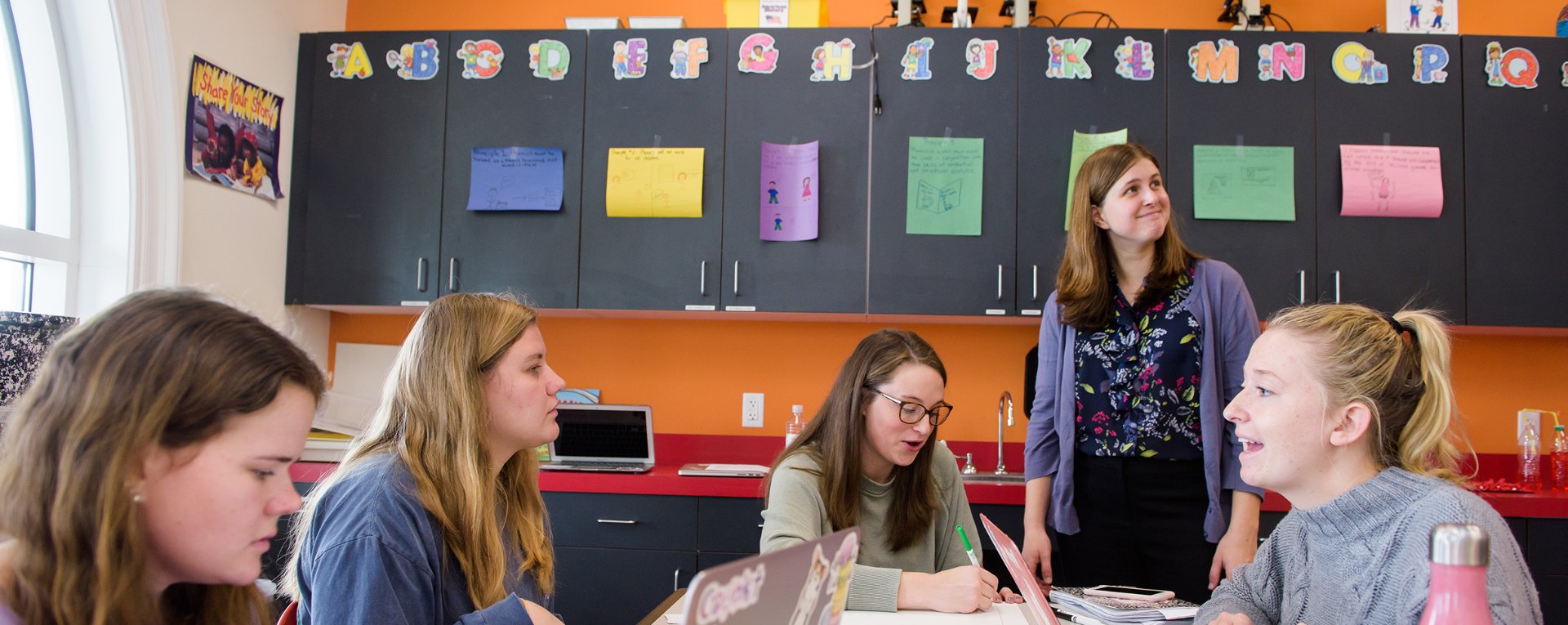
The 31,000-square-foot, LEED-certified building includes a Teacher Resource Center, a children’s resource library, methods labs that simulate elementary classrooms for literacy and STEM, and the Sheehy Specialized Curriculum Learning Lab.
Community Teaching
Education students lead Literacy Nights and LEGO Education Workshops for local families and have studied STEM teaching at the U.S. Space and Rocket Center.
Faculty With School Experience
Faculty include former superintendents, principals, classroom teachers, school psychologists and curriculum specialists. They rely on clinical experiences, simulations and problem-based learning. The Princeton Review gives High Point University a 95 out of 99 rating for professor accessibility, based on its student surveys.
EDU-Fellows
Qualified education majors can join EDU-Fellows, a four-year cohort program with special activities, trips and scholarship opportunities.
Field Experience in Practice
Middle grades coursework pairs a subject specialization with teaching methods, and graduates say the combination set them apart in hiring. Jessica Strickler concentrated in language arts and social studies and now teaches language arts for Henrico County Public Schools in Virginia. DuChante Davis committed the first two years of a teaching career to Teach For America. Crystal Miller, a middle grades major with minors in special education and history, passed the edTPA as part of HPU’s fifth straight year at a 100% pass rate.
The sequence meets the standards of the Association for Advancing Quality in Educator Preparation (AAQEP), and every course is described in the Undergraduate Bulletin. Students can pair the major with the Special Education Minor, and the Stout School of Education connects every major to its district partners and annual education career fair.
“Having compiled a detailed professional website over multiple semesters as part of our coursework gave me an added advantage in showcasing my lesson plans, technological capabilities and experiences in and out of the public school classroom.”
Jessica Strickler, language arts teacher, Henrico County Public Schools
Explore Middle Grades Education at High Point University
See how HPU middle grades education ranks and where its graduates teach.
Accreditation & Awards Careers & Organizations
Questions about the program? Email Dr. Amy Holcombe at [email protected].