The B.A. and B.S. in Physics
Physics majors build problem-solving skill, theoretical understanding and experience designing and running experiments. Computer programming is treated as a scientific tool: students learn computational modeling in Python in introductory physics and use it across all four years.
The B.A. requires 48 credits in the major and the B.S. 62, both within 128 total credits. HPU encourages double majors such as physics and mathematics or physics and chemistry.
Experiential Learning in Every Course
Every physics course includes at least two of three components:
- Experimental physics in the laboratory
- Computer programming and computational modeling
- A culminating experimental, computational or theoretical project
Mathematics and Programming
- CSC 1710 Introduction to Programming: Programming fundamentals used across the physics curriculum.
B.S. students also complete a pure mathematics sequence (MTH 1410, 1420, 2310, 2410 and 3410) or an applied sequence that adds MTH/PHY 2050 and 2150 and PHY 2200 Computational Physics.
Physics Course Descriptions
Course lists and degree plans are on the physics advising and courses page, and full descriptions of every course are in the High Point University Undergraduate Bulletin.
Required Physics Courses (B.S.)
- PHY 2001 and 2002 Research and Scientific Writing in Physics I and II: An independent research project with a faculty mentor, plus writing and presenting like a physicist.
- PHY 2010 and 2020 Fundamentals of Physics I and II: Calculus-based mechanics, electricity and magnetism, with computational modeling in Python.
- PHY 2030 Modern Physics: Relativity, quantum phenomena and atomic and nuclear physics.
- PHY 2100 Electronics: Circuits and instrumentation for experimental physics.
- PHY 3110 Classical Mechanics: Newtonian, Lagrangian and Hamiltonian approaches to motion.
- PHY 3210 Electromagnetism: Electric and magnetic fields, Maxwell’s equations and electromagnetic waves.
- PHY 3310 Quantum Mechanics: The Schrödinger equation, operators and quantum systems.
- PHY 3400 Statistical and Thermal Physics: Thermodynamics and the statistical behavior of large systems.
- PHY 4000 Undergraduate Research in Physics: An upper-level research project in experimental, computational or theoretical physics.
Research From the Start
Physics majors research in the first-year course Research and Writing in Physics, in the eight-week Summer Research Program in the Sciences (SuRPS) and in the upper-level Undergraduate Research in Physics. The Princeton Review gives High Point University a 95 out of 99 rating for professor accessibility, based on its student surveys.
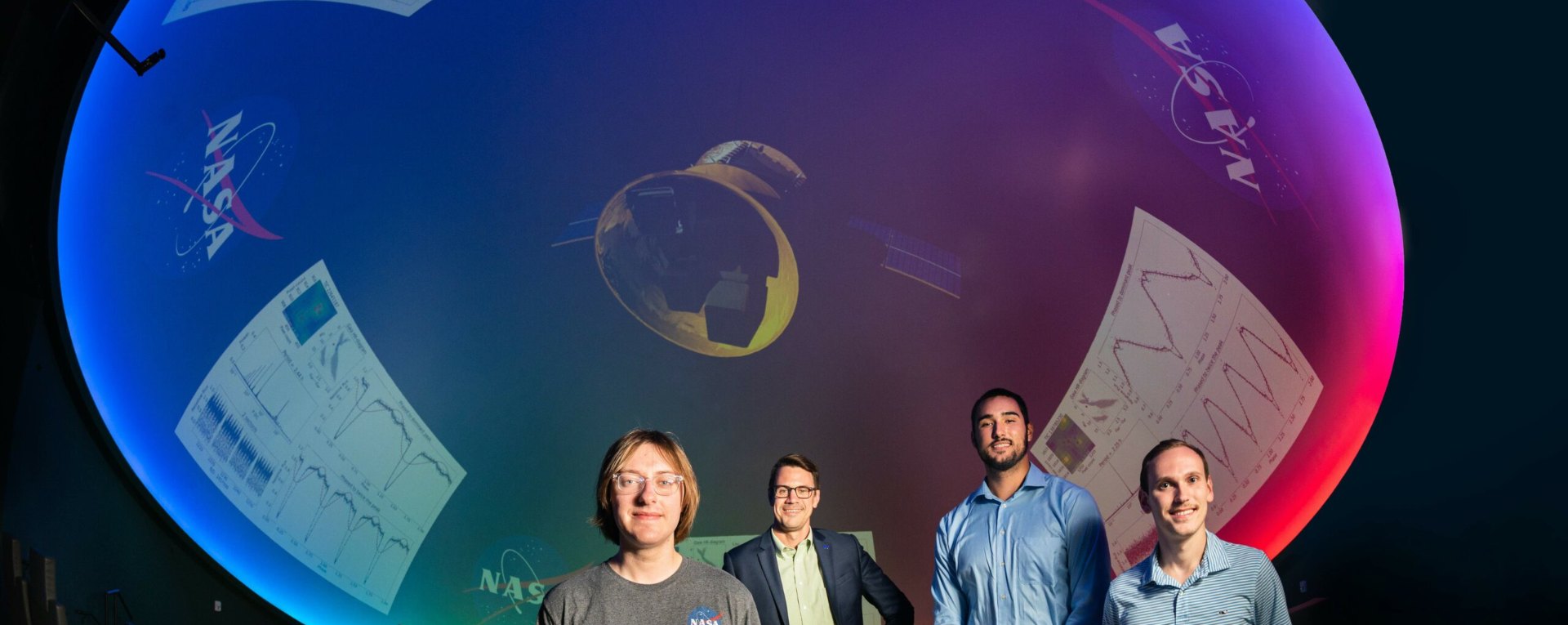
In SuRPS 2026, students modeled dark matter with Dr. Alex Sobotka and worked on particle detectors with Dr. Adam Anthony, whose nuclear physics research involves Argonne National Laboratory and the Facility for Rare Isotope Beams. See all physics faculty research.
Machine Shop, Clean Room and Microscopy
Students build and test in the Physics Machine Shop, a makerspace, the Materials and Microscopy Lab and a clean room.
The Culp Planetarium
The Culp Planetarium’s Spitz SciDome system brings astronomy to life and also displays 3D models of the human body, earth science demonstrations and virtual physics experiments. Planetarium Ambassadors run shows for the public, and the Society of Physics Students leads outreach, service and professional seminars.
Outreach
Students and faculty share science with the community, including programs at the Qubein Children’s Museum that drew about 600 guests in 2026.
What Physics Graduates Say About the Program
Physics alumni point to research projects, conference trips and faculty who know them by name.

Jake Brooks
Ph.D. in Physics, UNC Chapel Hill, now Interim Chair of Physics at HPU
“The most impactful moment I had in my undergraduate career was definitely when I was able to travel to Johnson Space Center and test our team’s device with NASA officials.”
Kevin Sanders
Ph.D. Program in Physics, Boston University
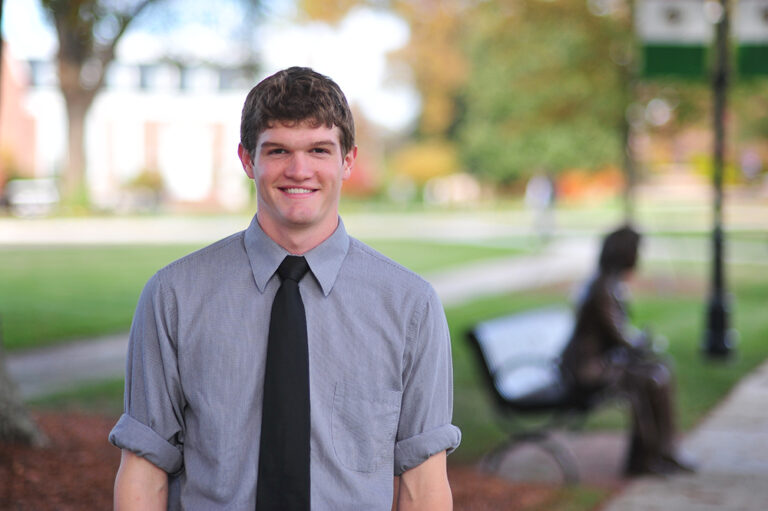
“HPU allowed me to present my own research at national conferences across the country in places like California, Florida, and Louisiana.”

Sarah Nowell
Integrated Product Design, University of Pennsylvania
“I wouldn’t be where I am without incredible mentors. The faculty at HPU is consistently helpful, kind and encouraging.”
Explore Physics at High Point University
See the program’s awards and where HPU physics graduates go next.
Accreditation & Awards Careers & Student Organizations
Questions about the program? Email Dr. Briana Fiser, dean of the Wanek School of Natural Sciences, at [email protected], or Dr. Jacob Brooks, interim chair of physics, at [email protected].