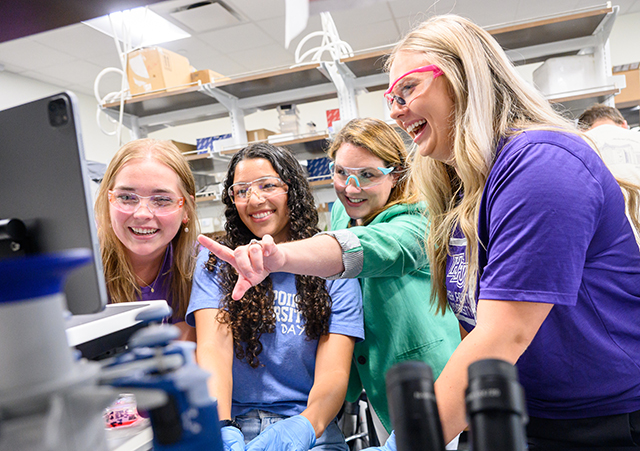
Our collaborative approach allows students to become active contributors to the scientific enterprise while developing the critical thinking, communication, and problem-solving skills essential for long-term success. The result is a culture of discovery where faculty and students work together to generate new knowledge and make meaningful contributions to science.
Selected Publications
HPU faculty are denoted in bold font. HPU Undergraduates are denoted with an asterisk.
Olivia J. Armendarez*, Grace C. Parizek*, Ruth J. Augustine, Evan J. Silver*, Tristan A. Kaz*, Kaylee A. Campbell*, Isabella P. Diaz*, Shobha Mantripragada, Robert D. Geil, Sadie M. Flagg*, Brian H. Augustine, Pamela M. Lundin. “Preparation of poly(3-hexylthiophene) conjugated polymer brush films from amine-terminated surfaces.” Journal of Polymer Science 62, no. 23 (2024): 5384. https://doi.org/10.1002/pol.20240377.
Hallie Balogh*, Amaiya K. Anthony*, Robin Stempel*, Lauren Vossen*, Victoria A. Federico*, Gabriel Z. Valenzano*, Meghan S. Blackledge, and Heather B. Miller. “Novel anti-virulence compounds disrupt exotoxin expression in MRSA.” Microbiology Spectrum 12, no. 12 (2024): e01464-24. https://doi.org/10.1128/spectrum.01464-24.
Kara N. Bensel*, Megan E. Rudock Bowman, and Nicole M. Hughes. “Plant Eating Behavior in Domestic Cats: Support for the Hair Evacuation Hypothesis.” Journal of Veterinary Behavior 82 (2025): 71–74. https://doi.org/10.1016/j.jveb.2025.08.002.
Erin C. Carr, Erin L. Bredeweg, Grace E. Hamilton, Tania Kurbessoian, and Audrewy M. Williams. “Pathogenic potential of polyextremotolerant fungi in a warming world.” PLoS Pathogens 21, no. 4 (2025):e1013102. https://doi.org/10.1371/journal.ppat.1013102.
Susan Carson, Heather B. Miller, D. Scott Witherow, Melissa C. Srougi. Molecular Biology Techniques: A Classroom Laboratory Manual. 5th ed. Burlington, MA: Elsevier Academic Press, 2026.
Whitney L. Coyle, Lauren K. Schefter, Ashley E. Cannaday, Max Griffin, and Eric Rokni. “Comparing classical and empirical end correction models using spatial pressure measurements in flue pipes.” Acta Acustica 9, no. 71 (2025). https://doi.org/10.1051/aacus/2025058.
Richard W. Dudley, Susan J. Lewis, Mariann D. Churchwell, Julie H. Oestreich, and Robert A. Charvat. “Evaluating the compatibility, stability, and antimicrobial effectiveness of vancomycin and cefepime admixtures in peritoneal dialysis solutions.” Scientific Reports (2026). https://doi.org/10.1038/s41598-026-53865-x.
I.M. Harca, M.J. Basson, K.J. Cook, K.W. Brown, S.A. Gillespie, A.K. Anthony, N.E. Esker, and S.N. Paneru. “The FABLE Silicon Detector Array for Comprehensive Studies of Fusion and Breakup Dynamics.” Nuclear Instruments and Methods in Physics Research Section A: Accelerators, Spectrometers, Detectors and Associated Equipment 1077 (2025): 170527. https://doi.org/10.1016/j.nima.2025.170527.
Billy L. Hayden*, Owen Kelley*, Keith Zientek, Ashok P. Reddy, Phillip A. Wilmarth, Rachel Munds, Michael J. Montague, Melween I. Martinez, Gadi Wollstein, James P. Higham, Arturo O. Barron Arrambide, John Danias, Amanda D. Melin, Larry L. David, and Jeremy A. Whitson. “Proteomic Characterization of the Rhesus Macaque Lens Nucleus: Similarity to Human Lens, Age Effects on Protein Solubility, and Trends in Post-Translational Modifications.” Investigative Ophthalmology & Visual Science 66, no. 12 (2025): 28. https://doi.org/10.1167/iovs.66.12.28.
Luis Manuel Salgueiro-Tosta, Arumugam Radhakrishnan Jayakumar, William Kochen, Renzhi Cai, Wei Sha, Erik Johnson, James O’Callaghan, Miklós Jászberényi, Andrew Victor Schally, and Nancy Klimas. “Evaluation of the Therapeutic Potential of Synthetic Growth Hormone-Releasing Hormone Antagonist MIA-690 as a Cognitive Modulator in a Mouse Model of Gulf War Illness.” International Journal of Molecular Sciences 26, no. 17 (2025): 8516. https://doi.org/10.3390/ijms26178516.
Christopher R. Travis, Katherine I. Albanese, Hanne C. Henriksen, Kelsey M. Kean, and Marcey L. Waters. “Evaluation of Cooperative Binding of Histone Post-Translational Modifications and the Surrounding Sequence by Trimethyllysine Reader Proteins.” Biochemistry 64, no. 21 (2025): 4367–73. https://doi.org/10.1021/acs.biochem.5c00532.
Tyler Wheeler, S. Ravishankar, C. Wrede, A. Andalib, A. Anthony, Y. Ayyad, B. Jain, A. Jaros, R. Mahajan, L. Schaedig, A. Adams, S. Ahn, J. M. Allmond, D. Bardayan, D. Bazin, K. Bosmpotinis, T. Budner, S. R. Carmichael, S. M. Cha, A. Chen, K. A. Chipps, L. E. Weghorn.” Nuclear Instruments and Methods in Physics Research Section A: Accelerators, Spectrometers, Detectors and Associated Equipment 1080 (2025): 170659. https://doi.org/10.1016/j.nima.2025.170659.
Joseph M. Wieske, Adam K. Anthony, William G. Lynch, Curtis Hunt, ManYee Betty Tsang, Y. Ayyad, Daniel Bazin, S. Beceiro-Novo, Kyle Brown, Zbigniew Chajecki, J. Chen, K. J. Cook, B. Kendziorski, C. Sumithrarachchi, F. C. E. Teh, C. Y. Tsang, R. S. Wang, and A. H. Wuosmaa. “Correcting Beam Space Charge Effects in Active-Target Time Projection Chamber.” Nuclear Instruments and Methods in Physics Research Section A: Accelerators, Spectrometers, Detectors and Associated Equipment 1078 (2025): 170563. https://doi.org/10.1016/j.nima.2025.170563.
Faculty Grants & Awards
Drs. Meghan Blackledge and Heather Miller, associate professors of chemistry, received High Point University’s first patent. “Small-molecule adjuvants for antibiotics to address antibiotic resistance” describes the discovery that Loratadine, Claritin’s active ingredient, acts as an antibiotic adjuvant, making some antibiotics more effective.
Dr. Jacob Brooks, Dr. Briana Fiser, Dr. Sean Johnson (Electrical Engineering at HPU), Dr. Pamela Lundin, and Dr. Brian Augustine (Furman University) received a nearly $150,000 Major Research Instrumentation grant from the National Science Foundation for a direct write maskless photolithography tool for use in the fabrication of microstructures as small as 0.6 microns.
Dr. Jacob Brooks, interim chair and assistant professor of physics, and Dr. Grace Hamilton, assistant professor of chemistry, were selected as Think B.I.G. recipients for the 2026-2027 academic year. Their proposal, “Innovative Assessment Techniques: Scaling Mastery Grading for Gateway STEM Courses to Improve Student Learning and Retention,” will fund a pilot study to employ mastery grading in introductory chemistry, physics, and calculus courses.
Dr. Kelsey Kean, assistant professor of chemistry, is the first HPU faculty member to receive the Jean Dreyfus Lectureship Award and one of eight faculty to receive it nationally in 2025. The $25,000 award provides funding to facilitate a visit by a science leader to campus for presentations about their work and support two summer undergraduate research students.
Dr. Grace Hamilton, assistant professor of chemistry, received a $34,520 grant from the North Carolina Biotechnology Center for “Identification and Validation of Eukaryotic Extremotolerance Genes for Space Synthetic Biology.” Her research investigates polyextremotolerant fungi, which can survive the conditions in space, and her grant provides funds for two summer undergraduate research students.
Dr. Pamela Lundin, associate professor of chemistry, and Dr. Amy MacArthur, assistant professor of religion and philosophy, received funding from the Educating Character Initiative at the Program for Leadership and Character at Wake Forest University. Their proposal will support the assessment of ethics within HPU’s Honors Scholar Program and support character education within the co-curriculum.
Dr. Ken McKenna, assistant professor of biology, was awarded a grant to attend a New Faculty Boot Camp organized by the Society for Developmental Biology. He was also awarded the Presidential Membership Award from the Genetics Society of America. This award provides discounted membership and access to networking opportunities.
Dr. Heather Miller, associate professor chemistry, received High Point University’s Ruth Ridenhour Scholarly and Professional Achievement Award. This award recognizes her exceptional contributions to her professional discipline, which include the scholarship of teaching and learning and biochemistry.
Dr. Heather Miller received the Academic Development Excellence Award from the North Carolina Biotechnology Center at Triad BioNight 2026. She was recognized for her mentorship of students, innovative course design, and integration of real-world research techniques into her courses to prepare students for careers in biotechnology fields.
Dr. Heather Miller, Dr. Meghan Blackledge, and Dr. Kelsey Kean received renewed funding through the National Institutes of Health Academic Research Enhancement Award program for their research, “Extending carbazoles as chemical probes from Staphylococci to Acinetobacters.” The three-year, $558,310 award will support innovative research on antibiotic resistance while providing meaningful research opportunities for undergraduate students.
Dr. Josef Stiegler, assistant professor of biology, and collaborators were awarded research time at the European Synchrotron Radiation Facility in Grenoble, France, where they used one of the world’s most powerful X-ray imaging systems to study the skulls of small dinosaurs. His research explores how these dinosaurs evolved and adapted to their environments during the early stages of dinosaur history.
Student Grants & Awards
Jake Ankrum (class of 2028) received a 2026 Barry Goldwater Scholarship, one of the most prestigious awards available for an undergraduate student who plans to pursue a research career in the natural sciences, mathematics, or engineering. Jake is a biochemistry and physics major mentored in research by Dr. Keir Fogarty, and was one of 454 students to receive the scholarship out of more than 5,000 applicants nationwide. He also received the prestigious DAAD Research Internship in Science and Engineering scholarship in Germany. He was one of 350 recipients out of more than 3,100 applicants from across the U.S., Canada, Great Britain, and Ireland. This scholarship provided the opportunity to conduct summer research at the European Molecular Biology Laboratory in Heidelberg, Germany.
Chemistry graduate Sadie Flagg (class of 2024) received a 2023 Barry Goldwater Scholarship. Sadie was one of 413 recipients of the scholarship, out of 1267 applications nationwide. She is now studying materials science at the Georgia Institute of Technology, and she recently received a National Defense Science and Engineering Graduate Fellowship, a competitive 3-year fellowship.
Isabella Frankovic (neuroscience major, class of 2028) received the gold medal for best Data Blitz presentation at the Society for Sports Neuroscience Conference in Fort Lauderdale, FL, in February 2026. Her research investigates traumatic brain injury in rats, and she is working with Dr. Bill Kochen.
Taylor Galavotti, class of 2025 neuroscience and English double major, received a Fulbright Scholarship in 2025 for an English Teaching Assistantship in Timor-Leste. She is currently in Timor-Leste teaching English at Universidade Nacional Timor Lorosa’e.
Jordan Havert and Tyler Janick, biology majors graduating in 2028 working with Dr. Grace Hamilton, received the Undergraduate Poster Award at the 33rd Fungal Genetics Conference for a poster entitled “Natural products from aquatic fungi as novel treatments for neurodegenerative disease.” The conference occurred in Pacific Grove, CA, in March 2026.
Biology majors Rebekah Olls (class of 2026) and Jack Schoultz (class of 2028), won the award for best undergraduate oral presentation at the South Carolina Entomological Society 71st Annual Meeting in Clemson, SC, this past October. Their work was done under the mentorship of Dr. Daniel Greene, and their presentation was titled, “The Effect of Microclimate, Land Cover, and Trap Height on the Oviposition Activity of Container-Breeding Mosquitoes”.
Robin Stempel, a biochemistry major who graduated in 2024, was named a 2024 Rhodes Scholar Finalist. Rhodes Scholarships are highly prestigious scholarships that provide the opportunity for post-graduate study at Oxford University. Robin is currently pursuing her Ph.D. at the Engineering Biology Center for Doctoral Training at the University of Bristol in the United Kingdom.
Biology major Anna Venditti (class of 2028, mentored by Dr. Sarmad Hindo) and biochemistry and physics major Jake Ankrum (class of 2028, mentored by Dr. Keir Fogarty) received George Barthalmus Undergraduate Research Awards through the State of North Carolina Undergraduate Research and Creativity Symposium. These awards support undergraduate research endeavors up to $500.
Lexie Young (Chemistry, class of 2025) was the first HPU student to be named a Department of Defense SMART Scholarship award winner. After graduation she went on to join the Department of Defense as a chemist in Picatinny Arsenal, New Jersey.